
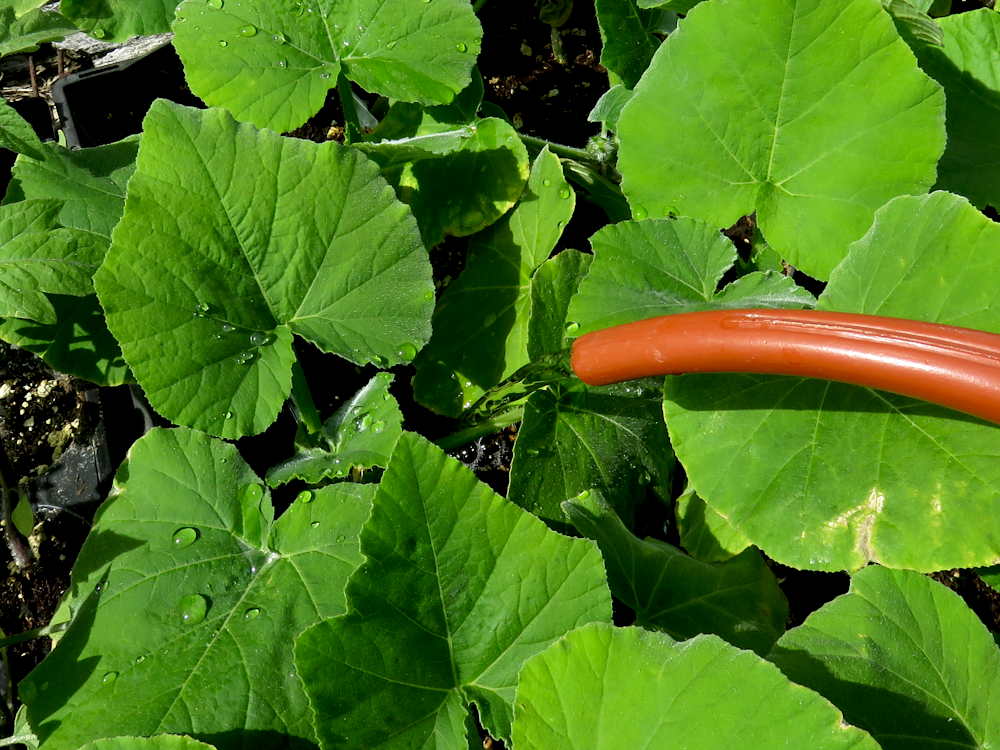
The seedlings are filling out fast now, with full days in the sun. Feels like they’re raring to break out! Stuck in their little pots, they could be being called to by their siblings already transplanted out in the field. Who knows?! One thing for sure is how fast they’re soaking up water now. Of course, it makes sense, it’s no surprise—but the little routine meter in my head sees that a good watering lasted a couple of days just a week ago, and now, especially in the tiny plug sheet cells, the surface is dry in hours and the trays feel light. There’s the sun and the wind to help evaporation, but still—thirstier and thirstier as they wait for the field!
watering
Gushing is good!
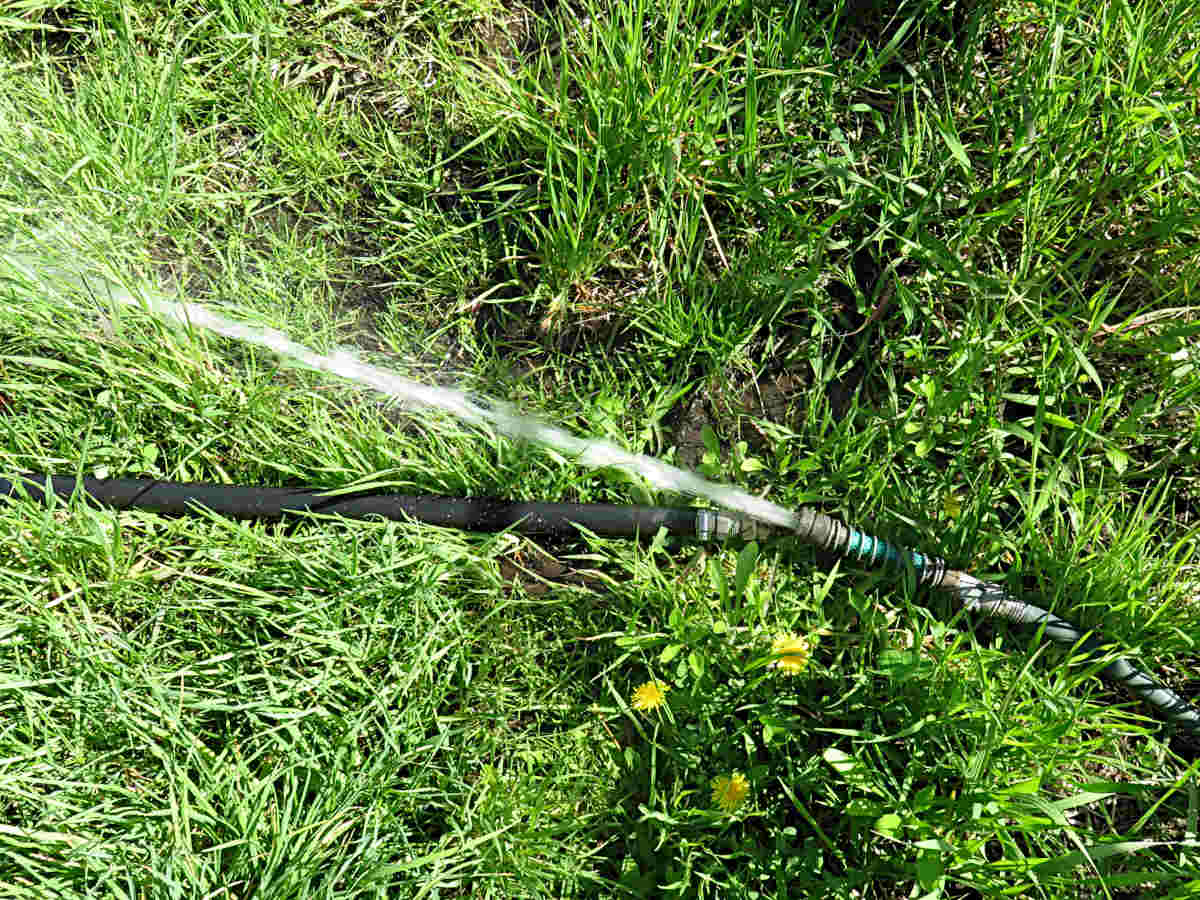
A gushing water hose—nothing more normal and mundane wherever electricity for pressurized pumping, and of course WATER, are in plentiful supply. This tiny farm is in such a place, yet the gushing hose signals something much happier, an elevated event, because it’s proof positive that the dug well that irrigates the field is back in action once again after another frozen winter.
Priming the pump is usually a mid-May thing, when freezing is over. The operation is simple enough: slowly pour a couple of gallons of water into the pump so it backfills the pipe that goes into the well, turn on the pump, and wait for it to catch. It may take two or three top-ups and retries. When water gushes, the pump is primed for the season! It’s not foolproof, though, the pipe could’ve gotten hopeless clogged, or the well-used and dilapidated pump and tank could decide to give up a seal or conk out entirely. Then the simple would likely become costly repairs or replacement. But not this time!
Details! If the irrigation fittings look small, they are indeed. I’ve seen photos of irrigation set-ups on big farms that are full scale waterworks, orderly grids of giant pipes. Here, the setup is a 1″ plastic pipe that snakes above-ground out into the field—it’s the disconnected part on the left. The pipe can be this small because it’s only meant for low-pressure drip irrigation, hand watering by hose, or a few sprinklers at a time: not every day, all crops, all the time. Also, a dug well like the one here doesn’t have an endless water supply, you don’t want to get ahead of its reservoir size and replenishment rate. Finally, the longer the pipe, the lower the pressure the closer you get to the end. Here there’s about 400′ of it, and you can notice the pressure difference at each of the taps spaced along it. It’s not geared to intense large-scale production, instead, a low cost way to connect a fairly distant water source to a thirsty veggie plot when there’s the need!
Best lettuce!

Just watered heads of Mezquite lettuce, doing well given all the heat they’ve had to deal with over the last weeks. This is a great, fast-maturing romaine lettuce. It’s sweet and crunchy, even in full summer heat that makes most lettuces strong flavored, with a slightly bitter edge.
I grew up with mild lettuce, the standard supermarket fare that’s sourced from wherever the crop grows most abundantly. Here in the mixed veg world of the tiny market garden, no crop can expect its own perfect conditions. That doesn’t mean inferior vegetables, instead, you get a full range of tastes. Grown in summer heat, lettuce often develops a full-bodied flavor and a pleasing hint of bitterness—with a little oil and vinegar, salt and pepper, or in a sandwich, it’s a whole new, elevated taste bud experience!
Anyhow, this Mezquite variety combines full flavor with sweetness, holds up well in all conditions, matures a week or two faster than most other romaines, and is even open-pollinated so you can save the seed. As long as a roving critter doesn’t breach the defenses, like the row cover these guys spend much of their time under, they’re a treat in the making! I harvested a couple today for early tasting purposes…
Hauling water
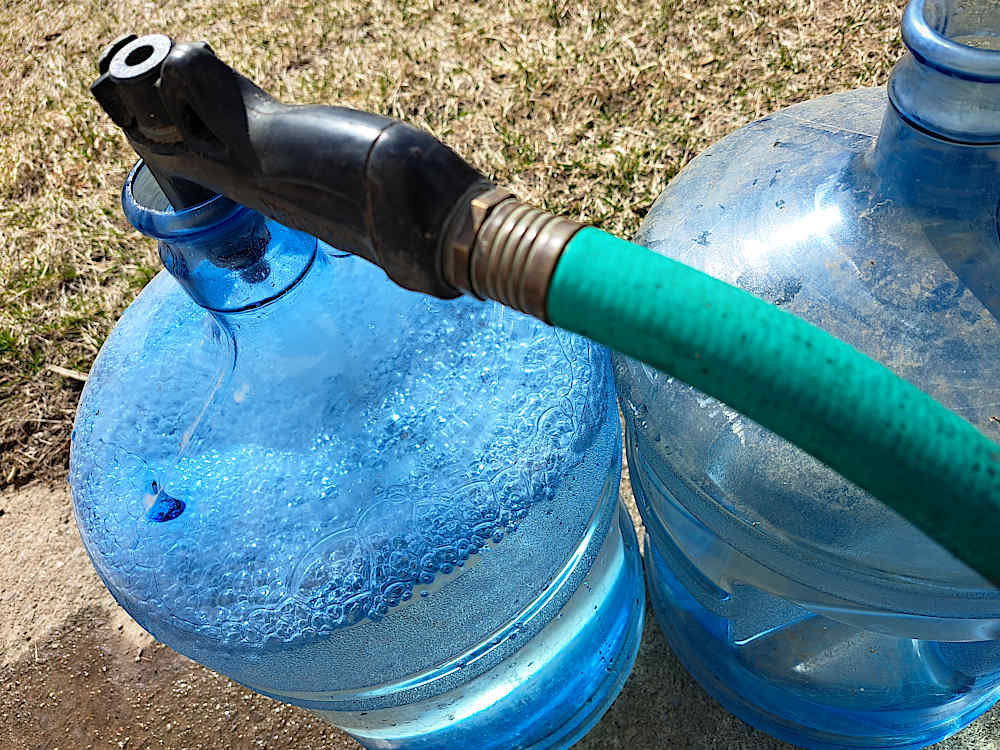
The seedling room is in a fully modern building with all the modern conveniences like electricity, heating, ample insulation and screened windows well-positioned for a bug-free cross-breeze and lots of natural light. The only thing missing is a handy supply of running water. Drilling for a new well located nearby ended in failure after a couple days of exploration produced only an expensive dry hole. So, until the gutter-fed rain barrels are turned over in warmer weather—overnight freezing of collected rainwater could crack them—I bring over water for the seedlings in 18 liter jugs filled from another well in a building not too far away. Simple systems and the rituals of spring!
The indispensably cheap sprinkler
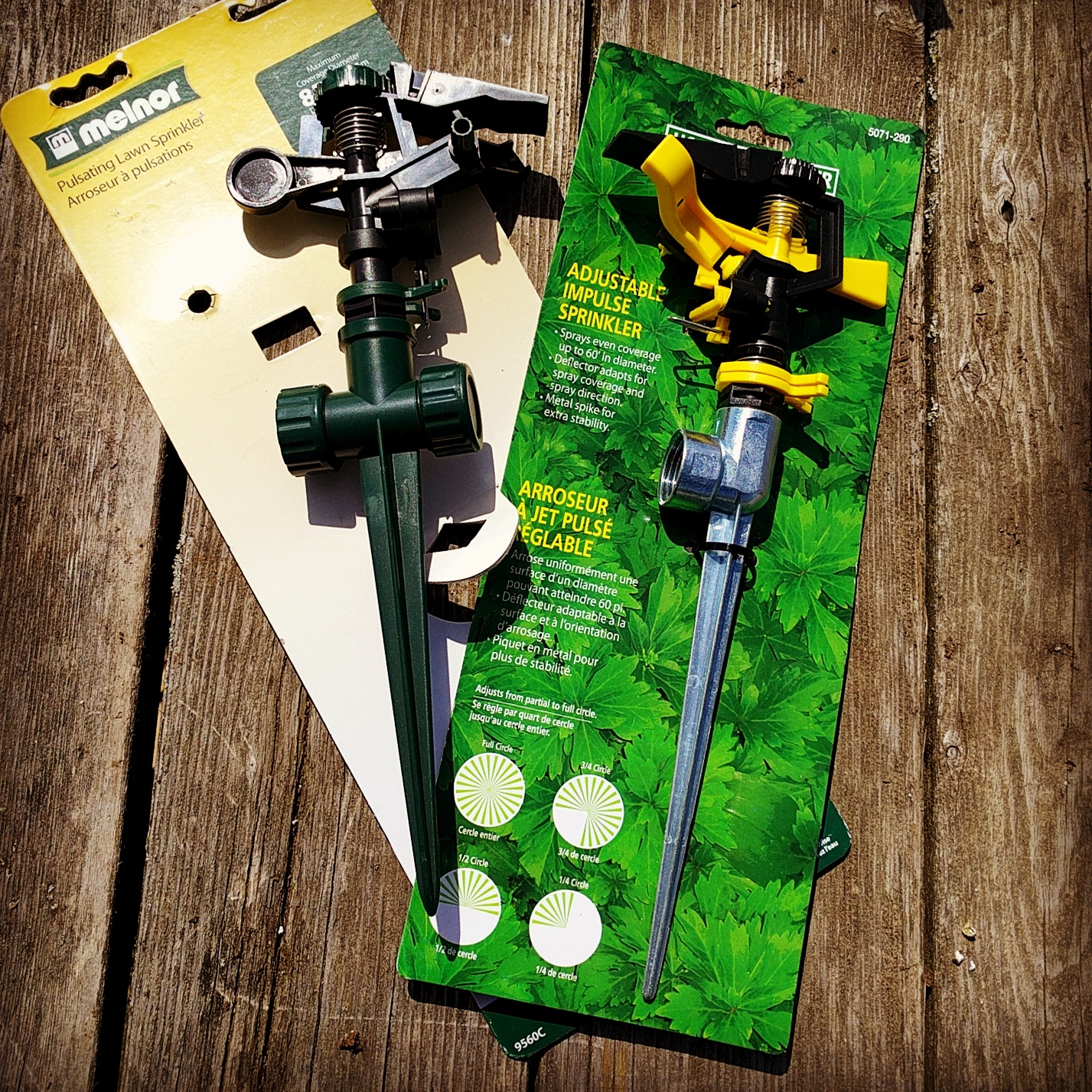
Cheap! To truly appreciate tiny farming, you have to embrace the humble tools that make it all possible, like these cheap ($6) plastic lawn sprinklers that work with the well pump’s low pressure (maybe 20% of normal urban tap psi), where better quality models are too well-built (heavy) to move. On the hunt for more replacements, I picked up a couple of versions at a second stop, after a failed attempt in the sprawling garden center of a giant hardware store, where they’d stopped carrying the cheap stuff. Overhead irrigation is inefficient at any scale, what with evaporation and water being blown off target, but at this small scale, it’s still an effective time-saver for watering in newly seeded beds…
Water from the barrel
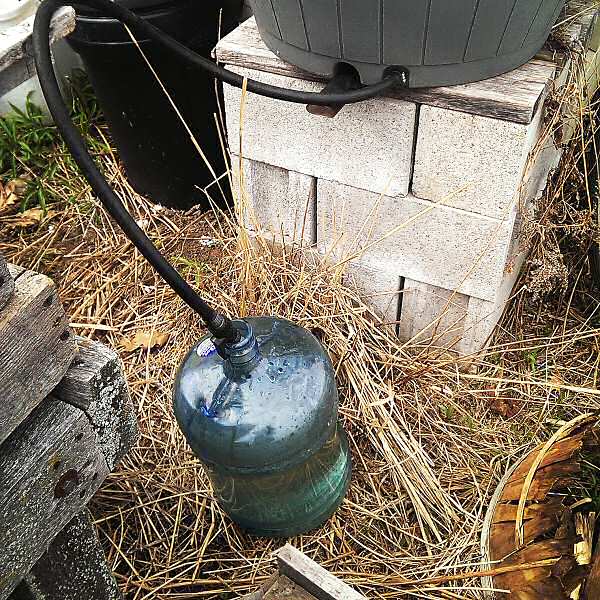
Rainwater upgrade: We only turned over this rain barrel yesterday, set bottom up for winter to keep empty in order to avoid frozen water expansion cracking the plastic, and it rained overnight. A little rain, a fair-sized collection area (roof with eavestrough), the law of gravity, and presto, the first seedling water of the season from just outside the door, a lot handier than having to haul it over in 50 lb jugs from the well pump in the barn, a bit of a hike away. Modern conveniences!
Saved by the barrel
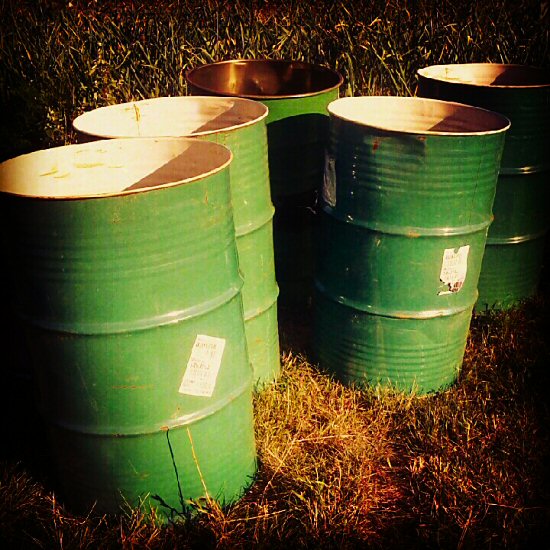
No luck with the dug well—at this point, the standing level has dropped around 10 ft. since spring, and the replenish rate is barely a foot in 24 hours—so it’s on to other water sources and delivery methods. As with most things on this tiny farm, the ultimate fallback tends to be something really labor-intensive. (Hahahahaha. I have to laugh.) In this case: WATER BARRELS. In a thankfully typical seek-and-ye-shall-find situation, there is a supplier of used barrels just down the road. Who’d have thought! These are standard 55 gallon, available in steel or plastic, and only about $10 a pop, with optional lids for a couple bucks more. Of course, they’re food-grade, which means, coated on the inside and used only for food, with those weathered white labels telling the story: pickles, perhaps. Strategically located around newly seeded beds, the barrels are filled from the house well (via the former dead well pipe) and then, 2-gallon watering cans do the final job. We still need rain as things grow, but this will work for germination and seedlings. Whatever it takes!