
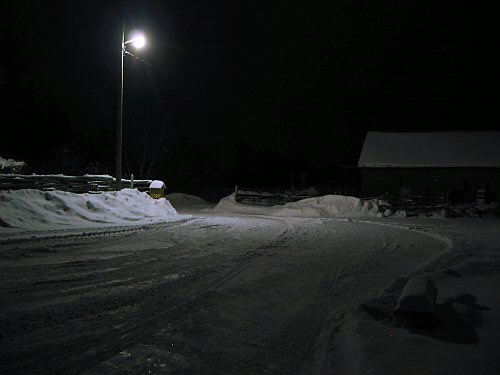
Here’s what I see coming out from the Milkhouse at night, as I head to the house. Facing is the goat barn, with the big old barn out of frame to the right, the farmhouse off to the left behind the rail fence, and the curve turning into the on-farm lane that meets the road. (I borrowed a tripod to check out photos by available light. It’s cool, way more picture possibilities. I’ve been using it for a couple of weeks, avoiding the annoying flash.) The light from the street light-type lamp pools brightly right below and fades across the yard. (Without that lamp, it would be pretty near pitch black around here unless the moon was out.) The scene seems sometimes picturesque, sometimes a little ominous, that desolate, deserted parking lot look…but it’s only the Farm. As far as anyone remembers, the lamp fixture was rented 20 years ago from the provincial hydro company, they still come around every few years in a huge truck with a cherry picker to change the bulb, or tube or whatever it is up there. I could call and find out the details, but at the moment, they’re not important…
night
Field at night
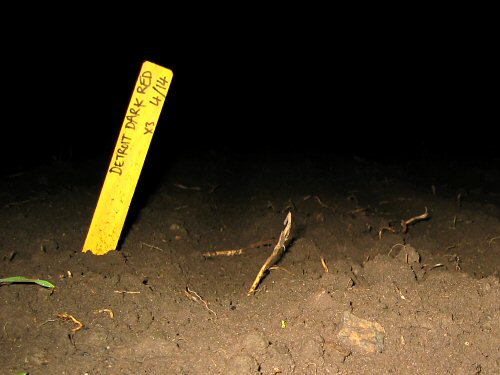
Nights are warming up now, so it looks like I won’t be cruising through the near pitch black field much longer, checking temperature in the greenhouse. There’s not much to see or do out there after dark.
Floating row cover!
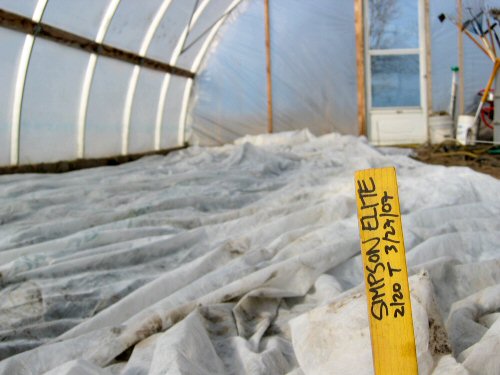
It’s around 8:30 in the morning and I’m about to uncover the early lettuce. Floating row cover is a very lightweight spunbonded polyester, light enough not to crush seedlings when laid down directly on top. It lets in water and sunlight, and also retains heat, to differing degrees depending on weight. This one is medium weight, my all-purpose cover. It transmits 85% of sunlight and keeps the temperature 3-4°F warmer when the surrounding air is around zero. Over the last couple of nights, the greenhouse low was 19°F (-7°C)—the lettuce can take a little freezing, and would probably manage without cover. Still, every edge helps, and this one’s easy. Floating row cover is a common sight around here throughout the year, it’s my main organic alternative to pesticides (it keeps out certain flying insects on certain crops at certain critical times) and also gives you an edge in getting things out early and keeping them out late. Beat that frost!
Grow racks at night
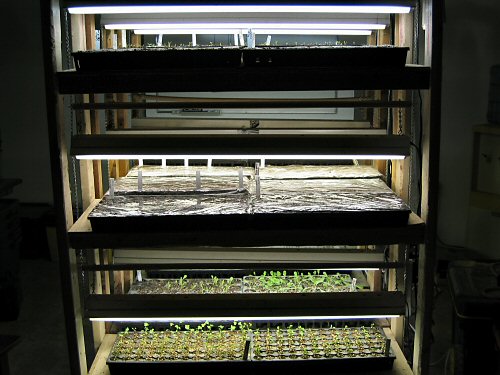
Plant racks, light stands…I usually call ’em grow racks. They’re filling up now.
Pushed to capacity, the three racks can hold a total of 36 trays, 12 each, or four trays per shelf. So, depending on the size of the plug sheet—I use 38s, 72s, 128s, 200s—I can start between 1,368 and 7,200 seedlings.
Sounds super-efficient. HOWEVER, it comes down to the light. With four trays per double fluorescent fixture, the light is pretty stretched, and a lot of rotating is in order.
Also, most of the fixtures are the old standard T-12 type, where the light is stronger towards the middle of the tube. You can clearly see the difference in growth if you leave trays in the same position for a few days. The newer T-8 type lights more evenly from end to end and uses less power, but I don’t feel like replacing all the fixtures (a couple in there are already T-8).
It’s an ongoing experiment to see which size plug sheet to best start in for each crop, given the light situation. That in turn determines if or how often I need to pot up to larger quarters before it’s time to transplant into the field.
All in all, I’ll get around 2,500 seedlings off the racks this year.