Tree in the wind

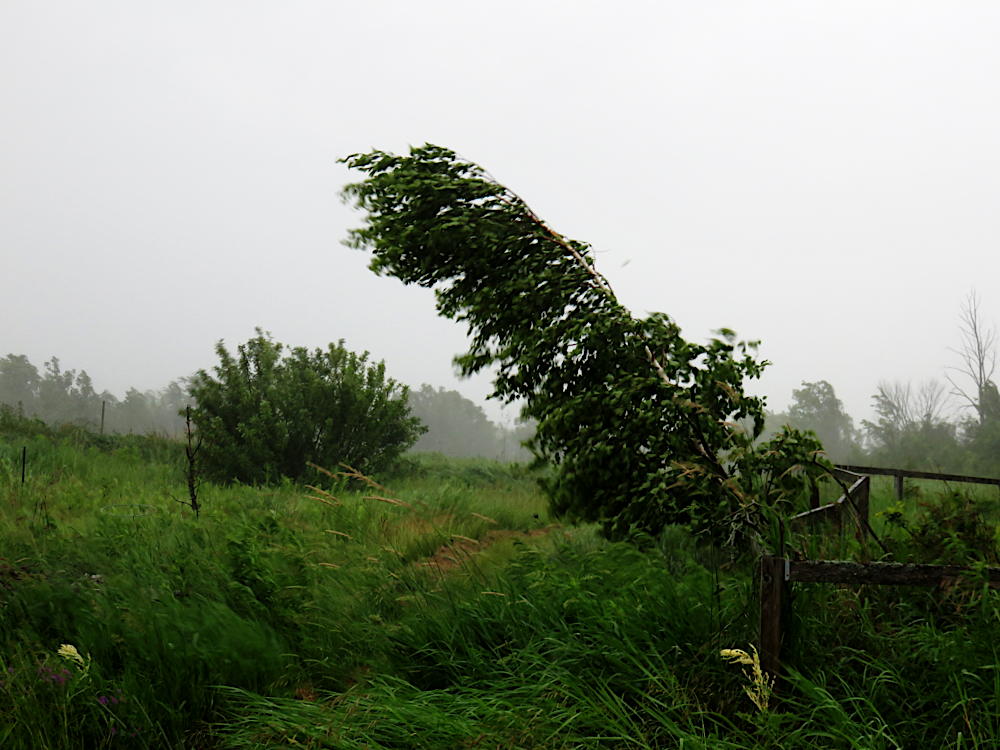
Tree bending in heavy pre-thunderstorm wind

It’s Day 2 of our little heat wave, and apparently time for the daily thunderstorm. This is the second one, same pattern. Heavy wind and darkness roll in for a while, shaking things up and looking ominous. Then rain, building up, pounding down for a few minutes, easing off again, then it’s gone. The whole thing happens in half an hour or so.

The whole thing is a little alarming, especially the wind, mainly because you don’t want the power to go out. But it’s not the storm itself, it’s these short periods and odd combinations of weather that there’s no settling into—a week or a month of one thing, then a quick switch to another. Like now, where after the storm, the air feels cool and fresh for a bit, then it’s back to oppressively heavy, humid heat wave heat.

Weather has become a regular news event, even around here where we haven’t had the extremes I read about. No months long drought with temps above a 100F (35C). No atmospheric rivers dumping massive floods. No wildfires that black out the sun at noon and cause their own local weather systems. No asphalt cracking in the street. No frying eggs on the sidewalk. Just this heat/storm combo for now. I’ll take it!
Wind and more wind

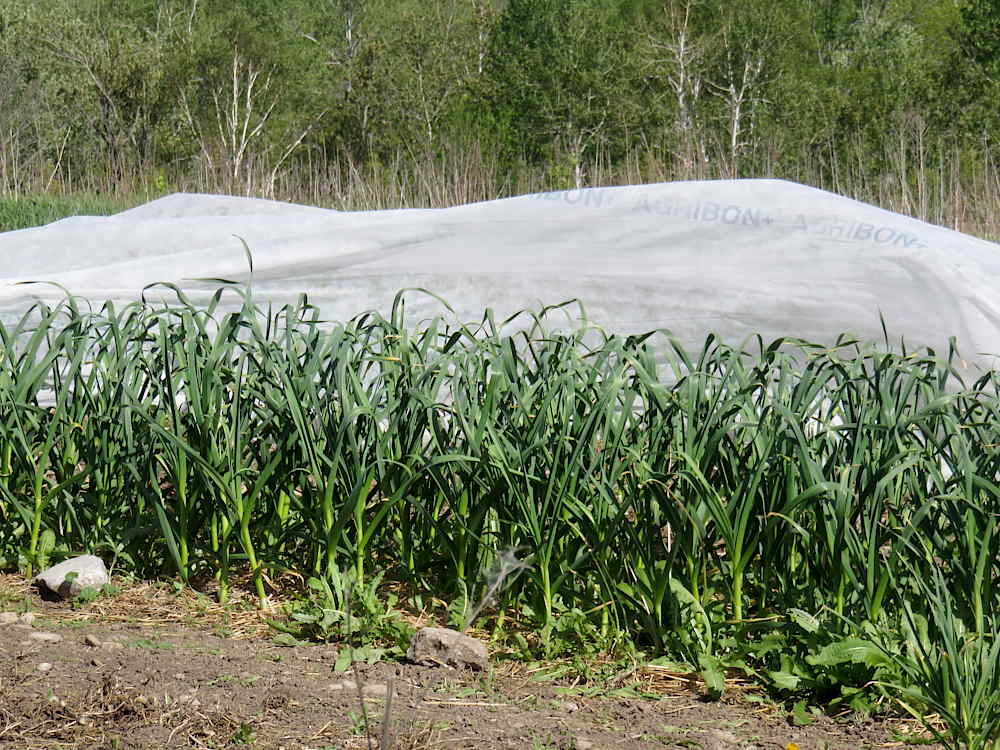
Row cover blown off the garlic

At this point, end of month, I’d have to say WIND has been the weather theme of this May. Practically every day. Gusty enough to sometimes threaten the more delicate seedlings, and to put off ladder work on the big greenhouse. Here, the wind has blown off the garlic’s row cover. Not a problem as far as protection from the nocturnal leek moth horde that may be lurking, but more work to put back. Complicating this little matter, the garlic is growing up and straining at the cover, gradually pulling it out from being fully weighted by the rocks. Since the cover should stay on through June, that will have to be solved. Stay tuned!

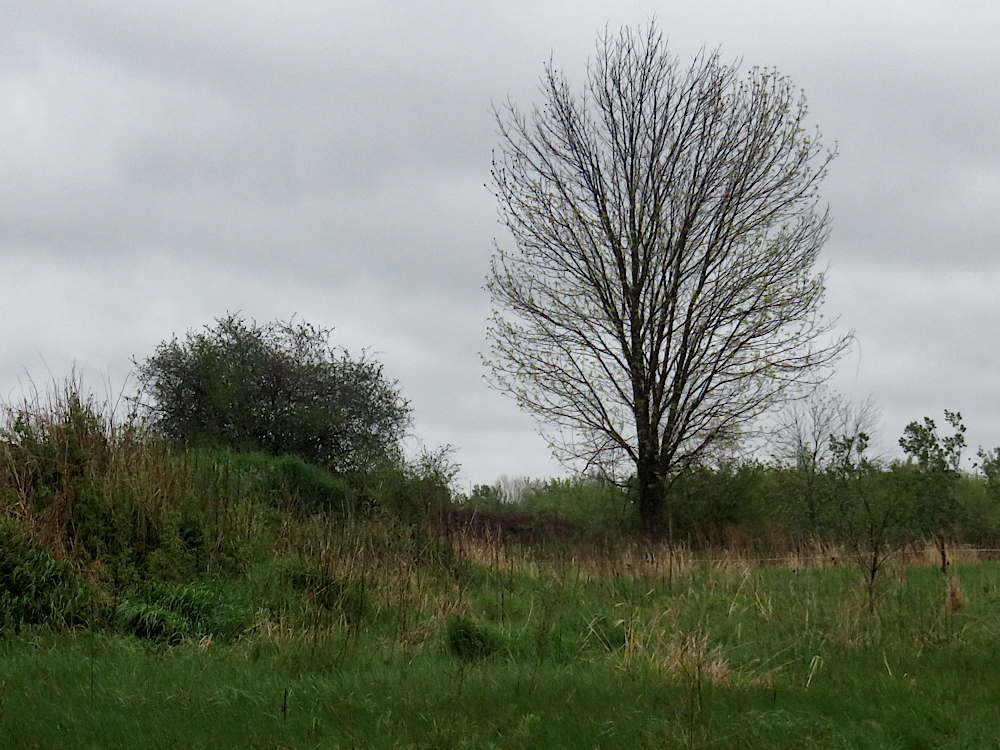
The tree at the end of the field

The sun’s almost set but the howling wind and bursts of heavy rain aren’t slowing down. It’s pretty wild out there, with ankle-deep marshy wet patches hidden in the grass. Stepped out for a last look around, and the tree at the end of the field caught my eye as it usually does. It stands in the middle of a large pasture, far from the woods, at the point where the main veggie beds end. It seems quite independent, holding back on the leaves when the other trees are already green, exactly the same shape year round, with leaves or without. Lots of big trees, sheltered in the surrounding forest, were snapped like twigs in the big wind and ice storms of the last four-five years, but this guy remains unbothered. I’m glad because it’s a central part of the tiny farming scenery here these last many years. Would be sad to see it snapped!

Carrot-burlap method gets a twist

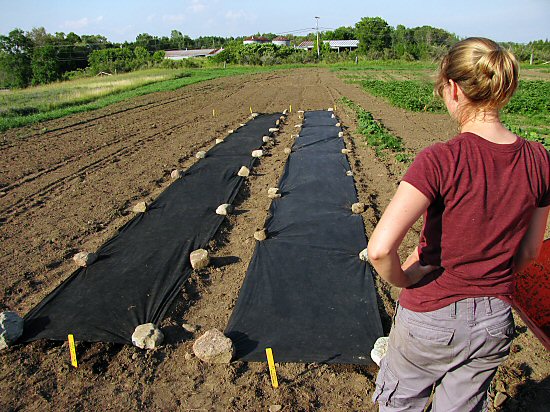
Here’s one of the more extreme displays of crazily labor-intensive tiny farming technique. Andie surveys our work, the result of deciding to try landscape fabric in place of burlap to help carrot seed germination. It’s actually a double experiment, because one of the beds is green onions.

The burlap method has been the way to start carrots around here for the last two seasons: tried and true. The main purpose is to preserve moisture in the seed drills, and the increase in heat helps as well.

After a good run, the first round of burlap expired, and I couldn’t find rolls of it in time for this season (I know it’s out there, somewhere). But, I spotted this gear, landscape fabric, a porous plastic mulch used to permanently suppress weeds in…landscaping. It’s light, and just wide enough (3’/30 cm) to cover 4 rows of carrots (that’s a little closer than usual for the bunching onions). I tried it on two beds earlier in the season, and it works fine!

One little problem: it tears easily, so how to hold it down? With the burlap, we made wire staples out of heavy gauge wire. Here, we placed a LOT of heavy rocks, close enough together that there’s no room for the wind to get under and start really pulling. This does the trick for now, but overall, it’s a little TOO intense. The hunt for burlap: still on!

50 feet!

Measuring and staking garden sections

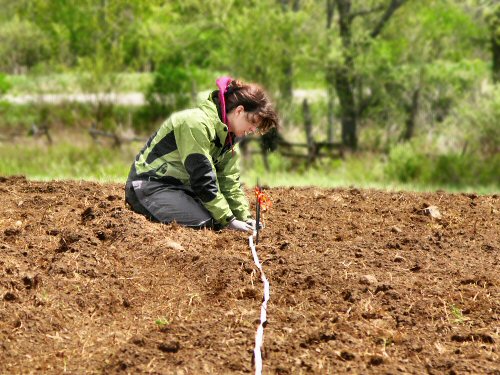
Nice sun, but kinda cool and definitely windy. Michelle came by for a day of mostly organizing and arranging: managing seedlings, and measuring and staking out garden sections (now, according to the new garden map). We’re once again using 50′ (15.2m) squares as the basic garden unit. The 100′ (30.5m) reel-up vinyl measuring tape is the handiest tool for this, as we walk up and down and around, a person on each end of the tape, calling out measurements and planting fluorescent-flagged stakes… There’s a satisfying sense of order when a freshly tilled section is staked out. All those neat squares tell you, you are master of your garden, and things are well under control! :)

Weird weather day

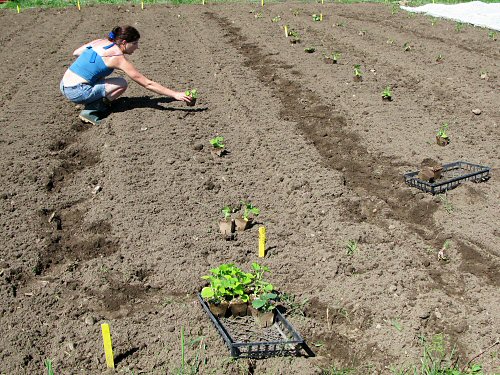
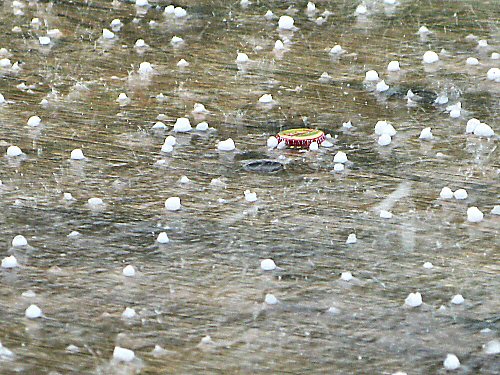
This was one of the strangest single days for weather that I can remember. Transplanting more squash in the morning—Michelle is checking out working on the farm one day a week—it was beautifully sunny, with a nice breeze. Around mid-morning, suddenly, it shifted to humid and sticky. I headed in to change into shorts, but before I’d even walked out of the field, the humidity started fading again, so I didn’t bother. A bit later, covering the squash with row cover, a nice breeze from the north, enough to easily float the cover, casually shifted 180°, coming from the south, in the 20 minutes it took to lay down the cover and unfurl the next. Early afternoon, the wind picked up, and within half an hour what had been a largely clear sky had totally clouded over, then, pounding rain and HAIL (not too big, only some leaves got battered, no smashed plants, you can used the bottlecap below for scale). Then back to calm and clear for a couple of hours. Then heavy clouds again, and a massive wind storm that tore some branches off of trees. Then back to…sunny. As extreme as this day’s been, two or three quite drastic changes in a single day have been happening quite a lot recently. This is our new weather…?

Tangling with hoses

Sorting out hoses

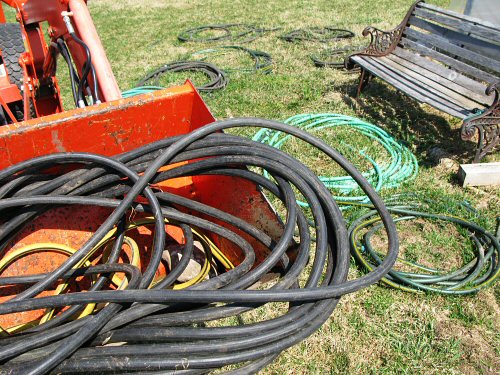
In smaller gardens (tinier farms!), hoses are generally a fact of life. In spring, it’s time to uncoil them all, check the fittings, and get set to deliver water largely by hand.

On BIG veggie farms, “hoses” are usually big pipes (3″/7.5cm and up), part of full-blown irrigation systems that suck up and spew MILLIONS of liters of water a season. Here on this tiny farm, we’re way closer to the garden hose end of the scale.

Our irrigation system is a work in progress. Drip tape is the ultimate goal, but there are obstacles to work around, like the limited water available from the barn well, and the distance to and lack of electricity at the spring-fed pond. Right now, watering is about regular 5/8″ hoses, fed by a 1″ plastic pipe that runs from the barn well to the pond located WAY at the other end of the field, with taps at 100′ intervals.

Actual watering is done with a combination of soaker hoses, sprinklers when there’s no wind, and various hand nozzles for watering in newly seeded beds. Quick connectors are a major convenience when hooking up the various combos of multiple hoses and other attachments. I try to find a balance between not too many hoses, because you can’t leave them lying around, and not so few that you’re moving the same rig all over the plot.

Accidentally tilling hoses that were left snaking around instead of being promptly put away has turned into a not absolutely rare occurrence, and a time-waster (untangling and splicing takes more than a minute). Just put away that 300′ of hose plus 500′ of soaker hose when you’re done! ;)

Spot irrigation with hoses on two acres is a bit tedious, but like everything else, you do get used to it, it’s part of the routine, and it gets the job done, which is satisfying in the end…

That’s the state of the watering art around here as we head into a new season, and I’m promising myself advances on the drip side of things. Of course, it could happen to rain all the time, about an inch (2.5cm) once a week would be fine, and then hoses would largely vanish from the garden landscape. That’s not at all that likely (and when it’s a really rainy year, you wish for hot, sunny hose weather), but…YOU NEVER KNOW!