
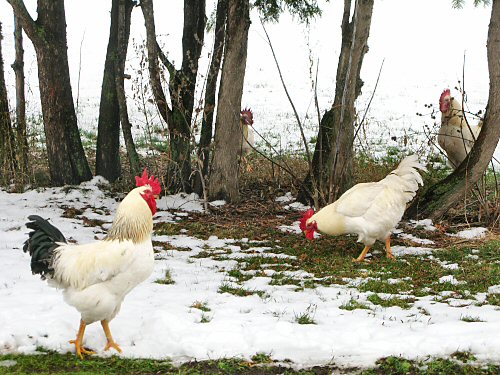
These chickens like snow! The eight remaining roosters have been out and about in some fairly wild weather, making their way through 6″ (15cm) blankets of snow, gusting winds and absolutely freezing cold. They always have the option of heading out of the little door in their half of the chickenhouse, or not. I’ve only kept it closed in the morning a couple of times, when the weather was ridiculously nasty. They’ve only stayed inside once by choice, on not such a bad day, which was a bit of a mystery (maybe snow had built up at their doorway that I didn’t notice). They still roam all over—chicken tracks just about everywhere in the barnyard snow—but tend to hang out on exposed ground, like around the small stand of trees in front of the farmhouse. So far, no frostbite and no frozen feet falling off. They’re pretty tough birds…
snow
Stacking cages

The backdrop of snow turned the puzzle of sorting tomato cages into a bit of abstract art. I don’t use these exclusively, most of the 500-600 plants each year are tied to stakes or sprawled. But the cages get used, too. After every season so far, I’ve been determined to move beyond these lightweight wire gizmos to a more robust tomato support solution, but come spring and the transplanting rush, I end up with even more of ’em. They work great for the first eight weeks after transplanting, but once the toms really get going, they’re kinda useless, too short and not strong enough to hold up the plants. At the end of the season, they have to be hacked and torn out of the tangle of dead toms. And then, they have to be bent back in shape and stacked, tossing the ones where the rings have broken from the spines. I’d left this last little task till today, and now it’s done: the before (above) and after, around 200 cages, stacked and ready to store. Next season, something new!
Frozen chokes harvest
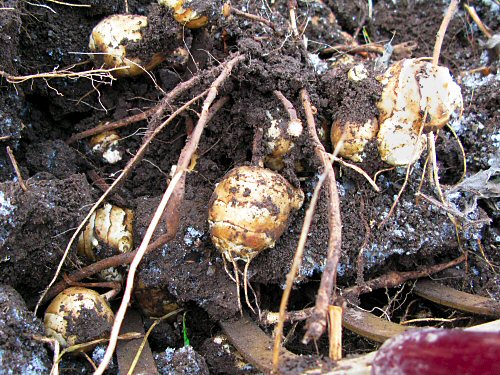
Despite the six inches (15cm) of snow on the big garden, fieldwork goes on. Today, I harvested about 30lbs (13.5kg) of Jerusalem artichoke out of the partially frozen ground, just to be sure planting stock is around over winter in case I need it. Since we don’t have a root cellar or walk-in cooler, storing crops in the ground as winter comes along is a risky but useful alternative. There’s still lots of carrot, parsnip, and some more chokes out there. Until the ground is frozen several inches or more down, it’s possible to harvest, although too much snow can make the whole thing a little crazy. Once thoroughly frozen, I’ve found carrots get killed off and thaw to mush, while parsnip and chokes withstand freezing just fine, staying alive and available again in spring. So far, though, everything’s still cool for digging. You can see the ice crystals in the frozen crust (above), but below that, it’s all cold, friable soil and plump, healthy choke tubers…
Change of view
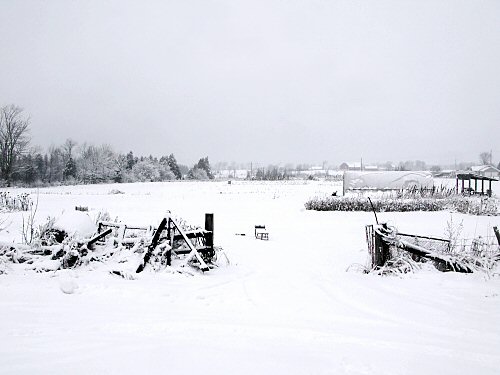
Last month, this month, the seasons march on. It looks farily snowbound, but this could all melt off in a single unseasonably warm day. Like last winter. (Browse through last January if you’ve forgotten the completely odd DOUBLE melt-off we had back then…). There’s never a dull moment with our thoroughly modern weather!
Snowy
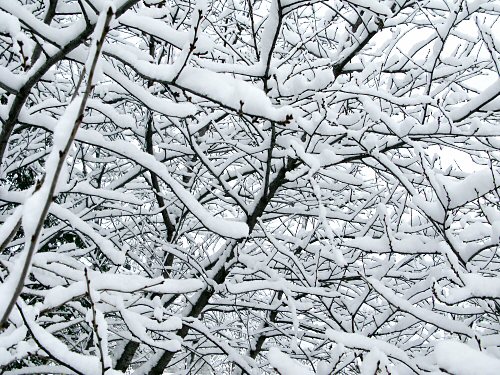
Around here, nothing says WINTER like snow in the trees (except, of course, solid ice in the trees). Three inches (7.5mm) or so of powdery snow overnight transformed the entire outdoors with that magical winter wonderland effect. At some point every year, I’m struck by how strange and wondrous snow like this must look to someone seeing it for the very first time (the feeling does wear off…). It’s pretty, breathtaking, even, if you’re out in the woods, and great for invigorating walks. Eventually, it gets good for winter sports. It perfectly complements the endless strings of holiday lights that’re already going up in the village, completing the classic look of a white Christmas. As for tiny farming, snow moves the action mostly indoors…
Veggies in snow
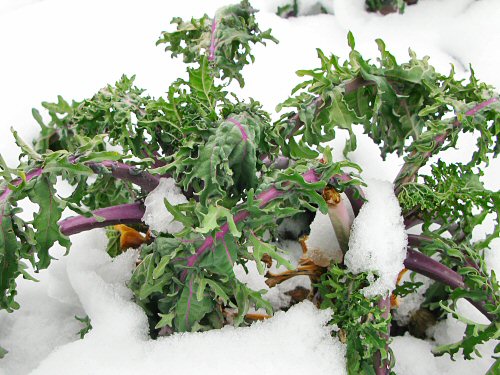
Every season there’ve been hardy veggies left to the cold and snow, and this season, it’s a record quantity, with nearly 2,000′ (610m) of broccoli, cauliflower, cabbage, and kale that mostly started sizing up just as the farmers’ market finished at the end of October. It seems like a waste, but it’s only a typical garden gamble on the weather (I was trying for an extra, really late crop). The risk was clear back in August, and we didn’t get enough sun to push things along a tiny bit quicker. We did harvest a lot of the Red Russian flat-leaf kale (above), for a good four weeks, and one round of 1-2 lb (450-900g) cabbage (a nice size for a meal for one or two). And there’s been a lot of personal-use picking in November. The rest is a giant farm lab experiment, more exploration of the snow-on-veggies effect…
More than the snow, the many nights of extreme cold (-15°C/5°F) that came with it this year really blasted these guys, wilting them and burning leaves and buds. So, none of the crops are too firm or pretty, BUT, they’re still alive: for the most part, there’s good color and texture. The kale, always super-hardy, did the best from a let’s eat some perspective, with good texture and great taste. The broccoli, while a little wilty on the stems and burned on the buds, also tasted great, fresh and flavorful. The cauliflower did the worst, the heads really damaged by the freezing and thawing, too mushy for me to bother with a taste. (Eating raw was fine, but how would this all cook up? We may see…) We’d already reaped most of the filled-out cabbage, so the rest aren’t going to go anywhere from here…
What’s all this odd information worth? Not much, I guess, I’m not planning on deliberately planting for snow harvests. But checking things out is always fun, no experience goes to waste, and there is at least one advantage to knowing there’s still good eating out there: the laying hens will be feasting on a fabulous greens buffet for a while!
It’s really cold
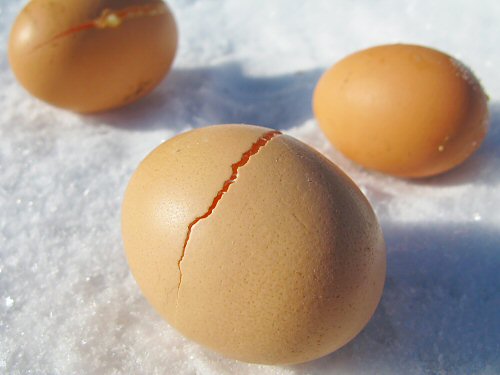
It’s taken a couple of days of this pretty intense cold snap for me to realize it’s yet another whimsical display of the crazy weather we’ve been having for the last six years or so. It’s not that overnight temperatures around -14°C (7°F) are unusual for southern Canada, just not in November. This time last year, there was a ton of snow, but without the unreasonable deep freeze. The winter before, I posted here in mid-January that “winter’s a no-show”—I was still digging carrots! Interesting… Inspired by the cold, I decided to see what it would do to chicken eggs and left a couple out overnight (there was a kinda practical purpose, it’s pretty cold in the chickenhouse). Of course, they froze as hard as hockey pucks. And cracked..