
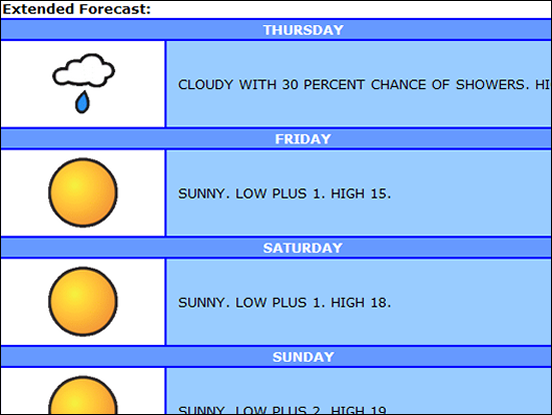
First frost on Friday? It all depends on whose forecast you believe in. Because, as I’ve discovered over time, all weather forecasts are not created equal. The online weather page we’ve used for the last few years is often in sync with the others, but when it comes to cold, it can go its own way, and it’s usually right. Here, we have a low of 1°C for Friday, OR, I can go for a more veggie-friendly choice of two 6°C’s and a 5°C, from three of the big weather outlets. That’s the difference for me between row covering all the tender crops we’d like to save, and…not. There is a pattern: sites like this one that’re based on Environment Canada’s weather service (that’s the Canadian government) tend to be several degrees lower and more accurate. So it’s on with the row cover on Friday, then wait and see!
risk
Last in!
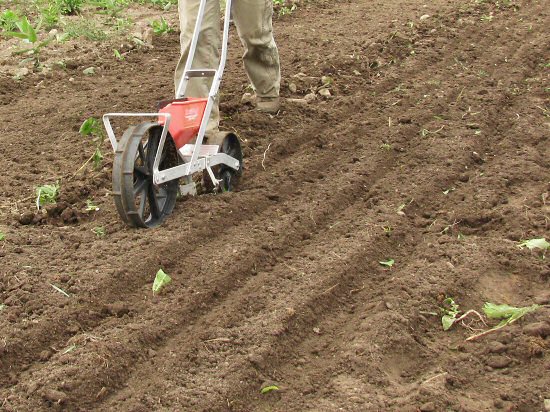
Today, the last direct seeding of the season: spinach, radish, Asian greens mix, arugula, and a lettuce blend for baby leaf… Here, Tracy does the honors with the always-generous Earthway seeder, laying down thick lines of Rebel radish. But is it…too late? Well, who knows?! In good summer conditions, all of these crops can be ready to harvest in 40 days or so from seeding, but the sun is getting weaker now. Hopefully, this round will come up fast, catch the last of the reasonably strong light through September—there WILL be lots of sun!—then continue growing slowly until ready for the last couple of markets through the end of October. That is the…plan. Fresh young veggies at season’s end are a welcome treat! If it doesn’t work out, oh well (and we may get a chance to do a few days at the indoor market in November). In any case, we have the space and the seed, and pushing for the absolute latest planting date seems to me always worth the gamble. Seeing what happens is kinda…exciting!
Tiny fall cauliflower tastes good
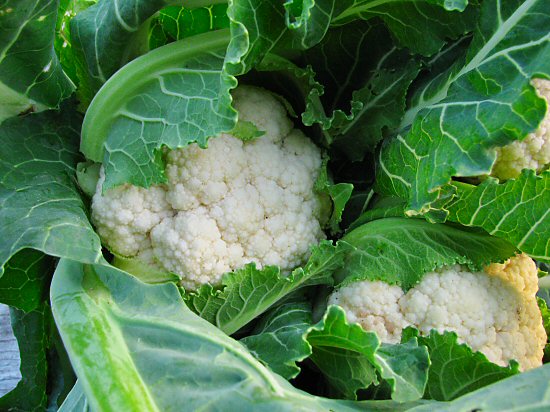
Harvested a few tiny (tennis ball to softball-sized, like, orange to grapefruit…little ones!) cauliflower from the last-planted section of brassicas that also has kale and broccoli. It’s still producing in home-consumption quantities, but with the exception of some strap kale, they entirely missed sizing up in time for CSA or the farmers’ market at the end of October. This is the normal. I usually take a chance on a final, extra-late planting—sometimes they make it, sometimes they don’t. Now, growth is so slow, the field is really just convenient live storage.
Not ideal storage, though. These plants are hardy, but the cold—many sub-zero nights—does take its toll on the parts you want to eat. Kale fares the best, broccoli is quickly savaged, and exposed heads of cauliflower get cold-burned to an unappetizing, mushy in spots, brown. BUT, with self-blanching varieties (this one is Minuteman), the leaves curl close to cover the heads, protecting them from sun discoloration (so our white cauliflower can be…snowy white), and this works fine against cold as well.
Then there’s the eating. The summer’s abundance of fresh-picked veggies has been over for a while, and every little taste of what remains becomes more of a treat as winter approaches, supplies dwindle, memories fade. The wheel keeps on turning…! :)
Veggies in snow
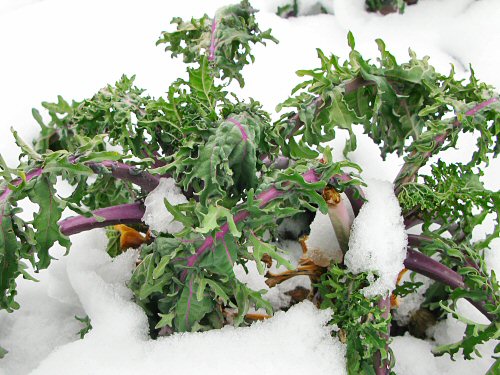
Every season there’ve been hardy veggies left to the cold and snow, and this season, it’s a record quantity, with nearly 2,000′ (610m) of broccoli, cauliflower, cabbage, and kale that mostly started sizing up just as the farmers’ market finished at the end of October. It seems like a waste, but it’s only a typical garden gamble on the weather (I was trying for an extra, really late crop). The risk was clear back in August, and we didn’t get enough sun to push things along a tiny bit quicker. We did harvest a lot of the Red Russian flat-leaf kale (above), for a good four weeks, and one round of 1-2 lb (450-900g) cabbage (a nice size for a meal for one or two). And there’s been a lot of personal-use picking in November. The rest is a giant farm lab experiment, more exploration of the snow-on-veggies effect…
More than the snow, the many nights of extreme cold (-15°C/5°F) that came with it this year really blasted these guys, wilting them and burning leaves and buds. So, none of the crops are too firm or pretty, BUT, they’re still alive: for the most part, there’s good color and texture. The kale, always super-hardy, did the best from a let’s eat some perspective, with good texture and great taste. The broccoli, while a little wilty on the stems and burned on the buds, also tasted great, fresh and flavorful. The cauliflower did the worst, the heads really damaged by the freezing and thawing, too mushy for me to bother with a taste. (Eating raw was fine, but how would this all cook up? We may see…) We’d already reaped most of the filled-out cabbage, so the rest aren’t going to go anywhere from here…
What’s all this odd information worth? Not much, I guess, I’m not planning on deliberately planting for snow harvests. But checking things out is always fun, no experience goes to waste, and there is at least one advantage to knowing there’s still good eating out there: the laying hens will be feasting on a fabulous greens buffet for a while!
Fall crops
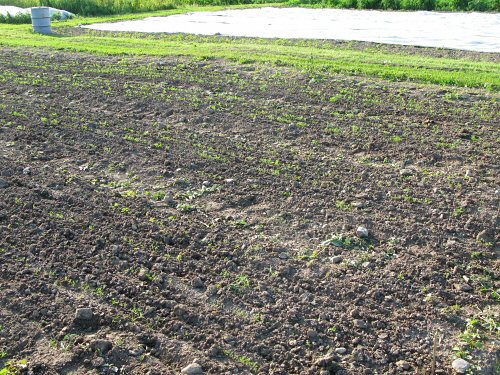
Not much to look at, yet, but the last plantings of 50-day-plus fall crops are doing fine. Here, carrots and, protected from flea beetles by floating row cover, one of two sections of brassicas, including broccoli, cauliflower and kale. There’s a bit of timing risk here, depending on the weather, if growing goes slow, they might not make it to maturity in time for market. But the sun’s been shining for a couple of days now, and the long range forecast is for more of the same. If all goes well, these will be ready for harvest through October!
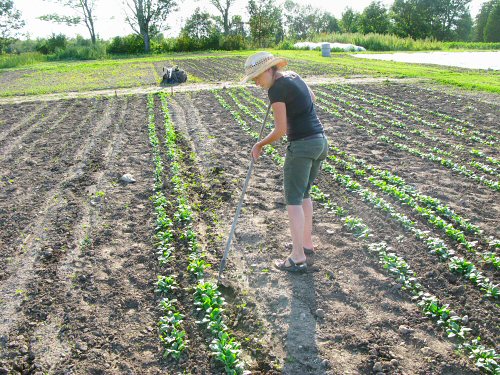
And the summer-seeded spinach couldn’t be doing better. There are two plantings, the first on July 22, and the second (left of the photo) a couple of weeks later. Here, Lynn hoes the first set: in this summer’s wet, cooler, cloudier conditions, germination was absolutely solid, as good as or better than regular spring seedings. Fall spinach has never been this good, by far. Excellent!
Row cover decision
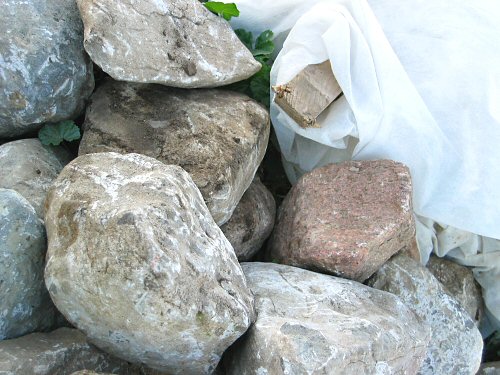
After a chilly and only reasonably busy day at the farmers’ market, it was a bit of afternoon nap time, and then on to making the first frost decision—to cover or not to cover—of the fall season. I “consult” four different online weather services, in general trust none to be very accurate, but when it comes to more dire predictions, like super high and low temperatures and mighty gusting winds, a certain one out the four usually stands apart and is…quite accurate. True to the norm, today three services forecast overnight lows of around 5-7°C (40-44°F), while the dire one calls for plus 1°C with “risk of frost”. So, a couple of hours before sunset, we started assembling floating row cover kits near tender crop sections. The cover, 14′ wide and cut to 50′, is kept loosely rolled on 4′ lengths of 2×2. Heavy rocks, 10lbs and up, are gathered and kept track of over the season. And that’s all you need: row cover and rocks! Unlike for insect protection, where edges of the cover should be buried, or at least, anchored firmly every few feet, frost protection only needs draping over top, and tacking down at the corners and a couple of additional spots. Anyhow, in the end, I considered the breeze, the slight cloud cover, and my…um, instinct (?!), and decided not to cover…
Latest brassicas released
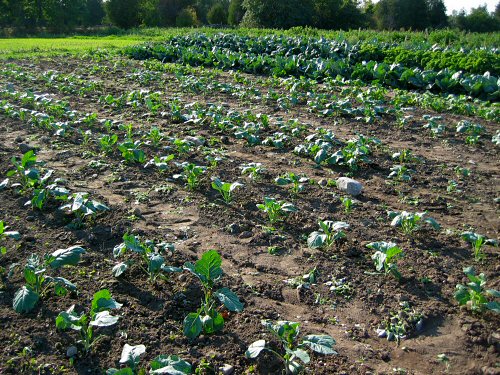
On this bright and shiny Sunday, we finally released the last of the season’s brassicas from under row cover. The flea beetles have almost vanished and the plants need all the light they can get if they’re gonna make it to harvest. It’s still a bit of a long shot for the broccoli and cauliflower, but the early and prolific Red Russian kale should do fine. For what it’s worth, the long range forecast calls for a warm September—I’m still starting to slip into frost watch mode!