
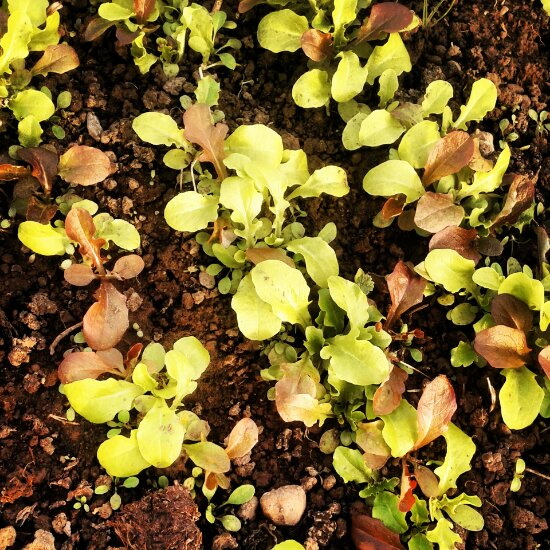
Cold-grown: Tiny lettuce leaves, crisp, fresh and delicious…and grown oh so slowly, without cover, in the unheated greenhouse, through many freezing nights, some down to -15C. Still a while till it’s big enough to harvest, and it was seeded way back at the beginning of October: that’s already 50 days compared to the usual spring/summer 25-35 days for baby lettuce mix). Also, the cold effect gets trickier as the leaves get bigger. All in all, though, seeing food grow in the cold with a minimum of help is quite fantastic.
unheated greenhouse
Winter spinach
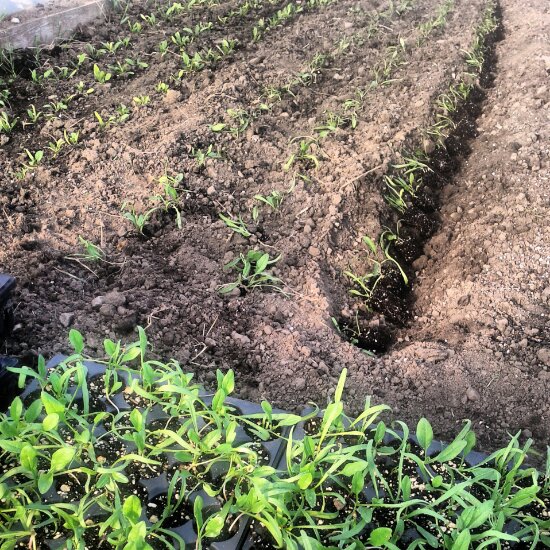
Later and later we go: More late season/winter harvest experiments, with four-week-old spinach transplants into the unheated greenhouse. Also trying out a trench approach to transplanting—a furrow about 6″ deep, made with a hoe—instead of putting them in one by one. Seems a little quicker, but it all takes time!
Shrouded against the cold
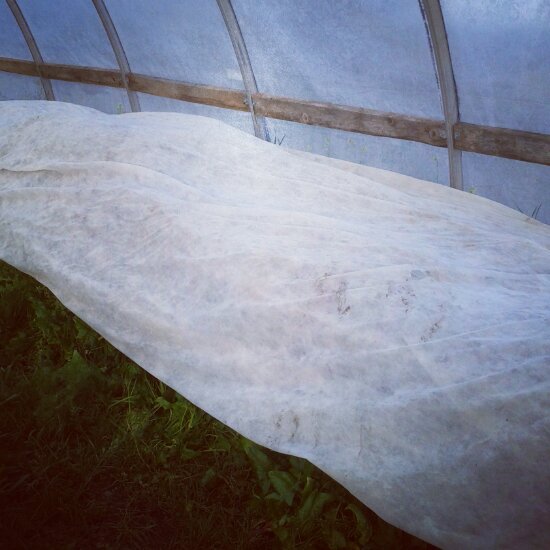
Shrouded against the cold: Not much to look at, but nice for the tomatoes, peppers and other seedlings on the tables underneath. It’s a double layer of medium weight floating row cover, tried and true, a familiar spring sight in the unheated greenhouse, good for a few degrees of protection in the forecast overnight near-freeze. Three days of chilly nights, they say.
Winter greens: the long haul
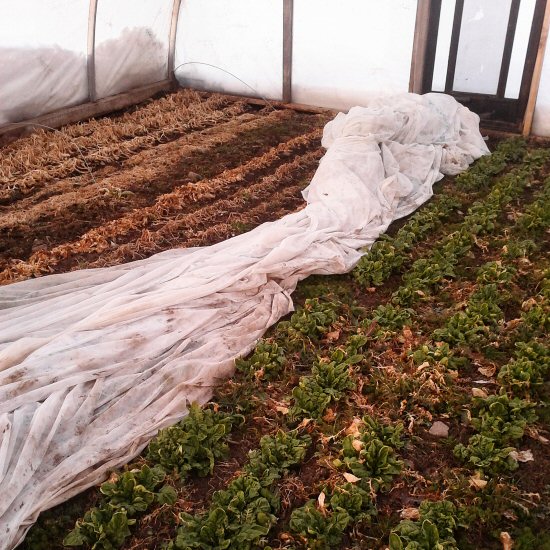
Checking in on the winter greens mini-experiment. These guys have been through six weeks of up and down weather, balmy days well above zero (reaching 60-70°F/15-20°C on a sunny day in the hoophouse) , and many extreme freezing nights. So, how did it all do? The Bloomsdale spinach, uncovered (above), is fine, although after all that freezing and thawing, the taste and texture changes (good to eat, but probably wouldn’t sell). It wasn’t the plan, but this spinach can be trimmed back to see how new growth does in spring. The other beds, all brassicas (tatsoi, mizuna, arugula, mustards), left half uncovered, are completely toasted. Meanwhile, under a single layer of medium-weight row cover, arugula (below) is good, perky and quite tasty. Not the most extensive and scientific testing plan, but combined with the experience of harvesting through December and in mid-January, it’s a solid starting point for next winter’s goal of full-on, unheated winter greens production!