

Another wave of brassicas, mostly cabbages and cauliflower, are getting a little big as they wait indoors under lights. In recent years, decent fall weather has extended a whole extra month from what used to be. So I’ve been planting later to extend the harvest. (More text to come…)
brassicas
Garden vs the hungry hordes

Much of veggie farming is playing garden defense. Yesterday’s garlic surprise attack was handled as an immediate emergency action, by hand-picking larvae before they could really tunnel in. The other no-chemicals approach is row cover, which seems to be laid out on more crops as each season. (More words to follow.)
Baby brassicas
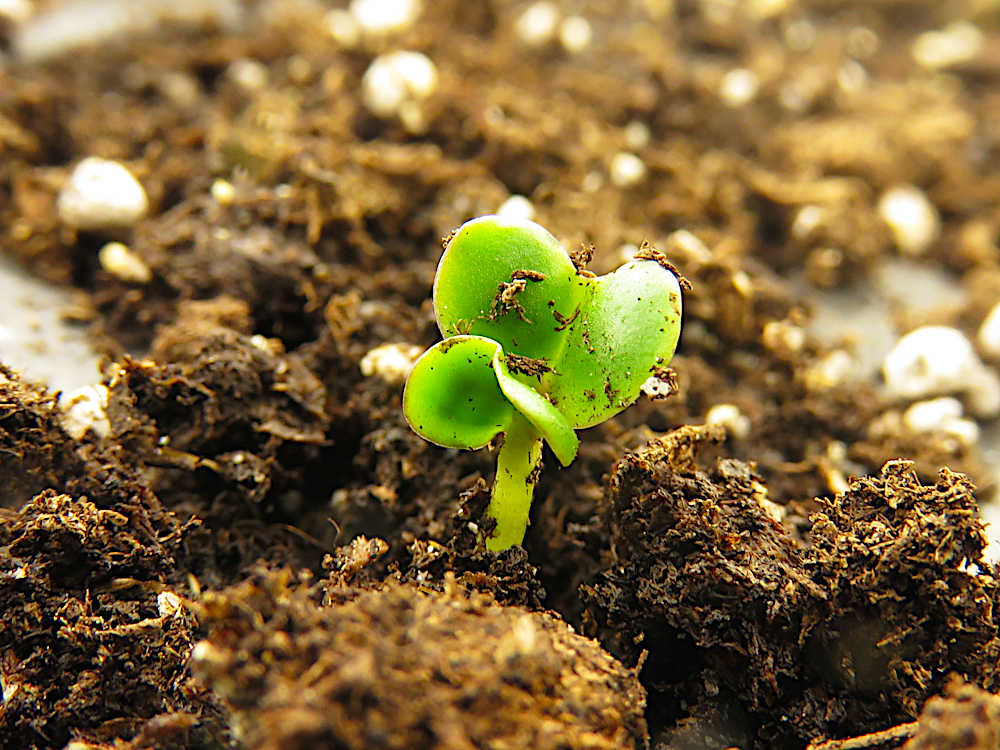
Broccoli? Brussels sprouts? I forgot to check the tray after taking the pic, so I can only narrow it down to one of the two based on size. They’re both in the quite vast garden veggie branch of the brassica family, that also includes cabbage, cauliflower, kale, mustard, bok choi, radish, lots more. The first pair of seed leaves look pretty much all the same. Next leaves take on their own look. At this point, they’re all similar, tiny and pushing up…
Bare root Brussels sprouts
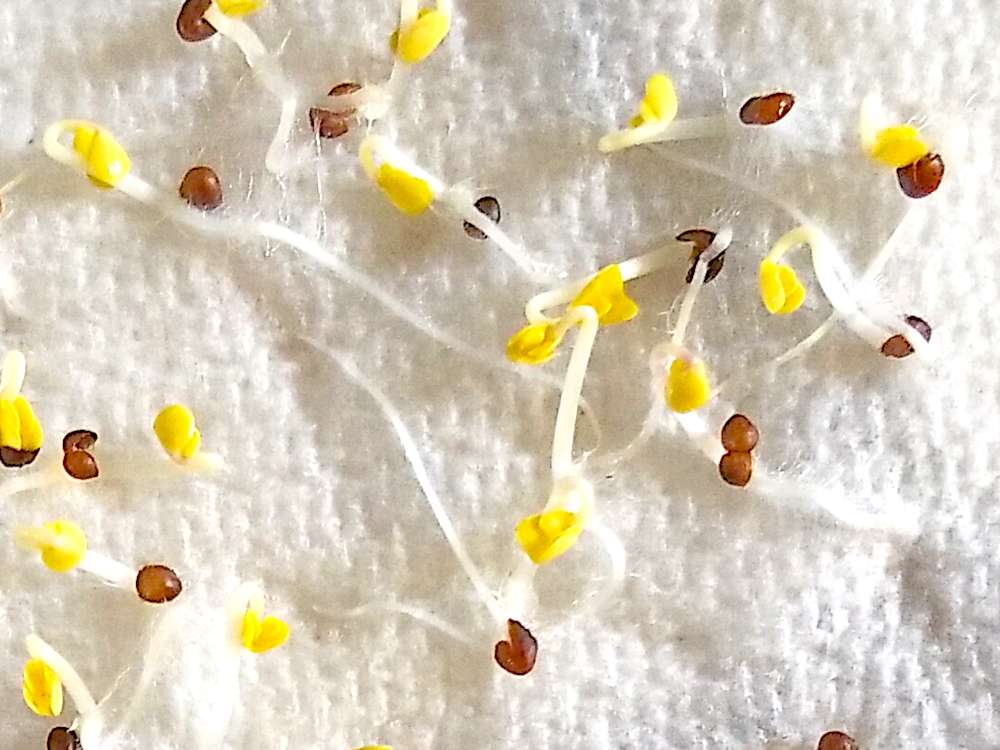
Yep, a wonder of Nature, up close. Three days or so after folding up the pinhead-sized seed in a damp paper towel, we have Brussels sprouts! Of course, this is only step one of many before we get to the deliciousness of actual Brussel sprouts. (Halved, tossed in corn meal and sautéed in butter is one way to go!)
Bare root germination like this is good for at least two things. It’s a useful germination test to see if old seed is still good. It’s also a way to start seedlings: transfer the sprouted seeds to a plug tray or pot, wait a few more days, and up they’ll pop. Let the greening begin.
The bare root approach adds an extra step compared to putting the seed directly in the plug or pot. It’s a little more work. It can be good with hard-to-germinate crops. Or if the seed is old, with a low germination rate, and you want to be sure that every plug has a plant. That it’s fun to see what’s going on is also a fine reason!
When to cover
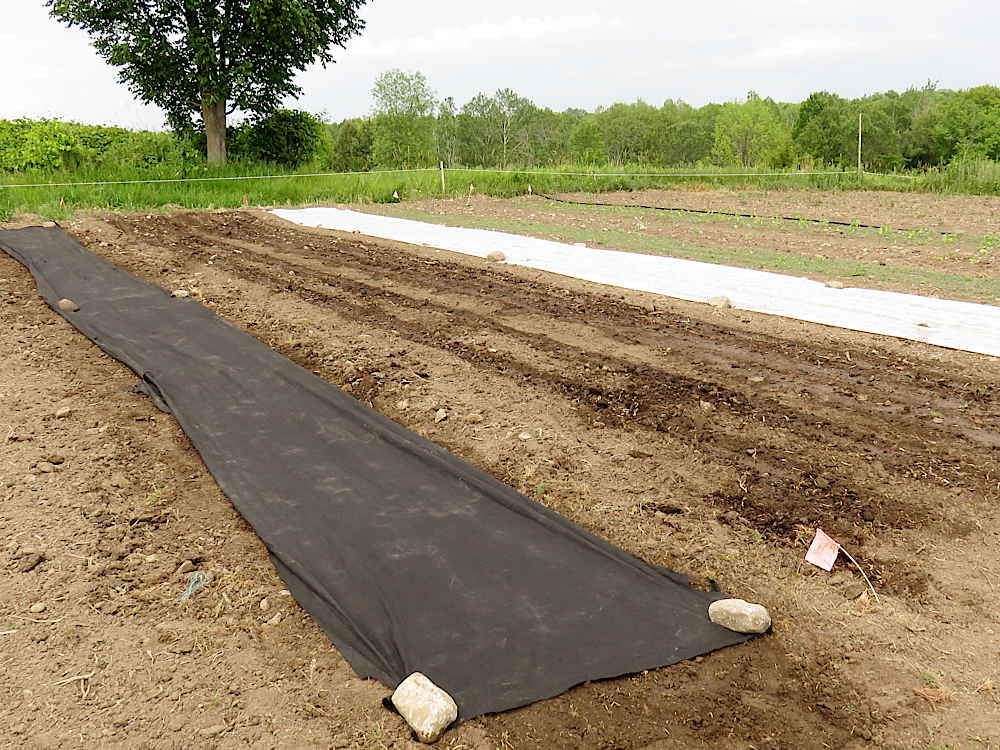
Some crops need to be covered and some crops don’t. It would be excellent if all the vegetables in the garden could bask in the sun together, like a picture-perfect postcard. Which would be possible if it weren’t for pests, and the special conditions some need to germinate. Trusty floating row cover is used here to keep flea beetles chewing holes in the brassica mix—flat-leaf kale, mizuna, mustard, bok choi, and their close cousin arugula, to be harvested as baby leaves for salad. Wee tiny carrot seeds need cover to retain the constant moisture in the ground they need to germinate—I’ve been using black landscape fabric, watering through it as need, for about a week. And some veggies, like green beans and beets, haven’t had insect problems, so they don’t need cover. It all depends!
Fieldwork, tiny farm style
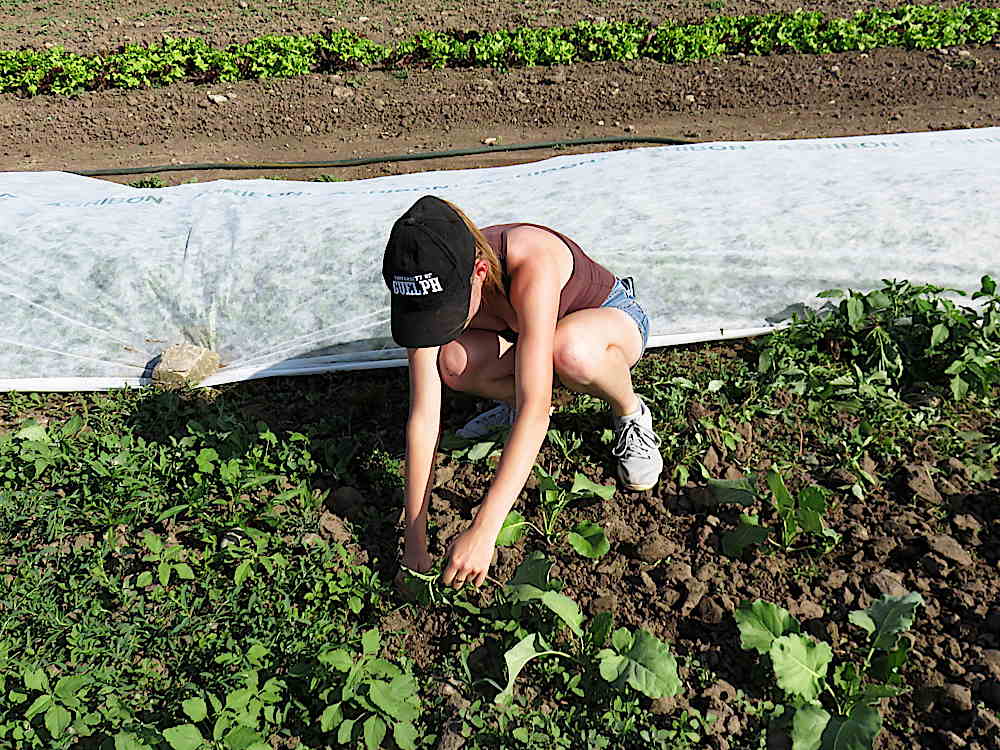
A simple snapshot of hand-weeding brassicas, and yet, a wealth of clues to how tiny farming is done in this market garden. Upfront, can see the weeding before-and-after: give them a few short days, and those weeds would easily catch up to the seedlings. The pulled weeds go around the plants or on the paths, where they do their bit in mulching, that helps keep new weeds from germinating. (Unfortunately, weeds often get bigger: more work, with the smaller tradeoff that they do a much better job as mulch.) Behind Casey, row cover, held down by big rocks that are carefully hoarded for just this use. Without the cover, flea beetles would have already gone to town, perforating the leaves with tiny holes. Further on, a critical water line, a 3/4″ hose off a 1″ pipe from the dug well pump. These are far from from a Big Ag diameters—they don’t deliver a firehose amount of water, but they do get the job done. Besides, there isn’t that much water in this well. The hose is lying on a trodden path, measured out at the beginning of the season to divide the field up into five-foot wide (1.5m), wide enough to take two rows of the bigger plants, like these broccoli and a cauliflower. The tradeoff is, comfortable hand-weeding is often done from both sides, to avoid lots of reaching across, while being a little less…efficient. And then there are open beds, with the clean look of fresh rototilling, ready for more seeding or transplanting. Casy’s fashion choices for fieldwear wouldn’t be mine: too much skin exposed to sun, insects, and spiky thistles—I gave up even shorts ages ago, for long sleeves and jeans—but to each their own. It’s all in the details!
Greens, protected!
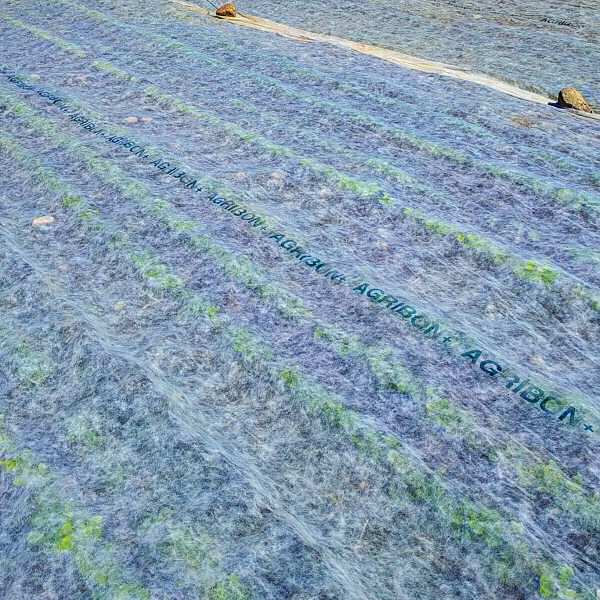
Floating row cover, weighed down and made semi-transparent by water, is all that stands between fine young brassica greens and the scourge of the flea beetle. The cover is placed right after seeding, weighed down by rocks every 12.5′ feet, briefly rolled back for weeding, and progressively loosened as the greens grow—we use 14′ wide sheets on 10′ wide beds. This medium-weight cover has worked as a good all-round solution, offering a few degrees of frost protection, and more durable than a lighter, insect-only weight, which would allow better light transmission (this medium weight one is 85%) and better air circulation, but also be more likely to tear.