
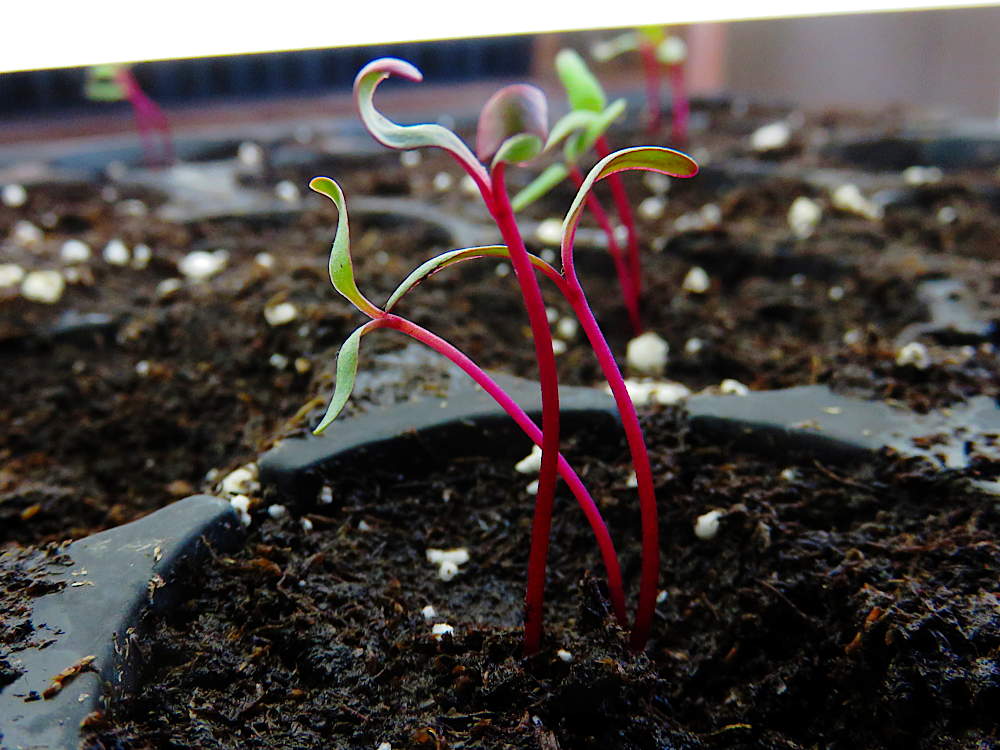
One of the basic things you learn about growing beets is that the seed isn’t actually seed, it’s small dried fruit that contain up to three or four tiny seeds. You’ll often get a tight little cluster of seedlings emerge, which could be a problem if you were precision seeding, going for exact spacing and no thinning. That sort of preciseness has never been a factor on this tiny farm—dealing with the vast volume of tiny carrot seed poured out by Earthway seeders in early years totally eclipsed any thinning issue one may have had with beets. Still, here’s PROOF. Beets aren’t transplant crops, but in this gardening year, I decided to try some in plug sheets. One shriveled fruit per cell. And here you can see, one “seed”, three seedlings! Could’ve also cut one open, but what’s the fun in that! They’re looking quite stretched under the fluorescents. Carrots definitely don’t like to be casually transplanted—they grow, but in my one experiment, they produced stubby little carrots. Probably something to do with the tap root being disturbed. Beets could be the same!
seedling
Birds 2 – Beans 1
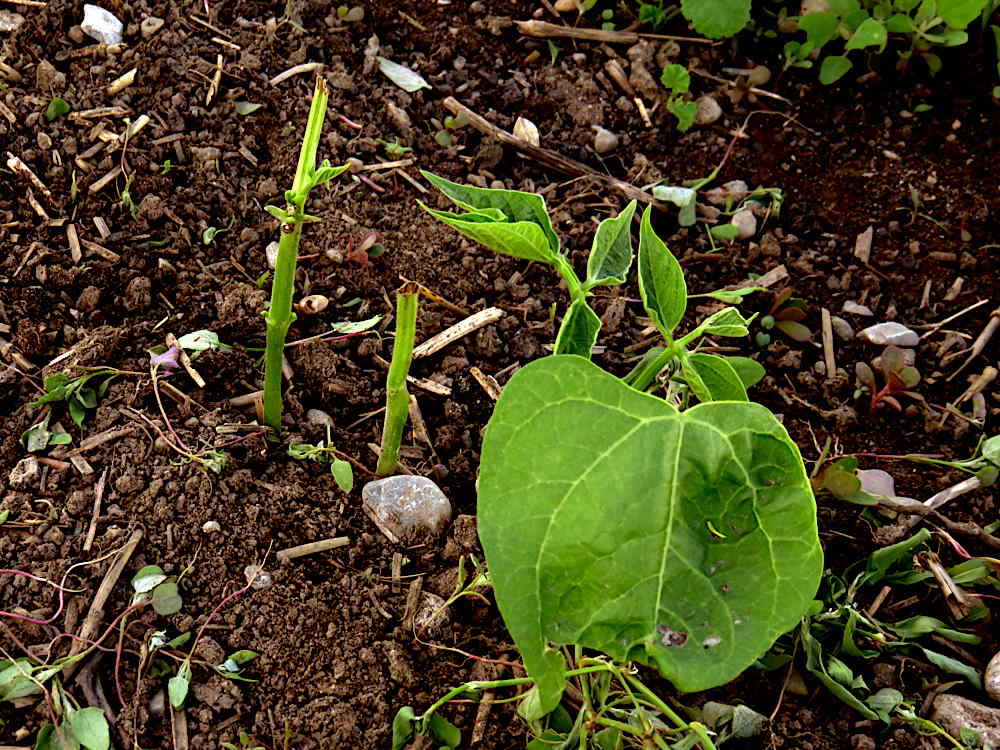
The first small bed of green beans was coming up fine—then I lapsed for a moment, and the beans were mercilessly attacked. So it goes in the rough-and-tumble world of the country veggie garden. I suspect birds. Can’t be sure but I’m pretty sure. I’ve seen them in action before. The ragged tops of the stems seem to point to pecking action, not the clean angled slice of creatures with teeth.
Instead of seed leaves, beans emerge with the actual bean split in two right on top of the stem, like an irresistible treat on a stick. Not sure what sort of garden raider survival strategy that represents. I usually put out anti-bird measures: inflatable scare balls or aluminum pie plates suspended on string. Or toss on some row cover—the duct tape of the garden—until a few leaves develop.
Here I didn’t act as soon as I saw the first signs of emerging beans. Also, I’m not used to hand-seeding and probably got a little too precise and seed-saving. With a seeder, plenty of seed drops, so there’s room for thinning, even by birds. Unforced human errors!
Anyhow, there are still enough plants for a decent first harvest, and a bigger bed is seeded and underway, with pie plates heading to the field. Bonus quarter point for the beans—you can see a tiny new leaf on one of the bare stems as it goes for a comeback!
Brassicas waiting in the wings

Another wave of brassicas, mostly cabbages and cauliflower, are getting a little big as they wait indoors under lights. In recent years, decent fall weather has extended a whole extra month from what used to be. So I’ve been planting later to extend the harvest. (More text to come…)
A day in the sun
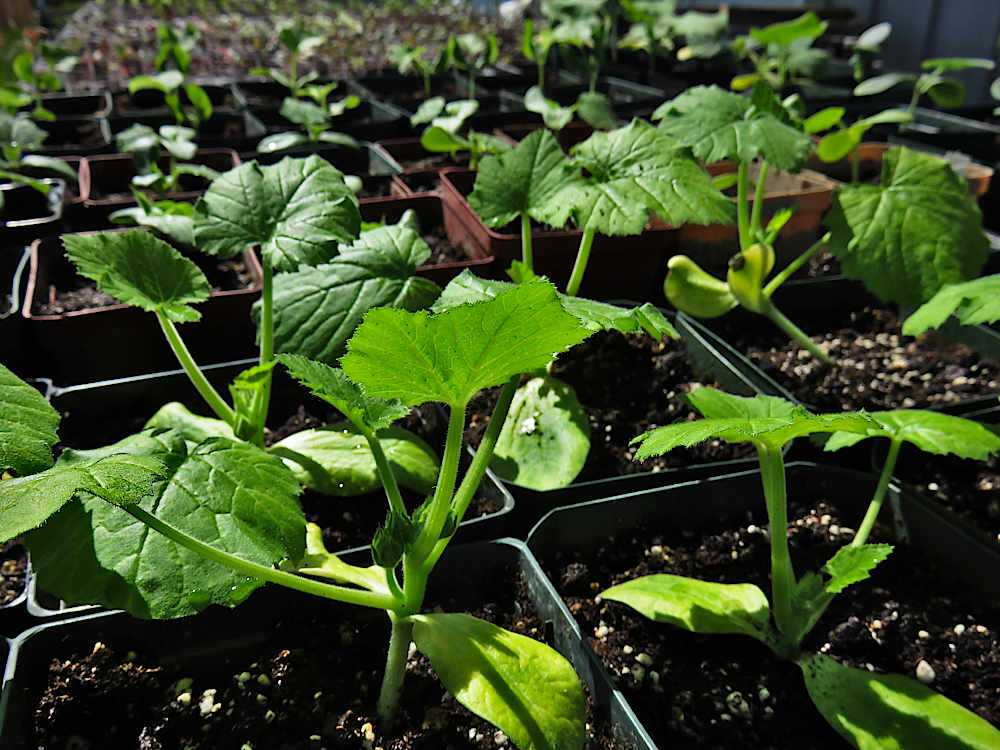
I’ve been hardening off trays of seedlings over the last few days, a few at a time, taking them out from the under the lights. Today, they were all outdoors, some for their first taste of the sun. It’s a manual routine, walking back and forth from the light racks with one or two trays at time, then bringing them back in in the early evening. I like it: a clear, simple, straightforward task, and the most important thing to do when you’re doing it. This is also exactly the type of routine that’s perfect for automation, or at least, optimization.
To grow a fair bit more than this year, I would put seedlings out in an unheated greenhouse where they’d stay until transplanting. That brings more convenience and efficiency, and also a few extra concerns. Voles tend to burrow in and munch on greens, so checking the perimeter becomes a thing to do. Daytime temperature in the greenhouse shoots up to 40°C+ (104°F+) on a sunny day, so ventilation is a must. When you open the doors in the day, you have to close them at night against cold and critters, and open them again early the next day. If the forecast is for freezing overnight, row cover placed in the evening and removed in the morning can handle a few degrees below (in a more extreme cold situation, a portable heater fired up in the middle of the night might be necessary).
Then there’s the new super-high winds that started happening around here within the last five years or so, there’s extra concern about the whole greenhouse staying up—mostly not in your control, but you still think about it with every weather warning!
Nothing wrong with scaling up and improving efficiency, while every step to bigger has its complications!
Seedlings in January!
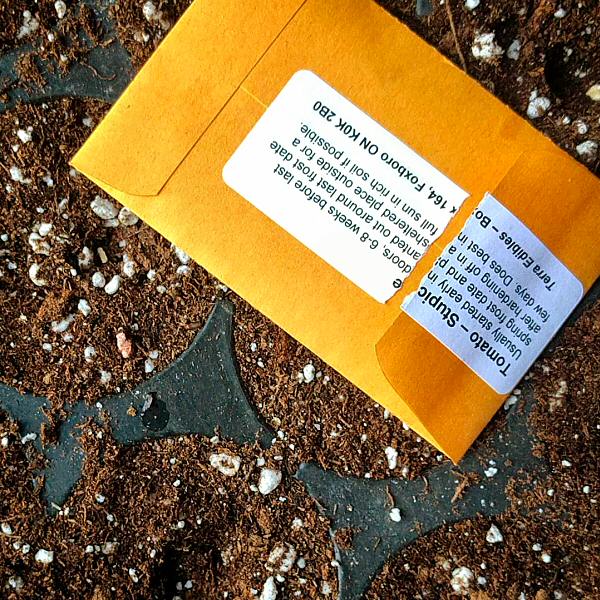
The earliest ever tomatoes experiment begins… Parts of the plan include a proven super-early variety, multiple seedling start dates, and the unheated greenhouse!
Trimming parsley
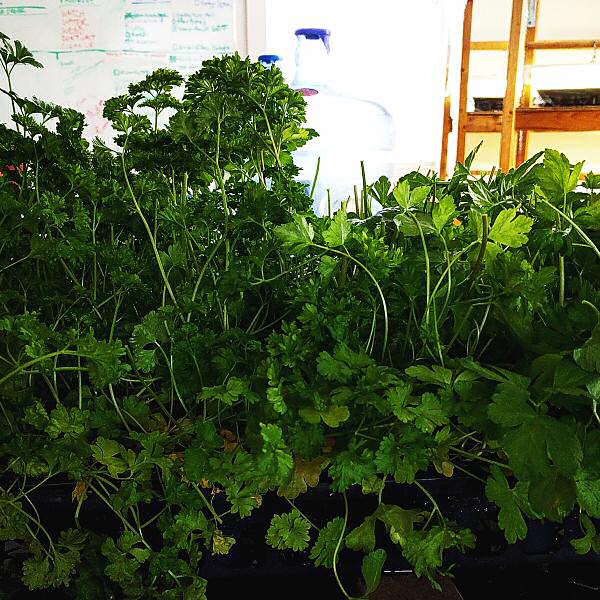
Parsley, curly and flat-leaf, overflows its 72-cell plug sheet. Time to trim it back (again), so they still fit under the lights. To be unfussy and safe, a quick shear of only 2-3″ off the top literally takes a few seconds and does the trick. Snip-snip-snip-snip-snip! This is what you have to do when you start seedlings extra early, and then wait on the weather!
Transplanting: tiny sections
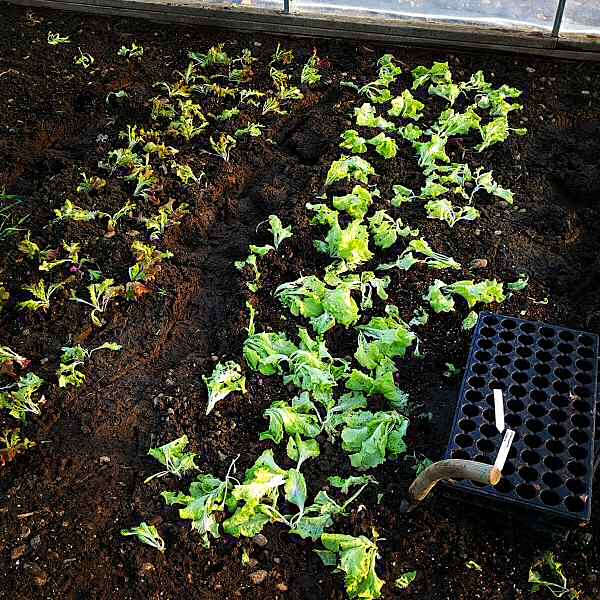
Transplanting lettuce into the unheated greenhouse, filling it out in small sections to work around wetter areas. The seedlings, waiting for drier conditions, stayed a couple of weeks longer in trays than ideal—now they’re a little floppy and stretched, but I’m confident they’ll figure it out. This first spring, seeing how the ground dries in the new hoophouse is part of the learning curve. Tiny farming!