
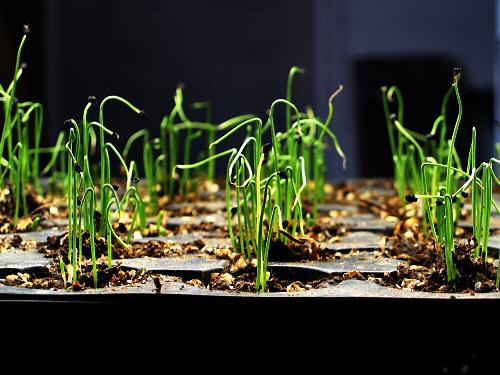
The leeks are thriving, all straight up and down. Ten days from seeding, and some of ’em are nearly 3″ (7.5cm) tall. Clearly, the seed was more viable than expected, looks like practically every one popped up. The first parsley just appeared, and a second set of arugula is already blowing in the wind. Things are slowly getting…busier.
wind
Seedling treatment
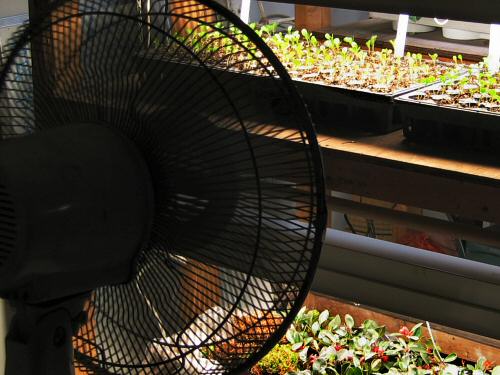
The fan is oscillating and the grow racks are slowly filling up. Parsley—curly and flat-leaf—are underway, and there’s more lettuce and some herbs…
Fanning the seedlings is particularly satisfying because it does a lot for such a simple thing. I forget where I heard about it, probably from a book, and I’ve been doing it since Year 1 or 2.
The idea is that plants develop differently when they have to deal with wind, or rain, or otherwise being pushed about. Seedlings raised indoors lead an extremely sheltered life; providing a bit of a breeze toughens them up, and this sort of mechanical stimulation (brushing is another approach) also encourages stockier growth instead of stretching.
It makes sense to me—seedlings definitely wouldn’t be so coddled growing out in the field! There’s even a term for this: thigmomorphogenesis! While hunting down the word, I found an interesting article about mechanical stimulation of seedlings as well (and here’s another).
I don’t follow a particular schedule, just give ’em at least an hour or two a day, sometimes more, turn the fan on and move it around every once in a while (I also make sure the seedlings are properly watered, since wind is great for drying out plants).
All in all, it’s easy, sounds good, hasn’t hurt! The fanning also dries the soil surface, which helps prevent damping-off, so you can’t lose!
A little fieldwork
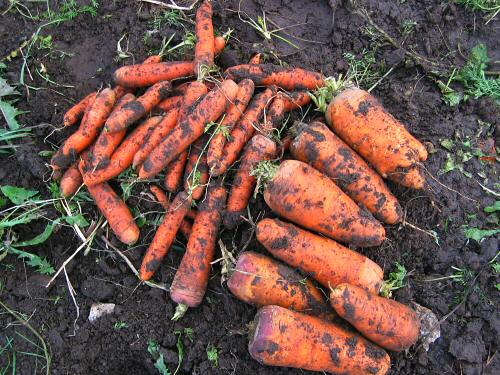
Spent about four hours out in the field. The feeling of calm satisfaction as you head in after doing some work in the garden never fails! I dug up about half a bushel of carrots to see how they’ve done. These are, I think, Nelson and Danvers Half Long (the BIG ones)—the label stakes were out, so I couldn’t immediately check the varieties, it’s not necessarily that easy to tell! They’re mostly in fine shape. On a few, the inch or two exposed above-ground had frozen and thawed, leaving the top tips spongy and mushy, but this didn’t affect too many. I can probably get a couple of bushels! This mid-January harvest is actually consistent with last year, except for the extra 6-7 weeks of RealWinter… I also mulched the garlic, leaving a couple of beds clear as a test (I’m not sure how useful an experiment that is, since I’ll mulch them for moisture and against weeds first thing in spring…). Anyhow, a bit of winter fieldwork…
Called for wind
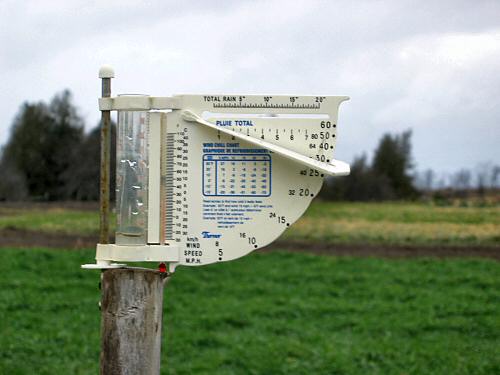
Happily expecting heat, I stepped out into a sharp, nasty wind this morning. The weather’s taken a downward turn from the cheery short-term forecast. It’s still going to be above zero for the next couple of days, They say, but just, and the nights have plummeted below. Also, in the 15-day, that follow-up warm spell predicted for 10 days from now has evaporated. All this meaning: harvest and mulch now! Unfortunately, the heavy wind makes grass mulching nearly futile (the mulch blows away), so I’ve put it all off till tomorrow…
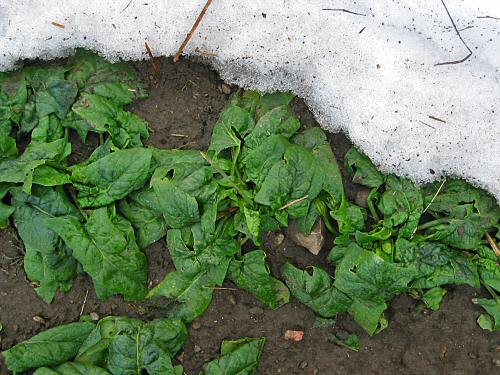
A last hold-out of snow is melting off a section of spinach. While the color is a bit odd, with two distinct shades of green going on (cold effects!), the taste and texture are good. Spinach lives in these conditions, so as long as the leaves haven’t been battered by cold wind, they’re still good eating. Just sort!