
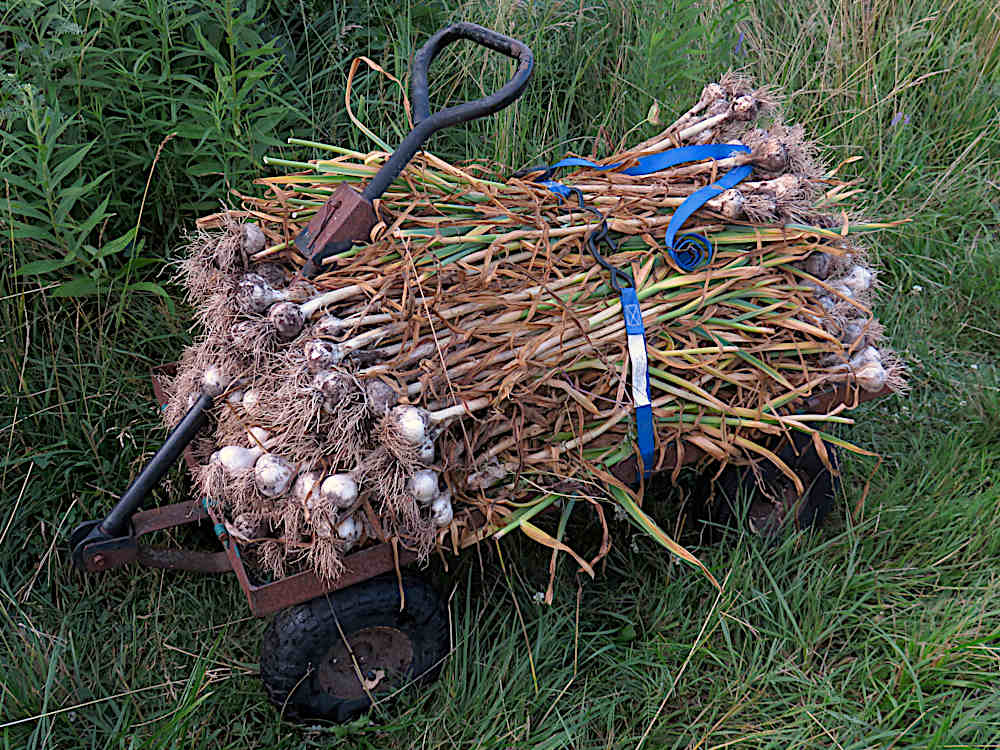
Who needs sides when you have ratchet tie-downs?! A load of harvested garlic, stacked on a trusty hand wagon that has been trundling around all sorts of things for many, many years. They’re off to be stacked on a wire table in the barn to dry out!
garlic
As the leaves die back
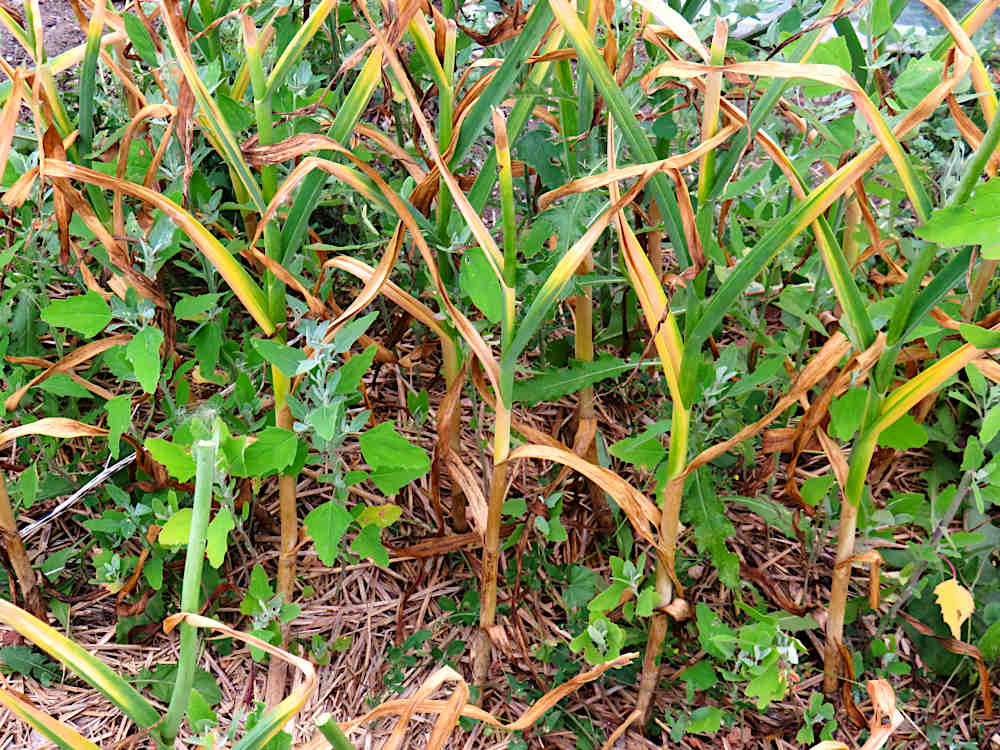
The rule of thumb for garlic harvest, as far as I’ve gathered, is they’re ready to come out when the bottom third of the leaves, or 2-3 leaves, start dying back. I’ve always sort of followed that, but mainly checked by harvesting two or three from different spots every couple of days, starting when the first leaves begin to yellow, how often depending on the weather. This year, because they’d been under row cover the whole time—the anti-leek moth strategy—getting 15% less sun according to the cover specs, I decided to wait longer. They were uncovered into full sun about 10 days ago, and I decided to let them do all the clove growing they could do.
There may be a more scientific, measured way of timing the harvest on big commercial garlic farms. Sensors could be involved! On this smaller scale, an educated guess and harvesting samples has been my approach. If the last month was very wet, an earlier harvest is a good idea. One extraordinarily wet June, rainy and always overcast, left the garlic sitting in pretty damp soil all the time. Even harvested early, at least half had swollen and split the skins at the bottom, making them not great for through-the-winter storage.
Garlic apparently does most of its clove growth as the leaves start to die off—a change of focus. This continues till about half the leaves have started dying back, which makes sense of the rule of thumb. Once the yellowing starts, it goes pretty fast. The idea of not letting them yellow too far is that every leaf blade is a layer of the papery skin that holds the bulb together. The leaves extend right down around the cloves, and once they’re dead on top, they could rot underground. But, if it’s not real damp down there, the buried leaf just starts to dry out. So if it looks alarmingly dead up top, it shouldn’t be a problem, more like the bulbs have started curing—drying out—in the ground. I’ve been checking.Doesn’t sound very precise, in this precisely measured digital world. And these field guesses can be wrong. Overall, though, going by simple experience, topped up by reading and chatting, continues to work out just fine!
Wind and more wind
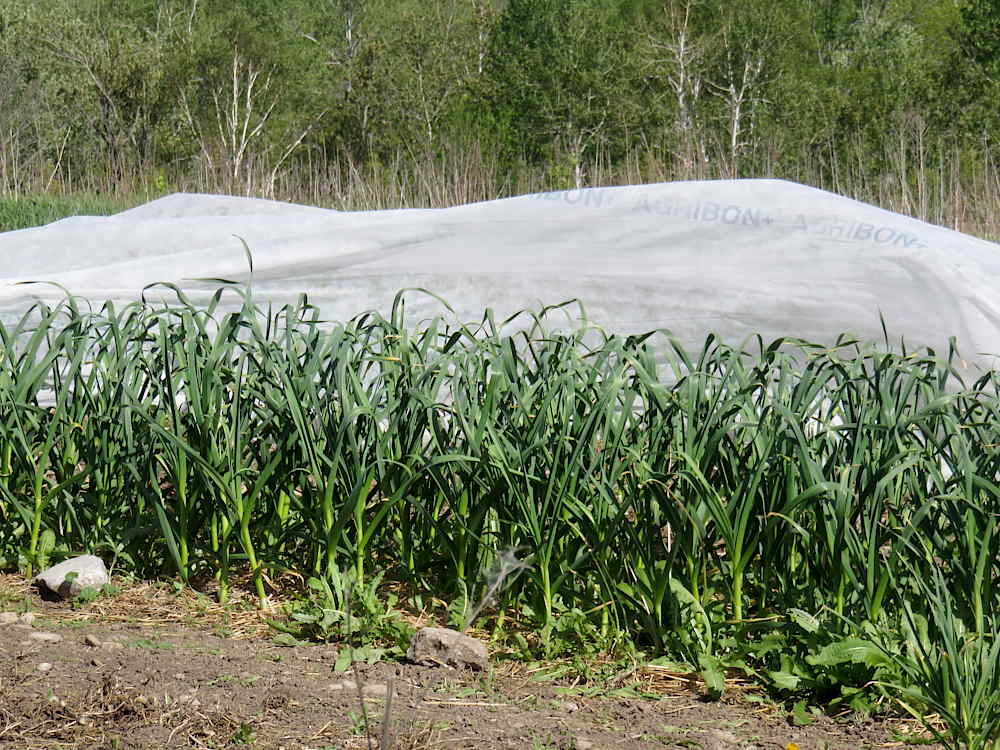
At this point, end of month, I’d have to say WIND has been the weather theme of this May. Practically every day. Gusty enough to sometimes threaten the more delicate seedlings, and to put off ladder work on the big greenhouse. Here, the wind has blown off the garlic’s row cover. Not a problem as far as protection from the nocturnal leek moth horde that may be lurking, but more work to put back. Complicating this little matter, the garlic is growing up and straining at the cover, gradually pulling it out from being fully weighted by the rocks. Since the cover should stay on through June, that will have to be solved. Stay tuned!
Garlic revealed
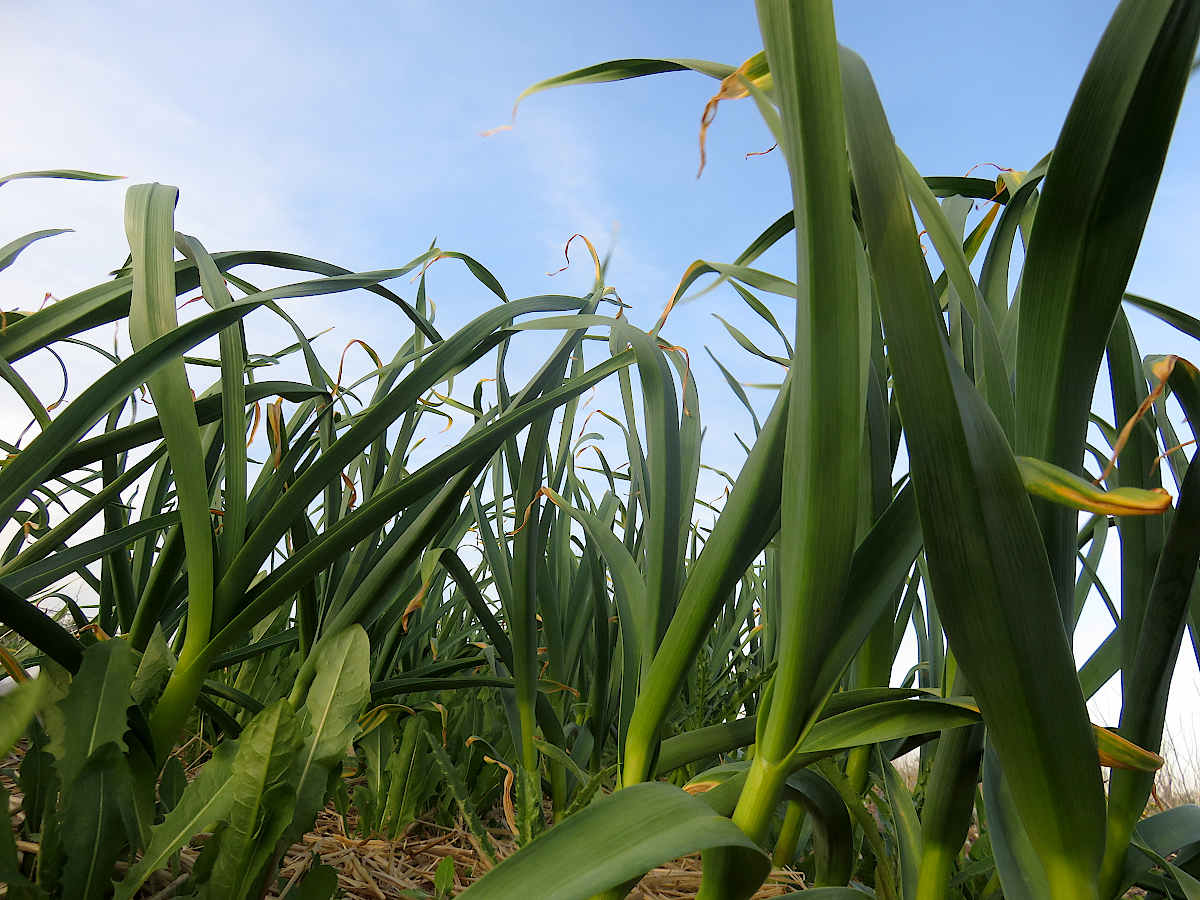
For the first time after years and years of growing garlic, they’ve been under row cover since planting in fall, protection from a repeat of last year’s surprise invasion of the leek moth. No longer the one crop that every garden pest, from deer-sized to flea beetle, seemed to studiously ignore. I covered them right after planting so I wouldn’t have to muck about in the marshy field in April before it dried out, and loosened it up earlier this month.
Today, a full day of unfiltered sun. Leek moths are out and about at night, so the garlic should be safe even if the moths are in the neighborhood. The plants look fine, healthy and growing quite fast, though the leaves were a bit bent at first by pushing up against the cover. Cover went back on late in the afternoon. Better that than be bored (by leek moths).
Grow the whole bulb!
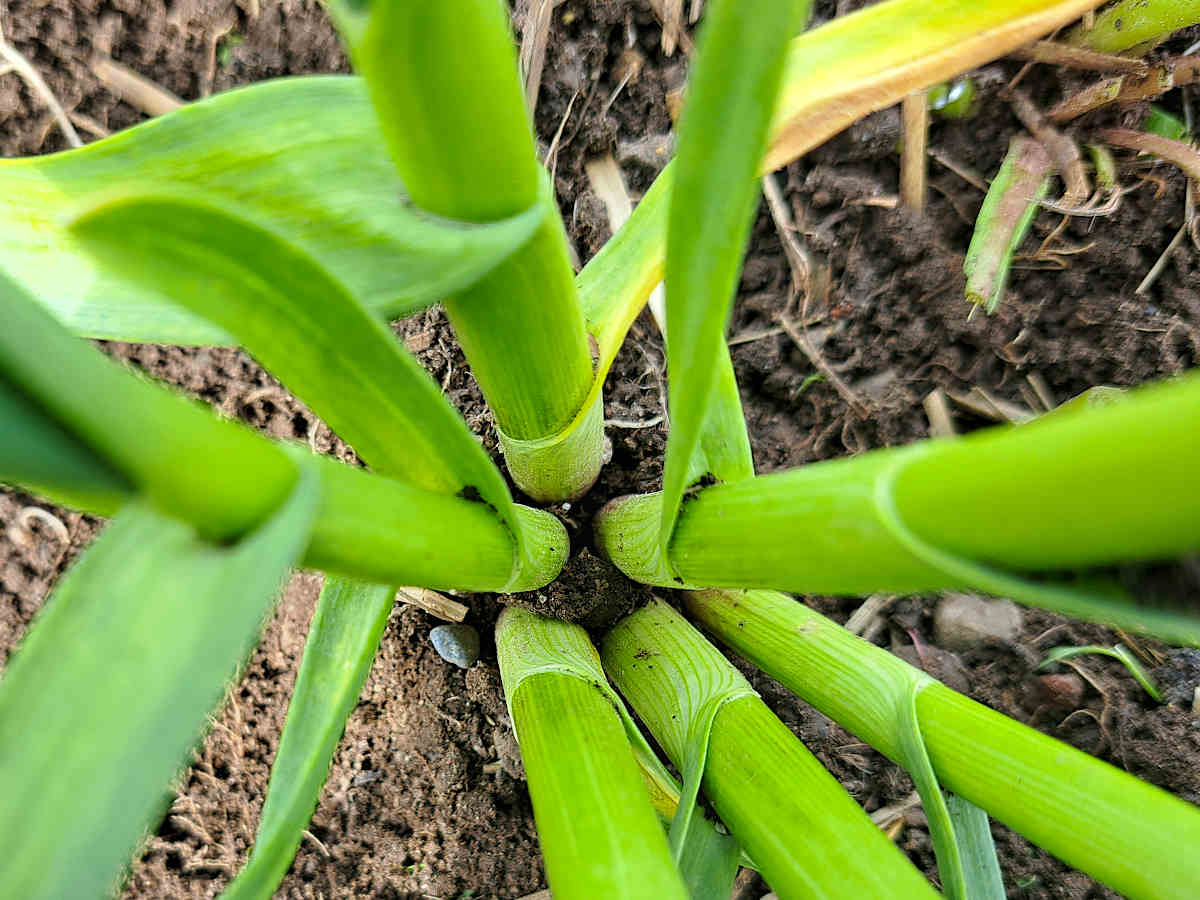
A left-behind garlic bulb from last year has set out on its own, with six cloves all making their way. Decided to leave it to see how things turn out. Not the greatest experimental venture into the unknown: in this quite heavy soil, when things are multi-planted, when it’s veg that grows in the ground in one spot, they tend to crowd and even flatten the sides of each other where they press together. This I know from experience. So expect small, maybe partly flattened new garlic in a couple of months!
Curing garlic
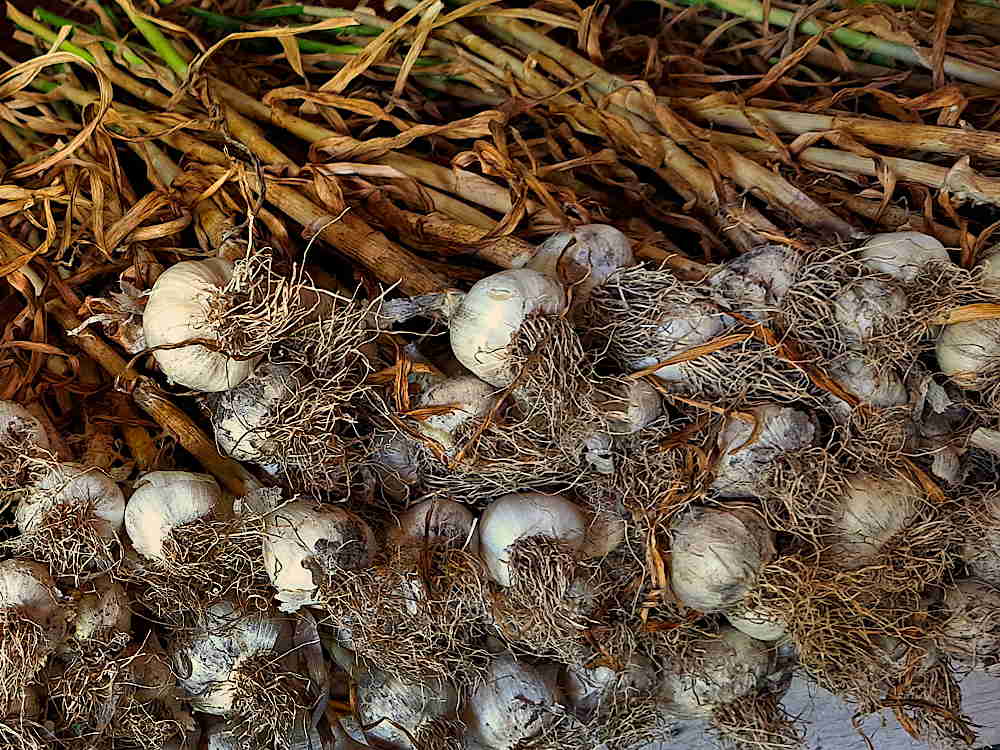
The invasion of the leek moths a few weeks back left the garlic somewhat ravaged but unbeaten. The moth larvae seem to have been stopped up top, snipped and pinched and dug out before they had a chance to tunnel their way down through the stems, reaching the bulbs, and eating into them as well. Instead of that, the harvest has turned out just fine. The bulbs overall are a bit on the smaller side, but the cloves are nicely filled out, so…all’s well. A few weeks of air drying till everything’s woody and brown, then done!
Leek moth invasion update!
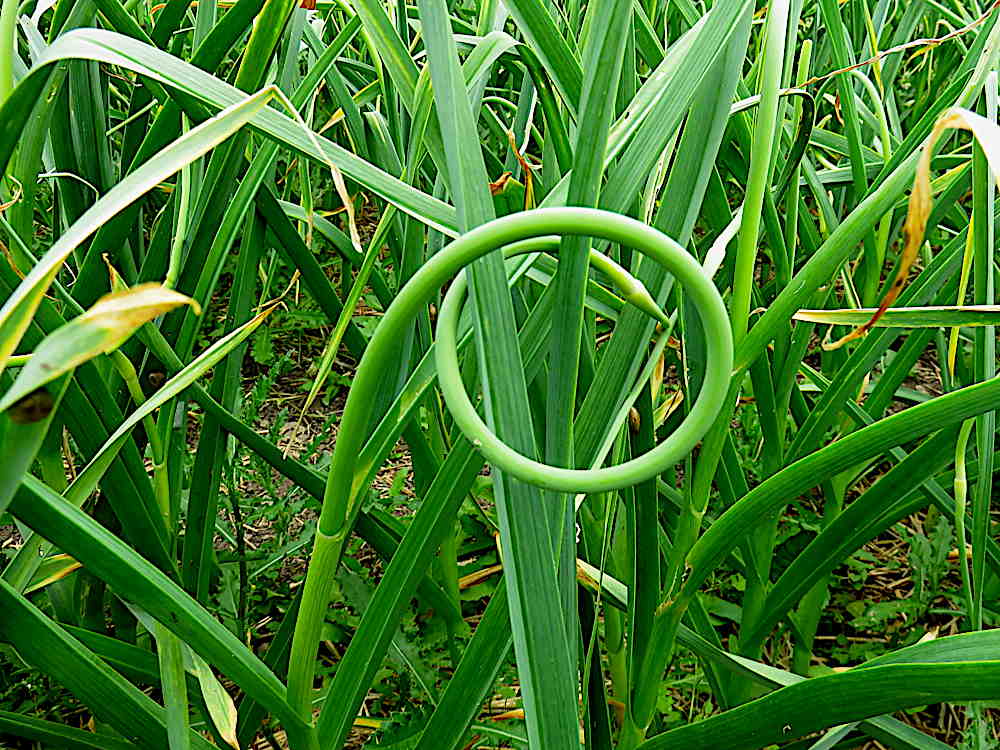
Here we are, a week after leek moths invaded the garlic, gazing at a healthy scape. If you’re not familiar, scapes are the curling tips that emerge as the garlic gets close to harvest. They’re also clearly a favorite target of the moth larvae: they chew their way in and start tunneling down. All of the attacked scapes had to be snapped off, right as they were emerging. Happily, many also survived. Snipped when tender—they get woody if left too long—scapes are filled with a full, delicious garlic flavor, a preview of the garlic to come. Let your imagination decide how to use them! (It’s also said that removing the scapes directs more plant energy to making the bulbs bigger, though I haven’t seen that for myself.) As for the bulbs and the leek moths, this is my first encounter, so we’ll only know for sure if all that hand-picking and scape snipping worked when the garlic comes out next month.