
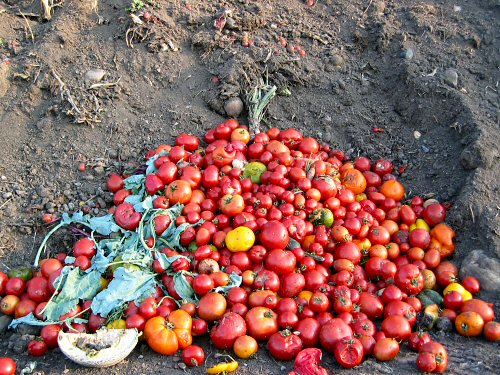
It’s not the waste it seems! At a distance, they may look whole, but they’re not. Most of this 100lbs (45kg) of tomatoes are well split or explosively squishy and really not worth reclaiming as gallons of sauce. Given the delicate nature of heirlooms, and the pumping up with moisture from the recent rains, split toms are an unfortunate fact of garden life. For this harvest, we got maybe three good ones for every reject. Not bad. Then, we made every attempt to find the unfortunate ones homes, selling off and even giving away big bags towards the end of the market day. At the house, putting up sauce is already ongoing, and there will be at least a couple of hundred pounds more available for canning around frost. There’s just nothing else I can think of to do with these! And so, to the compost heap…
Fieldwork
Chives-level view
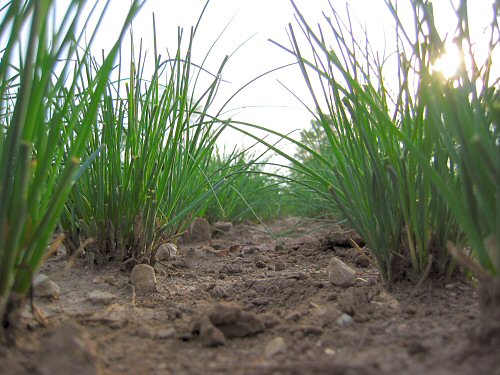
Chives are great. Usually considered a herb, and like many other herbs, chives are extremely low maintenance, compact, prolific, and never fail to please the senses. Cut them and they come back quick. What more could you ask for in the busy veggie garden?! The herbs section this year is serving mainly as a nursery for new crops (tarragon, lovage, a new variety of rosemary) and perennial holding spot, all for future herb production. It would be great to harvest a nice selection every week, but you also need enough of a market to justify the time spent snipping and bundling, and once you start, you have to keep it up: consistency generates word of mouth! And it turns out that most of the 50+ shareholders are picking up off-farm (mainly at the farmers’ market), else they could help themselves. So full tilt herb production is waiting on other things to move ahead. Meanwhile, no waste. Chives, along with curly and flat-leaf parsley, are occasionally making it into CSA shares. And there’s always…personal use!
Oats
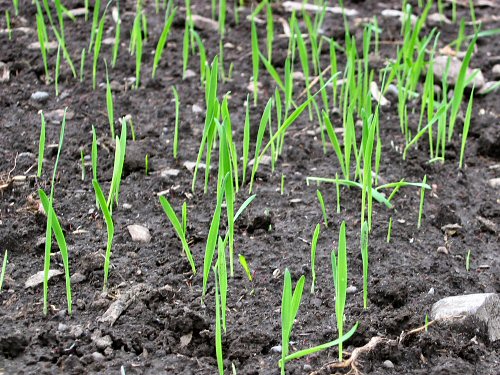
Promptly the day after the first rain in a while, OATS is surging up. Actually, strips of oats in one section planted a few days ago are appearing, the rest to hopefully follow just as vigorously. Oats anywhere but in a breakfast cereal bowl is a first for me. As a fall green manure cover crop, it’s an all new growing experience—if I didn’t know where this had come from, it’d look like an alarmingly healthy new weed attack…but it’s not. A couple of days ago, we seeded most of the open sections with an Earthway broadcast seeder (a simple, fun contraption, a bag with a shoulder strap that flings seed far and wide as you walk along turning the crank). In most sections, I used the rototiller on the Kubota compact tractor to till in the seed, skimming the surface in order to bury the seed no more than an inch or two. A couple of sections were raked so that the oats was lightly covered. In a couple more, the seed was left on the surface, a potential bird buffet. We’ll see what happens! Without the recent rain (we got another 1″/25mm today!), this wouldn’t have had much of a chance (oats needs to germinate by the end of August around here if it’s to get any growth on before winter kill)—we lucked out. So far, I’m liking oats!!
Japan to the field!
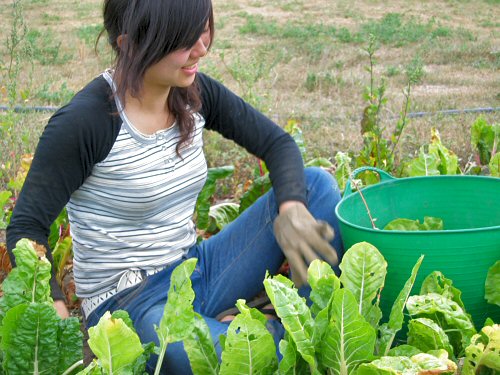
On her last day of a week that flew by, Mami, WWOOFing from Japan, works to rejuvenate a bed of Swiss chard battered by the drought. Despite a fairly formidable language barrier, there was much conversation and laughter about life, times, Hollywood movies, smoking laser printers, the apparently grave state of the world…the usual field chatting fare! For no one reason I can put a finger on, it was an energizing bit of cultural exchange, and a lot of extra fieldwork got done as well. Through this blog, tiny farming has become for me kinda…transnational, and Mami’s visit made that feeling even more real (the ClustrMap comes alive!). It’s really all about People in the Field!!
Pigweed piled high
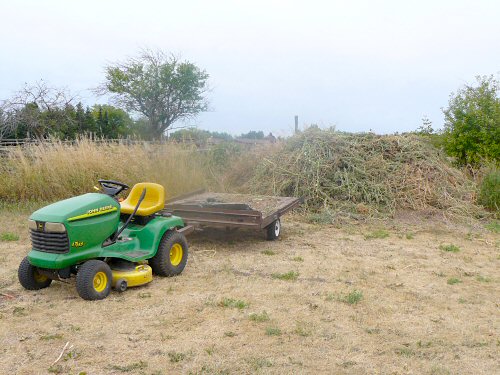
A vast repository of uprooted pigweed is collecting by the wagon load in the southwest corner of the field. It’s crazy the amount of effort that’s been put into pigweed pulling this year, that in addition to hoeing and tilling in younger specimens. The pigweed pile has already achieved almost surreal dimensions and a fascination all its own. I stop and gaze at it on the way by… What can I say? PIGWEED!!!!! Guest photo by Mami.
Harvest board
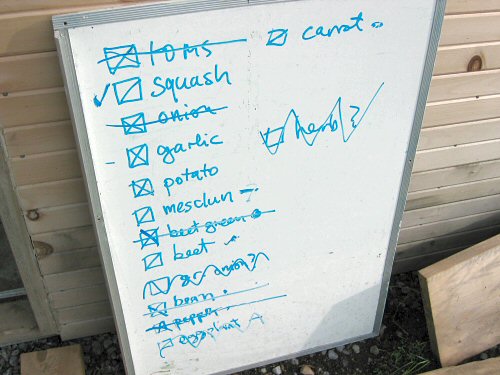
At some point on Thursday evening or Friday morning, I print out the harvest list on, of all things, a dry erase whiteboard! The last time I saw these things in action, they were lining walls floor to ceiling in trendily makeshift loft-style offices in big cities during the original dotcom frenzy. Then, they were covered with all kinds of wild brainstorming notes and diagrams for generally harebrained Web schemes. Now, it turns out they’re also perfect for listing veggies ready to be harvested. They’re fun to write on, quite impervious to a little runaway rinse water, and when it’s all over, easy to wipe clean with a damp cloth and start again! On busy harvest Fridays this year, the harvest board’s been the main way to stay on track, a step larger than the index card in an overall pocket that I used to use when harvesting on my own. Without a list of some sort, it’s amazing how you can forget an entire crop when racing against sundown. And there’s a little markup system: X in the box means harvested (half an X means maybe need more), a strikethrough line means fully sorted, rinsed, bunched or bagged, and counted. A simple and effective tiny farming tool, although a classic chalkboard would do as well!
Pigweeding and local food

In the foreground, a pigweeding throwdown with the crew of the day: Eoghan and Alison (trying out a little tiny farming for the first time), Jo, Mami (our second WWOOFer, also from Japan), Conall. Everyone pull! (The most alarming giant pigweed specimens had already been ERADICATED by the time this photo was taken!) In the background, a house on the subdivision to the east of the garden field (it was severed from the farm years ago), home of our nearest CSA member. Their veggie farm for the season is literally a stone’s throw away—local food doesn’t get closer than that!