Garden in transition

Garden in transition

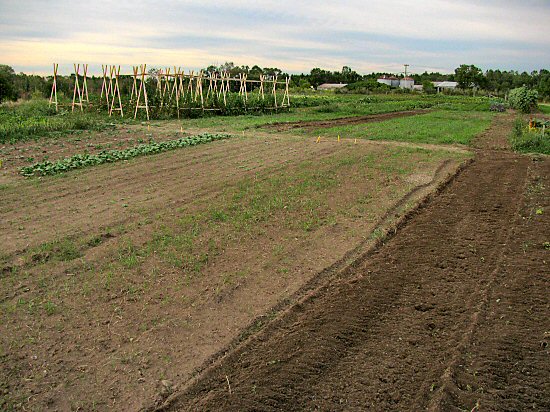
The weather is warm, the days still feel long (although, at 5:00 a.m. for Saturday market, I’m already waking up in the dark)—summer is in full effect, but you know the season’s soon changing because the field is clearing out. Today, I did some tilling, cleaning up before weeds get too established, and preparing for a last seeding of spinach for fall harvest (a gamble, for sure).

In the pic, a couple more passes to the left of the freshly turned strip and we’ll be at the edge of the previous spinach planting, barely visible, seeded about 3 weeks ago. To the left of that, a half-bed of bok choi, delicious and miraculously untouched by flea beetles, at tiny baby stage from seedlings transplanted at the beginning of the month. Beside the bok choi, beds of broccoli and cauliflower, also set out 4 weeks ago, and looking pretty good for harvest in October.

This section was planted out at the start of the season to snap peas, lettuce, and the first spinach. After adding in some of the handy pelletized alfalfa, it gets to go round again!

In the next section (top right of the photo, which is…east), I’ve started tilling in an overgrowth of grass and vetch, where more peas and the first plot of potatoes used to be. That section is done for the year, and may get a protective cover of fall rye, as a green manure to be turned under in spring.

In the market garden, it’s always one thing after another… :)
At the wheel

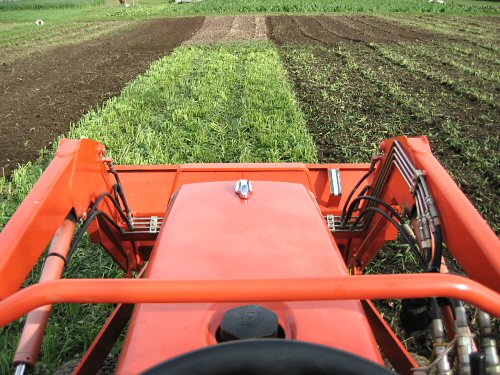
Tilling in the monster oats green manure/cover crop is a task where the Kubota compact tractor sure comes in handy. The oats is tall, dense and seemingly unstoppable by cold. It took a double mowing to get it down to a manageable state, and even then, it’s a slow till. The walking rototiller could’ve gotten the job done as well, but it would’ve taken several passes and a couple of tanks of gas, so I was happy to be at the wheel for this one. Originally, the plan was to let the oats winter kill, and work it in in the spring, but there’s just so much of it, I decided to take it out now rather than lose an extra week or two next year, waiting for it to break down. Decisions!

Autumn harvest action!

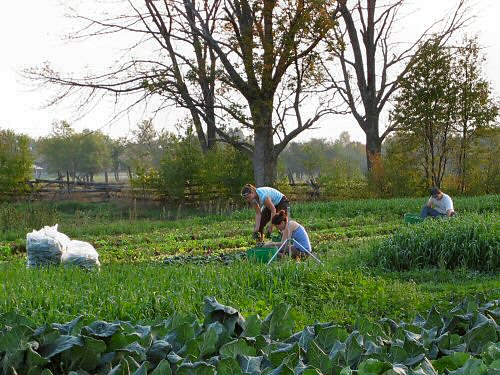
A steady harvest through a warm, hazy afternoon wound up quite early, with just about everything sorted, rinsed and bunched or bagged by around 8:30 pm. Smooth! The end-of-season crew has settled down to Jo, Lynn, Conall and me. Here, Jo and Lynn are harvesting a sparsely germinated but bountiful spinach patch (the second growth leaves are HUGE, fleshy, tasty and tender), while Conall cuts all-lettuce mesclun on the Greens Machine. When not snapping pics, I’m bunching kale in the last stand of brassicas. Filling in between the veggies, lush expanses of oats. In front of Lynn, a sprinkler from the last days of irrigation. The large clear leaf bags are used once for greens harvest, then saved for collecting mulch, or at least, trash. All is in order… It flashed through my mind how over the course of a few short weeks, everyone who came regularly to work in the field started with, in most cases, no experience, and casually transformed into a cheerful, efficient crew. Tiny farming must come naturally!

Rye arrives!

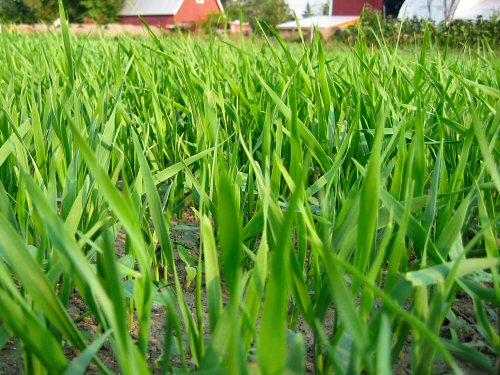
Where the oats arrived with a dramatic, iridescent splash of green, the fall rye made a much more sedate entrance, so much so that I didn’t notice it until today. It probably emerged a couple of days ago. It’s looking great! I dunno why I’m so extremely pleased by these green manure cover crops…but I am! The rye comes with a lot of promise. It probably won’t winterkill, instead, start up again in spring, making it good for sections that won’t be planted out till May. It thrives in cool weather, also making it great for fall and spring service. And it may have an allelopathic effect on PIGWEED, meaning that, on a plant-produced chemical level, future pigweed may suffer… That’s nice. On the caution side, if it gets too well-established, it could be a little tough to eradicate. No worries. I won’t seed it on sections that’ll be used for the earliest spring planting (there won’t be time to till it in), but otherwise, I’ll spread this around everywhere I can for the next month or so and see what happens!

Trying fall rye

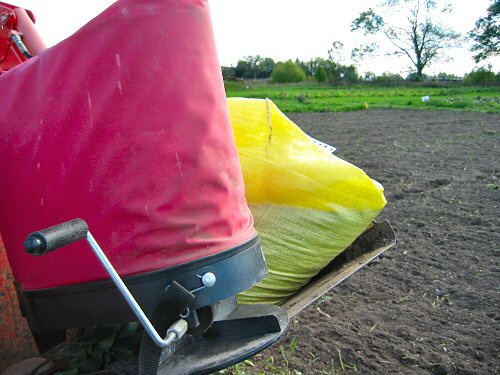
With the oats experiment going good all around the field, it’s time for experimental green manure-cover crop #2, fall rye (starts and grows well in cool weather). Reading about cover crops online, I found one apparently popular method for seeding ’em is…”airplane”. I use the more down-to-earth Earthway broadcast seeder, which works like one of those hand-held lawn seeders, except there’s a big zippered bag and shoulder strap instead of the handgrip and little funnel. You fill up the bag, sling it over your shoulder, and then, in one smooth movement—limbs, synchronize!—turn the crank with your right hand, slide open the seed hole (with a little spring-loaded lever) with your left, and start walking (I go forward). The seed streams out of the aperture at the bottom of the bag, onto a rotating plate with dividers that flings the seed a little over 180° in front of you. The combination of seed hole size (determined by how far back you pull the lever), and the cranking and walking speeds determine the coverage. Seed is spread maybe 5′-7′ (1.5-2.1m) on either side. Open the seed hole aperture too much and you’ll drain the bag in no time at all—heavy coverage. It’s not at all difficult, you can be broadcasting seed in minutes, but still, a little bit of a trick!

Oats vs pigweed!

The cover crop-smother crop-green manure oats is doing rather well! Strolling by the several sections checkerboarded through the field is one of my newfound small fall pleasures. It’s so vigorous and vibrant and…vigorous… In different sections, you can also see pigweed and round-leaf mallow in mad profusion, but low to the ground, towered over by the tall, slender stalks (you can spot some pigweed in the pic, but I gotta admit, I chose a shot that favors the pretty oats! :). Question is, will the oats actually SMOTHER its weed competition. I can hardly imagine the near unstoppable pigweed just giving up. And mallow is no lightweight in the pernicious weed department, either. So, WE SHALL SEE!

Oats

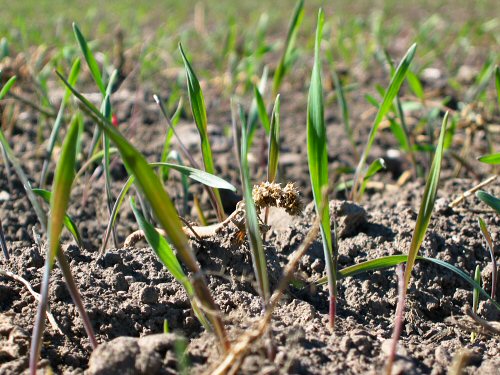
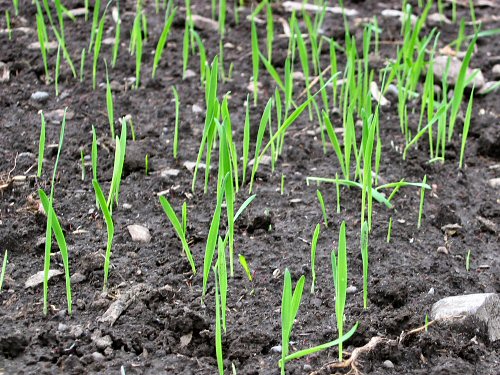
Promptly the day after the first rain in a while, OATS is surging up. Actually, strips of oats in one section planted a few days ago are appearing, the rest to hopefully follow just as vigorously. Oats anywhere but in a breakfast cereal bowl is a first for me. As a fall green manure cover crop, it’s an all new growing experience—if I didn’t know where this had come from, it’d look like an alarmingly healthy new weed attack…but it’s not. A couple of days ago, we seeded most of the open sections with an Earthway broadcast seeder (a simple, fun contraption, a bag with a shoulder strap that flings seed far and wide as you walk along turning the crank). In most sections, I used the rototiller on the Kubota compact tractor to till in the seed, skimming the surface in order to bury the seed no more than an inch or two. A couple of sections were raked so that the oats was lightly covered. In a couple more, the seed was left on the surface, a potential bird buffet. We’ll see what happens! Without the recent rain (we got another 1″/25mm today!), this wouldn’t have had much of a chance (oats needs to germinate by the end of August around here if it’s to get any growth on before winter kill)—we lucked out. So far, I’m liking oats!!