
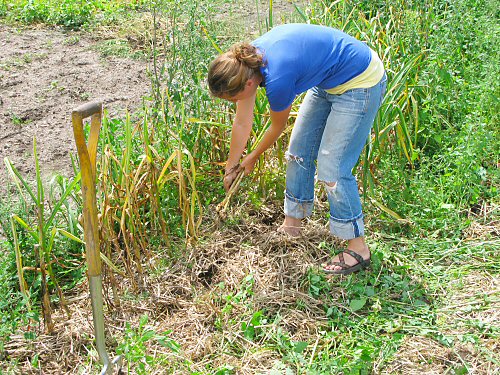
Harvested in three parts over the last week, the garlic is now all in! This crop seems to’ve done well once again (I LOVE growing garlic!). For the first time, there’s a small pile of damaged goods, water-logged from all the rain. But overall, things are looking good. The combination of oat straw (from last fall’s cover crop) and grass mulch worked great (below)—weeds were kept down, and although the paths weren’t as heavily mulched as around the plants, they weren’t bad. We’ve been having trouble starting the riding mower, which means no trailer, so the tractor bucket took its place for transport duties. The garlic is stacked on pallets in the barn. Lynn seems to’ve taken to garlic harvesting and went to town: fork and pull, fork and pull…around 3,000 garlic bulbs hit the local food chain!
oats

Field wakes up…
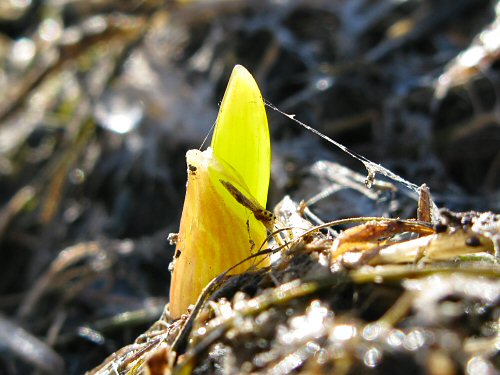
There’s a kind of magical moment between winter and spring, as the snow rapidly disappears and the water runs off. It lasts only a couple of days. Unusual sights are everywhere you look. I watch it closely every year, but this time around, with the blog-and-camera habit by now well-ingrained, I’m appreciating it more. I found garlic earlier than ever, only a few hours after emerging from months buried under snow with little or no light. The color is odd, I’m used to GREEN, but they look healthy, so I guess they need some sunlight to put on a little color. At the lower, south end of the field, the melting snow runoff gathers in a giant puddle, 40 or 50 feet (12-15m) across at its widest, and a few inches deep. This field has good drainage, so the puddle doesn’t stick around long, shrinking by the hour and vanishing entirely within two or three days. This year, the residue of the oats cover crop added a bit of a surreal dimension, as a bleached gold beach, and wavy underwater like seaweed. When you focus tightly and think miniature (like a kid would!), it’s a crazy little inland sea-for-a-day… All over, the little details of melt-off, looked at up close, are entirely odd and gone soon…
All clear…
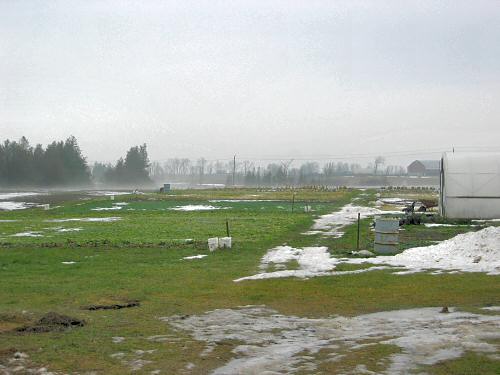
After a night of rain and 50°F (10°C) warmth, the field is just about clear. What a difference a couple of days can make… I took a walk. The ground isn’t even frozen—with the odd way all that snow came before a real cooling down period, the ground was insulated by the snow and didn’t freeze too deeply. It’s quite strange. Usually, during the March end-of-winter melt-off, the clayey soil is wet, sticky, mucky, sucking, and the drainage is slower as the frozen ground thaws out, but now, some areas are dry enough to till! The scene also looks quite differen—greener!—than in previous years, because I’ve left a lot of cover crops (oats, bit of rye), and there were quite of few beds of late harvest veggies caught in the first snow. There’s potentially good stuff out there: huge carrots, beets, spinach. They may be too cold-damaged to be worth a harvest, I’ll check ’em out tomorrow. And the unmulched garlic is doing fine!
Cleaning up
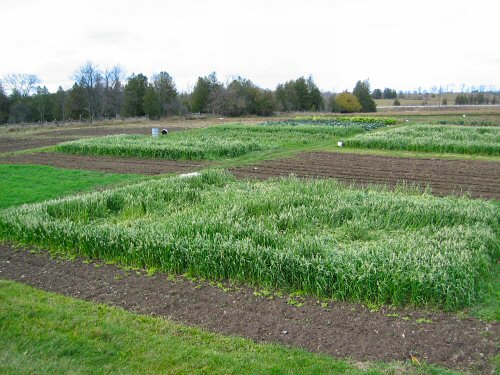
Here’s a look to the north from my new favorite photo spot, on top of the farm stand. We’re down to mainly brassicas, oats and rye (that’s the low, darker green section poking in on the left). The oats has started to die off and topple over, leaving collapsed areas that look as if animals had bedded down… The days lately have mainly been overcast and quite cold, just above 0°F, with a fair bit of rain that leaves the ground mucky. My hours a day spent in the field are winding down, a two or three hour job at a time, weather permitting. Elsewhere, there’s lots of putting in order and stowing away, and clean-up in the Extended Milkhouse where all kinds of junk accumulates over the year. Getting set for winter.
Turn to the left and here’s the view over the greenhouse. The grass-alfalfa mulch is still inside, along with stacked rolls of row cover.
More fall finishing
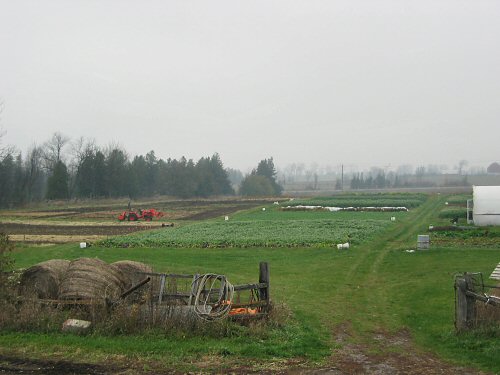
Fall clean-up is moving along bit by bit between the weather. Half the field is cleared, fertilized, and tilled or about to be. The rest is mostly covered by oats and a little rye. The Kubota compact tractor is ready to take up where it was stopped yesterday by the broken rototiller chain. At this point, I have an hour or so before the rain…
At the wheel
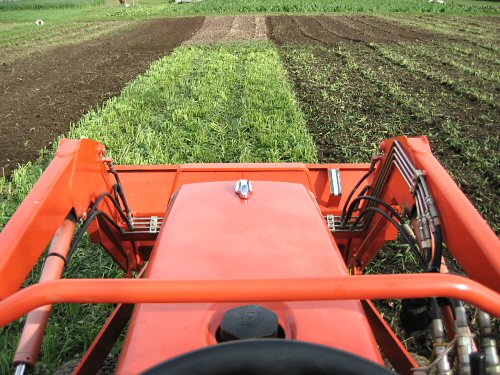
Tilling in the monster oats green manure/cover crop is a task where the Kubota compact tractor sure comes in handy. The oats is tall, dense and seemingly unstoppable by cold. It took a double mowing to get it down to a manageable state, and even then, it’s a slow till. The walking rototiller could’ve gotten the job done as well, but it would’ve taken several passes and a couple of tanks of gas, so I was happy to be at the wheel for this one. Originally, the plan was to let the oats winter kill, and work it in in the spring, but there’s just so much of it, I decided to take it out now rather than lose an extra week or two next year, waiting for it to break down. Decisions!
Killing frost, kinda
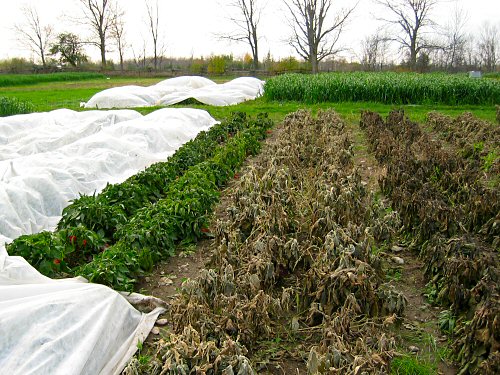
Yes, the weather’s crazy. According to the min/max thermometer outside the greenhouse, last night’s low was a chilly 18°F (-8°C), cold enough to kill off all but the hardiest. Finally, and only six weeks or so late—the endless autumn harvest is interesting, great for personal use veggies, but otherwise, it mainly throws off the fall clean-up schedule (I haven’t changed zones, have I?!). Here, the eggplant is clearly toasted, while the peppers, which had been under fairly light row cover (I pulled it back today to harvest some), came through in relatively fine shape . And the oats, well, it’s a monster, lush and green and if not exactly growing anymore, it seems to be getting thicker. It’s fascinating the way cold works in the field. Wind, cloud cover, mini-windbreaks, slight elevation, all kinds of factors add up differently in spots only a few feet apart to determine life or death by cold. Anyhow, can’t wait around forever. I’m soon going to roll up the row cover and till it all down!