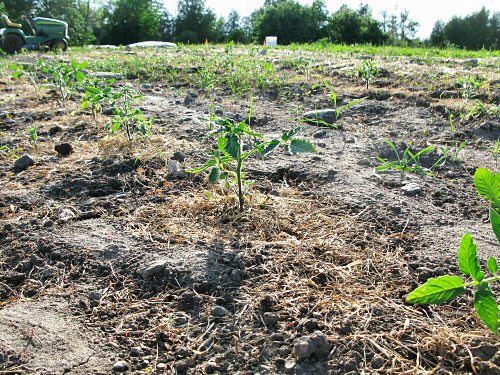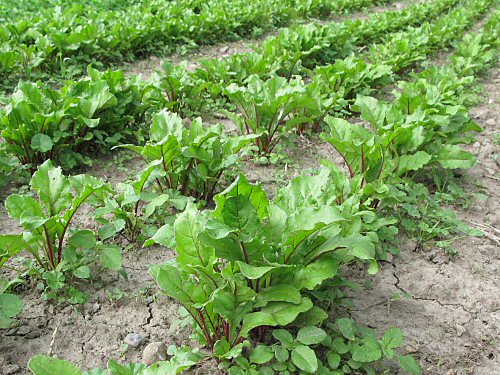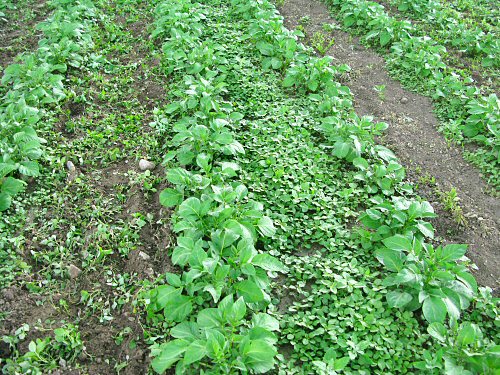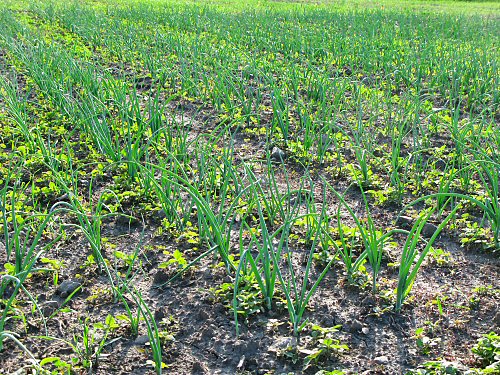
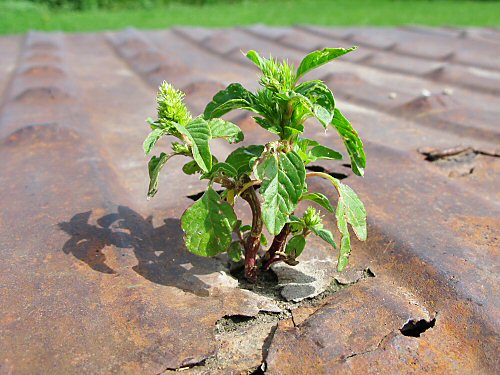
Weeded with the wheel hoe and hoop hoe, the onions looked impressively clear just six days ago, but after a few days of heat and moisture, the tiny weeds that were left shot up to the point where it’s time to do it all over again. Pigweed and lamb’s quarters, along with outbreaks of grass, are working to take over. It may look like a lot was missed. but weeding intensity depends on the crop. With onions, weeds tend to cluster close to the stems, so it usually seems easier to work more quickly and come back again, than spend double or triple the initial time, getting painstakingly close all around each plant (that’s how it seems, maybe not!). With the first section of tomatoes (below), things aren’t so advanced on the weed front, but there’s more grass in this area, and it’s still hard to see the crops in the general green haze of unwanted stuff growing. Hopefully, there will be enough grass mulch ready soon so we can extend the coverage between plants, and then onto the paths. This battle against weeds is the big one. All across the garden, both the veggies and what’s growing with them are at different stages, and require different weeding approaches. Typically, if you’re not using herbicides, tractor cultivation is the quickest way to keep the majority of the weed population down by working between rows. Even then, in-row weeding (between the plants) is still a hand job. It’s a LOT of work, and every few days that a section is not handled, the amount of work required increases as the weeds grow bigger and harder to kill. In a smaller market garden like this, with relatively short 50′ (15m) beds, the tractor is not an option; hand tools and methods rule. The idea is not to keep up this battle year in year out, but to progressively work smarter to reduce the load, through better timing and various techniques: mulching is the most obvious one, but there are lots of things to try. It’s not overnight, but things do improve as you go…!
Pests & Disease
Row cover everywhere
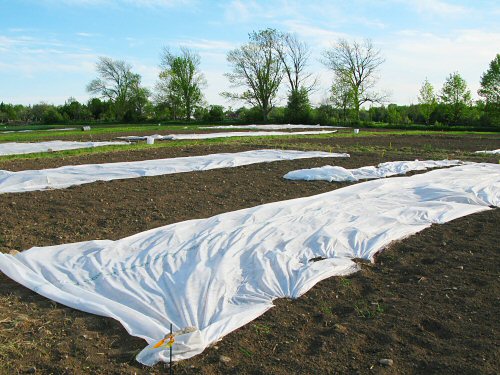
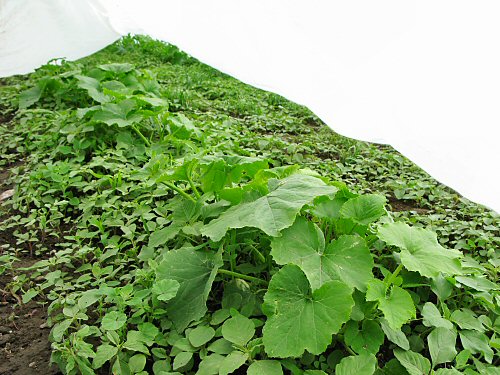
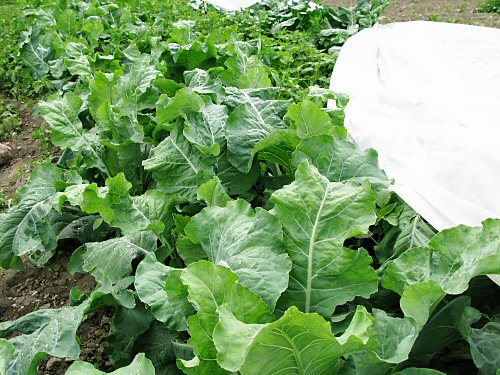
It was impossible to capture all the floating row cover outposts scattered around the feel in just one shot. This pic shows maybe a third of the area under the light, white, spunbond polyester protection. Right now, it’s being used as protection from two separate things: frost and bugs. Let’s see, it’s on all the cucurbits (so far, that’s cucumber, summer and winter squash, and pumpkin) to protect from the cold and striped cucumber beetles, on tomatoes against cold (and coming off in a few days), on the brassicas (broccoli, cauliflower, and the like) against ravaging flea beetles but not the cold (coming off when the plants are fairly big and can withstand the FBs). I’ve used row cover from Year 1, far as I can remember (there are NOTES and even pics…somewhere). Initially, I really didn’t like it, it looked so…unearthy, synthetic,…not part of the garden. BUT, the alternatives, like planting later, ending harvest earlier in fall, temporary wind breaks and cold air channels, trap crops, and all sorts of complex interplanting (so one crop protects another), encouraging beneficial insects, more elaborate timing (basically, closer second guessing of insect cycles and the weather), not to mention a completely adapted, semi-permaculture set-up where everything is at home no matter what, were all way out of what I could handle as I dove into tiny farming with the intention of heading to the farmers’ market in the first season. Floating row cover lets me extend the season by at least a couple of weeks at each and, and I can avoid all pesticides (and there are some killer insecticides allowed even in certified organics) and a lot of bug grief (stemming from lots of LOSS). I still don’t really LIKE row cover, though, the way I like, say, my Sneeboer three-tine cultivator or even the Horse rototiller (I can understand how the Horse is built, get if fixed, or do without). More and more lately, I wonder when FRC will become insanely expensive, or real scarce, or just plain run out… It’s as oil-based as they come, and kind of in a high tech product class of its own. This year, in a small fit of…paranoia (?), I actually ordered a new 1,000’x14′ (300mx4.3m) roll, even though I have enough for this season at least. It’s not much of a stockpile, but, carefully managed, it could get me through 3-4 more years along with what’s on hand, at this tiny farming scale… Oh, well, the more you know, the less you need is what I believe. I’m learning as I go. Keep farming long enough, and I’m sure I’ll get beyond the cover if it doesn’t run out on me first…! :)
Submerged garlic and root-diving voles
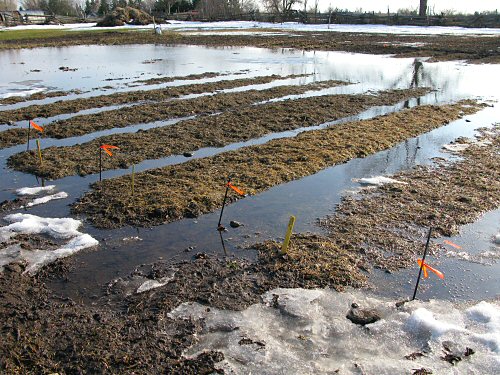
For all of the melt-off’s magical moments—garlic tips emerging and big puddles that look like tiny seas—there are mild melt-off concerns as well. About one third of the garlic beds have been fully submerged for nearly two days now, and may stay that way for 2-3-4 more, especially if it rains tomorrow as promised. (This area usually doesn’t get flooded with runoff, but I should’ve paid attention to the natural gully and not rotated the garlic there, just in case.) I doubt being underwater for a while will affect the garlic, but I don’t know for sure… How long garlic can hold its breath is another thing I’ll soon find out! And elsewhere, I discovered the handiwork of VOLES (it had to be them) in the herb patch. Under cover of snow, they’d neatly excavated 25′ feet of parsley roots, methodically working their way down the double row. These aren’t tunnels, just holes that go down about a hand’s length. Interesting. Another first. And no loss. But could this be population explosion year in the local vole cycle? Last year’s spring lettuce raids in the greenhouse were nothing compared to organized action like this… Good thing they don’t like garlic!
Tea and fungi
Chamomile tea prevents damping off—I’m a believer! It’s one of those natural but-do-they-really-work remedies, used where more product-minded folks would fork over a few bucks for a bottle of No-Damp fungicide… I brew up a batch of tea, dilute it by eye to a pale gold, and apply every couple of days with a fine-misting spray bottle. I’m pretty casual about the recipe, and keep spraying until the seedlings are established (that’s my method, there are more precise instructions around as well, search online).
Damping off is the name for a bunch of different fungal infections that can hit seedlings in trays with similar effect. In my encounters, the damage appears right below the soil line, strangling the stem just out of sight. Dig up a stricken seedling and there’s a small section of the stem, all pale and shriveling to nothing, while above and below, all looks well (the symptom’s called “wire stem”). It’s pretty shocking to see in action. One minute, your seedlings are looking all perky, and then you touch one…and it topples over! Whooaa!
Up to a couple of years back, I’d lose a few seedlings, usually PEPPERS for some reason, never anything major, parts of a tray or two, but enough to be scary. I seed-start in soilless mix (so it should be disease free), trays and tools are given a good disinfection at the beginning of the season, there’s always plenty of air circulation, and I make sure the soil surface doesn’t stay wet—all the things these soil-borne fungi don’t like. Still, damping off was sneaking in, until chamomile tea spray came along… Coincidence?
And now for something completely different…
Looking through photos on the computer today, on a rainy afternoon after the farmers’ market, I ran into this one. I’d saved it from somewhere on the Web three or four years back (public domain, I think). It’s a striking shot, although whether it’s advertising safe pesticide handling or the scariness of chemical agriculture, I’m not sure. And, hey, that could be me, all dressed up and getting ready to go—you’re never too tiny to do some spraying! I looked up the pictured product, Monsanto Lasso. It is, or was until recently, the biggest selling agricultural herbicide in the US, used “everywhere” on corn and soybeans. It’s also a “known or probable carcinogen” and apparently messes with human reproductive and developmental functions as well. Hmmm… Luckily, I use a wheel hoe…
Oats vs pigweed!
The cover crop-smother crop-green manure oats is doing rather well! Strolling by the several sections checkerboarded through the field is one of my newfound small fall pleasures. It’s so vigorous and vibrant and…vigorous… In different sections, you can also see pigweed and round-leaf mallow in mad profusion, but low to the ground, towered over by the tall, slender stalks (you can spot some pigweed in the pic, but I gotta admit, I chose a shot that favors the pretty oats! :). Question is, will the oats actually SMOTHER its weed competition. I can hardly imagine the near unstoppable pigweed just giving up. And mallow is no lightweight in the pernicious weed department, either. So, WE SHALL SEE!
Pigweed piled high
A vast repository of uprooted pigweed is collecting by the wagon load in the southwest corner of the field. It’s crazy the amount of effort that’s been put into pigweed pulling this year, that in addition to hoeing and tilling in younger specimens. The pigweed pile has already achieved almost surreal dimensions and a fascination all its own. I stop and gaze at it on the way by… What can I say? PIGWEED!!!!! Guest photo by Mami.