Grass vs moldboard

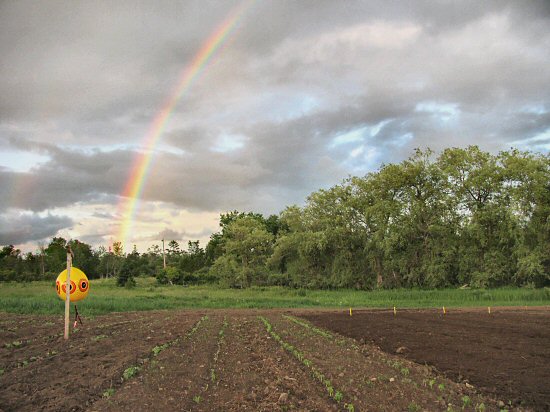
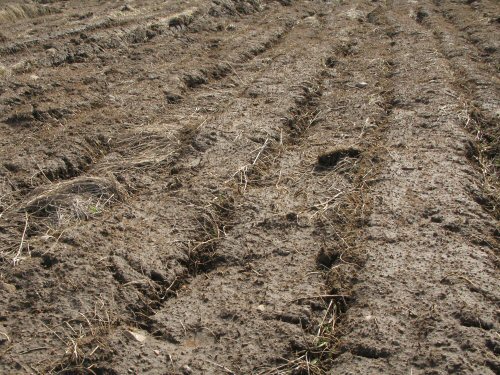
The hay fields were plowed late November, the sod sliced and flipped over by the moldboard, burying the grass so it gets no sun and exposing the severed roots to winterkill. A quick, bold, chemical-free first step in preparing a large clearing for crops. In the couple of  garden sections I’ve started like this, it’s been quite effective, but given the slightest break, the grass is ready to come back…

Moldboard plowing—peeling back the land—is usually big-tractor work these days. It takes a lot of energy. If you happen to of soil as a complex living web, an intricately choreographed dance of life taking place mainly in the top 6″ (15cm) or so—sounds good to me!—one look tells you that moldboarding is pretty intense and destructive. Done excessively, with big, modern machines, it is a proven soil killer, encouraging erosion and other unhelpful things. For the tiny farm, this is a one-time-only deal, to start off a new garden area. It’s just the beginning…

Pumpkins and pigweed

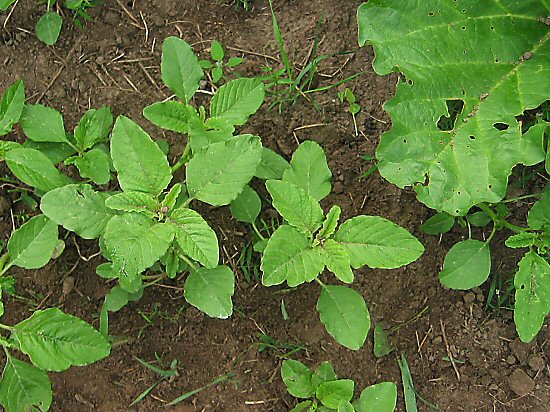
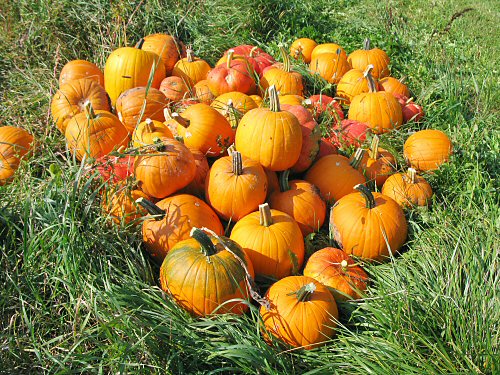
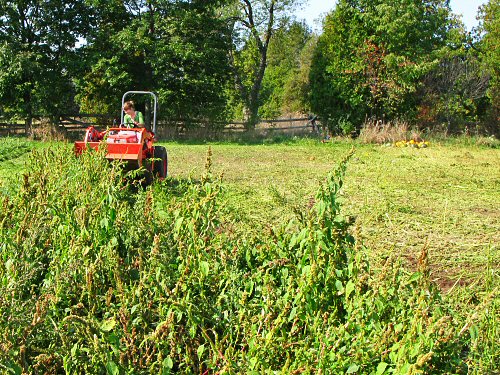
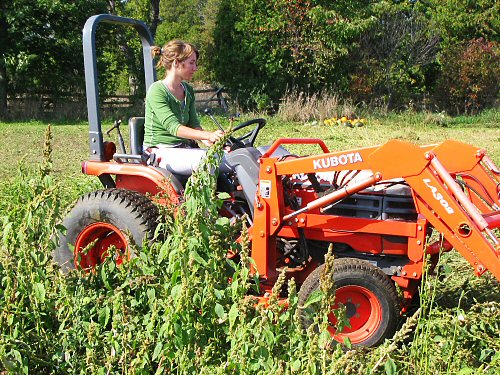
Today, the pumpkins came in, wrested from a jungle of pigweed gone wild. Every year, a few of the 40 50’x50′ sections that make up the 2.5 acre garden get a little overrun with one weed or another (usually, pigweed). This year’s pumpkin patch was a good example, with pigweed growing unchecked for a good six weeks—no time made to weed, not IMPORTANT enough a crop—until today, when Raechelle used the belly-mounted 52″ mower deck on the Kubota compact tractor to mow it down!

Of course, this is exactly what you DON’T EVER DO in a garden: allow weeds to flourish and go to seed, then mow them down, broadcasting seed everywhere… Oh, well. The alternative, pulling the pigweed by hand, then carting it off, we also do when necessary—see the Pigweed Mountain—but once in a while, I go for the instant gratification of seeing a section clean and clear in an hour or two. The millions of pigweed seeds, ensuring healthy future generations for years to come, will be dealt with…later. (As long as we weed on time next time around, how bad can it get?! :) Anyhow, it’s all part of the grand experiment! Guest pumpkin photo by Lynn.

After the row cover: weeding!

Weeding after row cover

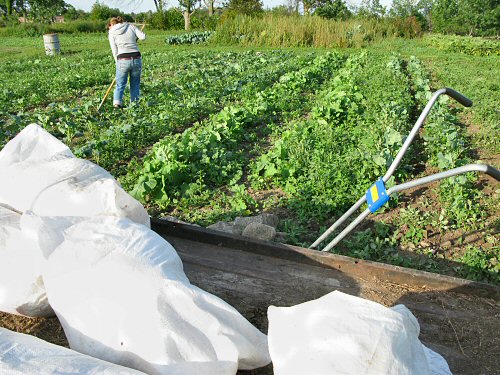
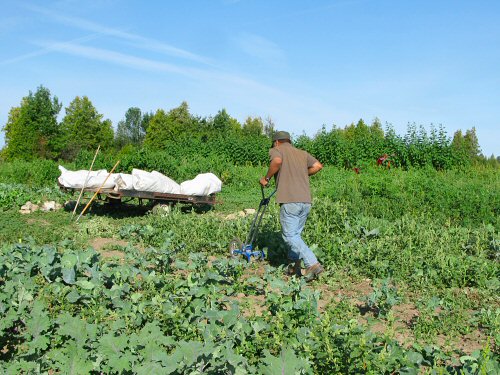
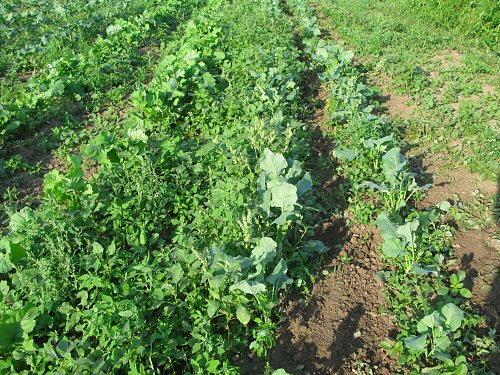
It’s been about six weeks, time to permanently remove the row cover from the last transplanting of fall brassicas! There are two sections, about 20 x 50′ beds in all, with broccoli, caulflower, cabbage, collards, kale. The cover protected against flea beetles, and at this point in the season, the FBs aren’t around much. Which leaves the post-cover weeding! I generally plan to remove the cover earlier, weed, and then replace it quickly, but this seldom seems to happen. Instead, it’s one big weed-a-thon at the end… Here, the mainly pigweed looks fairly big and dense, but it’s actually not much of a problem. The row cover has protected the ground from many days soil-packing rain, so the beds are nice and loose (it’s amazing how much rain can compact clayey soil).  Weeds come out easy! With two people, it’s a relatively quick job, 2-3 hours for a pretty thorough clean-up. We worked with a combination of hoe and wheel hoe, me doing the paths and between-row clearing, and Lynn hand hoeing in-row, between the plants spaced at 18″ (45cm)…

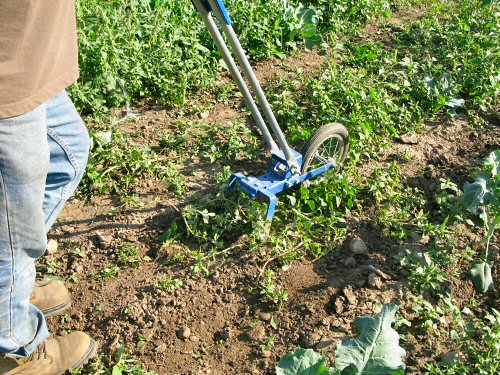
Each time I use the wheel hoe, I grow to love it that much more. So easy, so TIME-SAVING! It’s such a sophisticated yet simple tool, a perfect marriage of wheel, leverage and steel (you could say! :)… Today’s job is heavier work than it’s usually used for, the weeds aren’t just emerging, they’re pretty big. Rather than rolling the wheel hoe continuously down the rows, I’m cutting the weeds with a series of forward and backward strokes that either slice the plants below the surface, or pull them out, roots and all…

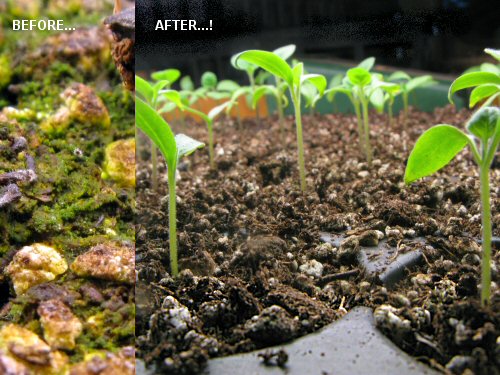
Clearing a path (before and after, above) in the loose soil takes maybe 3 minutes for 50′, many times faster than hoeing or hand pulling…

For this heavier weeding work, I use a fairly forceful forward stroke that travels about 1-1.5′ (30-45cm), then raise the blade to clear the felled weeds as I step forward to start the next bit…

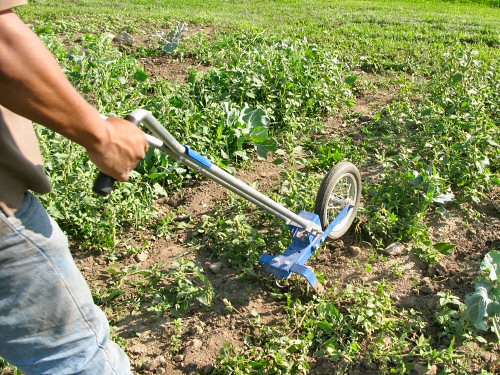
The wheel hoe is equally good at cutting on a backstroke, which comes in handy for dense areas and tough specimens… It’s not particularly strenuous work: the blade is sharp, the wheel and angle of the handles give lots of leverage and momentum, and some part of the hoe is always in contact with the ground, so you’re never completely lifting the whole tool. Like most things I do here in the field, I’ve figured out how to use the wheel hoe on my own, by reading instructions, looking at pictures and applying my version of common sense. Techniques no doubt vary. It’ll be interesting to eventually see how others do things! Meanwhile, everything seems to work out…especially, the wheel hoe! (Wheel hoe action photos by Lynn)

Pigweed rehabilitated?

You’ve gotta respect pigweed. It’s resourceful, extremely flexible and adaptable, prolific…it just keeps on coming! It’s managed to grow in tiny dirt deposits, through rust holes in the trailer we use to get things around the field. It’s also run wild in one of the potato sections, where we’ve taken to hand-pulling it in one-hour concentrated weeding missions—it comes out by the trailerload…

The strangest development is that, this season, pigweed seems to be turning into a FOOD, a gourmet crop, even. Going down the lambs’ quarters urban trendiness path, I suppose. I started to hear about it from a couple of people, that it was being sold in Toronto (big city) farmers’ markets. There was even a comment here on the blog… Finally, browsing the web site of a farm not so far from here a couple of days ago, I read how they harvest PIGWEED at 12″ (30cm) and sell it as a tasty and nutritious cooking green…and they named it: Amaranthus retroflexus. Wow. Pigweed is the common name for a couple of varieties of amaranth, retroflexus being one of ’em. I’ve learned a fair bit about amaranth over the last few seasons, and there’s lots to like. There are many varieties and four general classes: vegetable (eat the leaves), decorative (the seed heads make colorful filler for cut flower arrangements), grain (more protein than wheat!), and…the WEED. Yes, I know a weed is only what you make of it, and it’s great to discover that we can EAT a plant rather than destroy it…but after all our hard-fought pigweed battles, this is hard to swallow. I CAN’T IMAGINE harvesting pigweed (that is, the weed varieties of amaranth) as a market crop. I mean, it would take some getting used to. And could I find a wholesale buyer, because I have a lot…? This year, I’m growing a couple of varieties of decorative amaranth in the cut flowers beds, last year, I grew one type of vegetable amaranth as a trial salad green, and a while back, I grew a couple of beds of grain amaranth, all from purchased seed, and all the while, weeding tons of pigweed… Weeding amaranth from amaranth. OK, I’m ranting a little… Maybe I’ll stroll out and gaze upon the mountain of pigweed for a while (that’s last year’s pic, it’s bigger now)—eventually, perhaps, I’ll get to a place where I’m simply wondering about all that wasted harvest… (Guest photo of trailerload of pigweed by Maria)

“I love intense!”

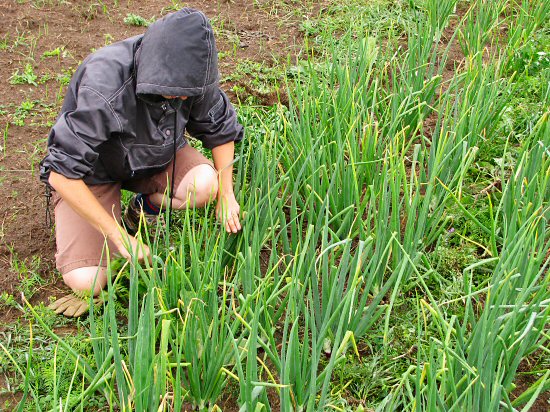
If you’re not on top of weeds by mid-June, things are gonna get ugly. Here, I’ve yet to come close to not having…problem spots, like this year’s onion section, where a perfect combination of heat and rain made relatively tiny pigweed JUMP in just a couple of days. At this size, and with the weeds growing right close to the onions, careful hand-weeding is the only option, other than tilling under the crop. Today. Lynn, Libby and I tackled the job…

Hours of weeding and a complete weather change later, the deed was done. As much as you think about the intense amount of labor, what that adds to the true cost of one of these onions, how things could’ve been done more efficiently, and so forth, you can’t help but be satisfied by such a complete…makeover. I asked Libby, after her very first crazy weeding spree, how she felt. With a big grin, she said: “I love intense!” You can’t help but love that attitude! :)

And there was still time for other fieldwork, an unhurried lunch break, and time out to play with the goats… Is this an economically viable way to farm? Well, it’s kinda working out so far, things are slowly, steadily improving, and we seem to be having ever more fun as it goes along!

Checking under row cover

Three weeks ago, it was floating row cover everywhere. So, what was it worth? Today, I checked things out. Overall, growth has been startlingly slow, due to the lack of sun. This is really noticeable in the summer squash (above), which could be huge at this point, but…aren’t. Under cover, these zucchini (I didn’t check the variety) are doing fine, no cucumber beetle damage, but of course, weeds are doing fine as well: unmolested under there, pigweed runs rampant. I’ll take the cover off here in another week or so, and then there’ll be a whole lotta weeding to do… I removed the cover from the first beds of cauliflower (Snow Crown) and broccoli (below), they’re big enough to take a little flea beetle munching. The leaves have shaded out much of the potential weed action in the beds, but you can see a nice collection in the path (top center, where the row cover ends). The plants look untouched, although the flea beetles managed to get under and at the kale and collards, (they’re out of sight just to the left)—I left them covered, back in a week. If there’s any doubt about what the FBs will do, just check the radishes, which grow MUCH faster than these guys and can survive the damage…

Back with the cucurbits, the cucumbers are the most noticeably slow: after a month, they’re hardly bigger than the transplants they started as (hope it’s all going into the roots!)… I’ve cleared away the weeds between a couple of the plants, beetle damage is minimal (they tend to get in at the ends of rows, where the cover can get blown up by the wind), but there are weeds everywhere. Cover goes back on here for a while. Weird stunting weather and floating row cover: not the most peaceful and inspiring natural garden combo, but it should all straighten out in a bit… ;)

Thinning and weeding

The first beet greens have sized up: lush and looking delicious, they’re ready to harvest. I love beet greens, both raw in salad, and lightly sauteed in olive oil and/or butter (a kind of deluxe spinach). I’ve never grown them as a separate crop, instead, they’re a happy byproduct of thinning the beets—removing the extra plants so that the remaining beets have room to grow. So the greens are both a harvest crop…and a weed. (I guess this is a continuation of yesterday’s post about WEEDS!) As you can see below, with the exception of a few gaps where nothing germinated, the first-planted beets are growing quite solid in their rows, which means a lot of plants have to be removed, maybe as much as 6-8 out for every one left behind (did you know, beet “seed” is actually tiny dried beet fruit containing several seeds?). There’ll be so much from four or five 3-row beds of beets, I won’t be able sell, eat, store or give away all of the greens that’ll pile up, but I can’t leave them in to stunt each other, so at at some point, the thinning becomes…weeding. Funny how that works! :)

Meanwhile, after a quite intensive weeding by hand and hoe a few days ago, the beet beds and paths are in fine shape, with only some growth near the plants that’ll come out during the thinning. (The cracks in the ground are what happens with our heavyish clay-loam soil: it’s not at all concrete-solid, it’s nicely moist, but as the surface dries out, it tends to…crack.) As far as overall weeding, with some quick touch-up hoeing along the way, these beds should be fine till harvest in 3-4 weeks (maybe earlier for some). The increasing leaf cover will keep down weeds near the plants, and the increasingly narrow paths and between-row strips can be quickly walked down with the weed hoe. It should be…sweet! On the other hand, in the potato patch…

…things have gotten a little crazier. A dense and vigorous mix of mostly pigweed and some lamb’s quarters has carpeted one of the two potato sections. Here, you can see the difference a pass with the wheel hoe makes. On the left, a just-hoed path still looks pretty green. In the middle, it’s untouched and looking a little scary. I’d call this…Stage 2: leave these little guys just a few days longer, and it’ll be a fight to hoe as the pigweed stems in particular will start to get tougher. On the right, a path weed-hoed a couple of days ago (I was on the way through while walking back from hoeing another area)—after a day of sunshine, the cut and uprooted weeds dry up, and you can see how much weeding you’ve really done. There’s still a lot of close work around the plants, but the potatoes are really shooting up now, so once that final weeding is done, the plants will shade out and prevent germination of whatever weed seed’s still near the surface. On the other potato section, the weeds aren’t nearly so…dense. On this one, some of last year’s weeds obviously went to seed, which really increases this year’s population. It almost fee;s like a closed system: what work you get away with not doing now, you eventually pay for later, usually with a little interest…