
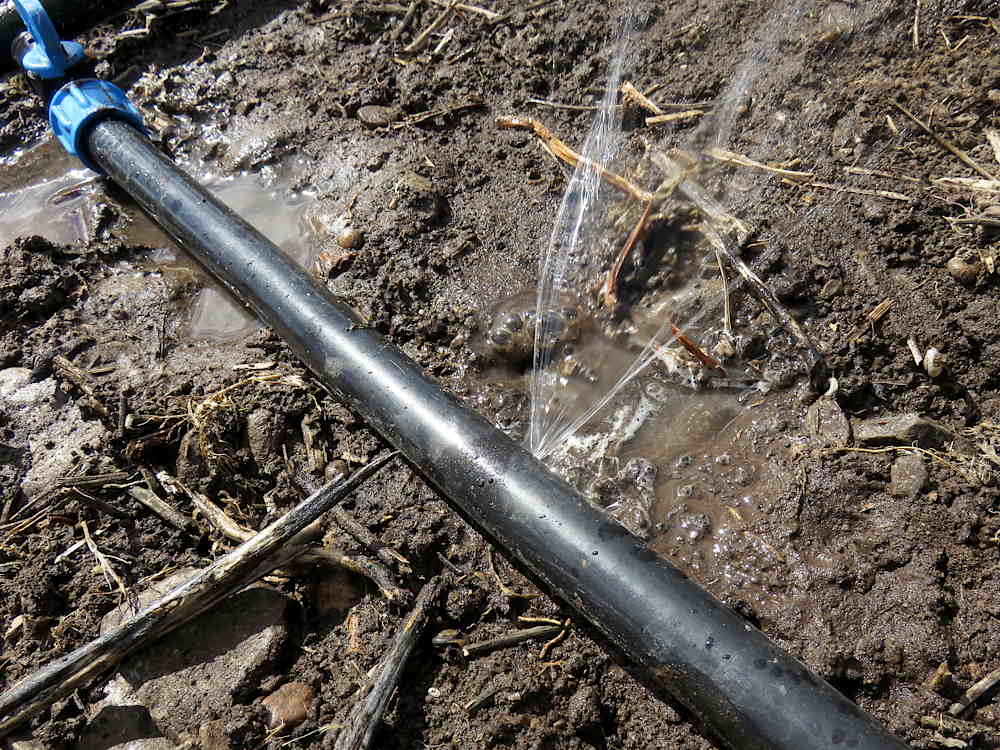
Drip tape is a really fantastic way to irrigate: low-pressure, drop by drop, straight into the ground leaves no room for being blown off target or evaporated by a hot sun. Slow and steady. Peaceful. For years now, I’ve been set up with the tape and fittings to fully drip-ify an acre or two. And it’s really not expensive. Yet somehow, it’s never gone all the way. Whose loss, if anyone’s, I wonder. Instead, the crops have gotten by with natural rain, and in desperately dry times, it’s been dragging around hoses to water by hand, or deploy the water-wasting but quick and easy sprinklers. I have used drip for melons, because they really don’t seem to grow well without the extra ground heat of black plastic mulch, and drip tape underneath waterproof plastic is a perfect pairing. Still, haven’t always used it even there. This year, for the tiniest melon row, it’s drip tape deluxe. Eliminate leaks, then turn the water valves to low!
“It’s flea beetles on radish, baby!”
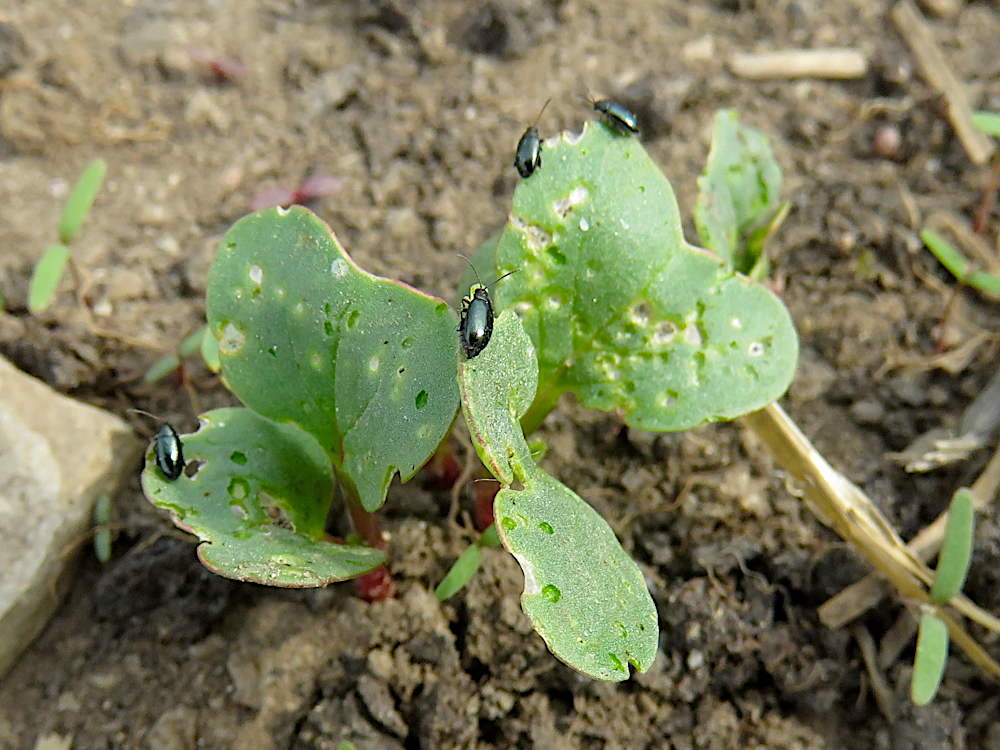
Yes, the flea beetles are back! They’re the size of a pinhead or less. In the photo, they’re at work on the first pairs of radish leaves that’re smaller than a fingernail. The action is all quite tiny-scaled. With the radishes, I’m not concerned about the damage. In the large veg-garden brassica family that the FBs favor, unlike the rest, radish grows so fast, the flea beetles can continuously feast and their damage is outgrown. Outcompeted in the veg garden arena. The leaves are scattershot with holes and dents, but the radishes themselves are fine, and…no need for row cover!
Grabbing this photo, getting as close as possible without making them flee, I notice how my relationship with the FBs has changed over the years. Even though they’re a scourge on the brassicas, meaning lots of row cover expense and labor right through the summer, they’re no longer an enemy, more like fellow travelers. Welcome, even—on the first radishes, they’re a sign that all is still in order this new season. They arrive, I row cover, except for radishes. They do their thing, I do mine. “Hey guys, how’s it going?” “Good, good. Just getting to work on these radish leaves.”
Thirstier and thirstier
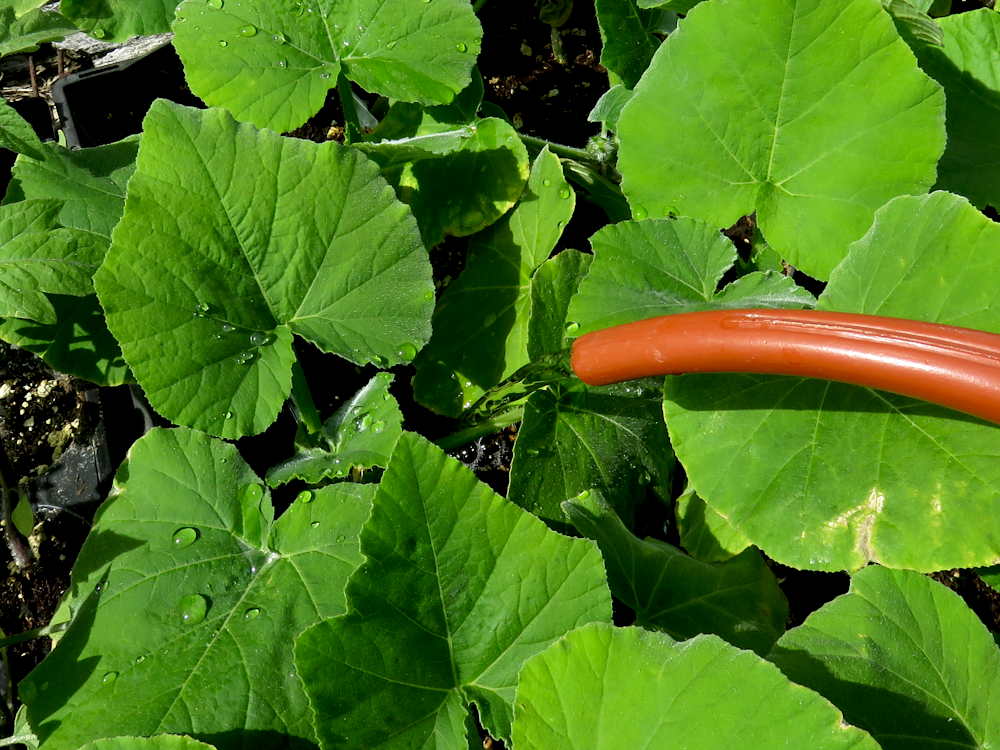
The seedlings are filling out fast now, with full days in the sun. Feels like they’re raring to break out! Stuck in their little pots, they could be being called to by their siblings already transplanted out in the field. Who knows?! One thing for sure is how fast they’re soaking up water now. Of course, it makes sense, it’s no surprise—but the little routine meter in my head sees that a good watering lasted a couple of days just a week ago, and now, especially in the tiny plug sheet cells, the surface is dry in hours and the trays feel light. There’s the sun and the wind to help evaporation, but still—thirstier and thirstier as they wait for the field!
Crop cooperation
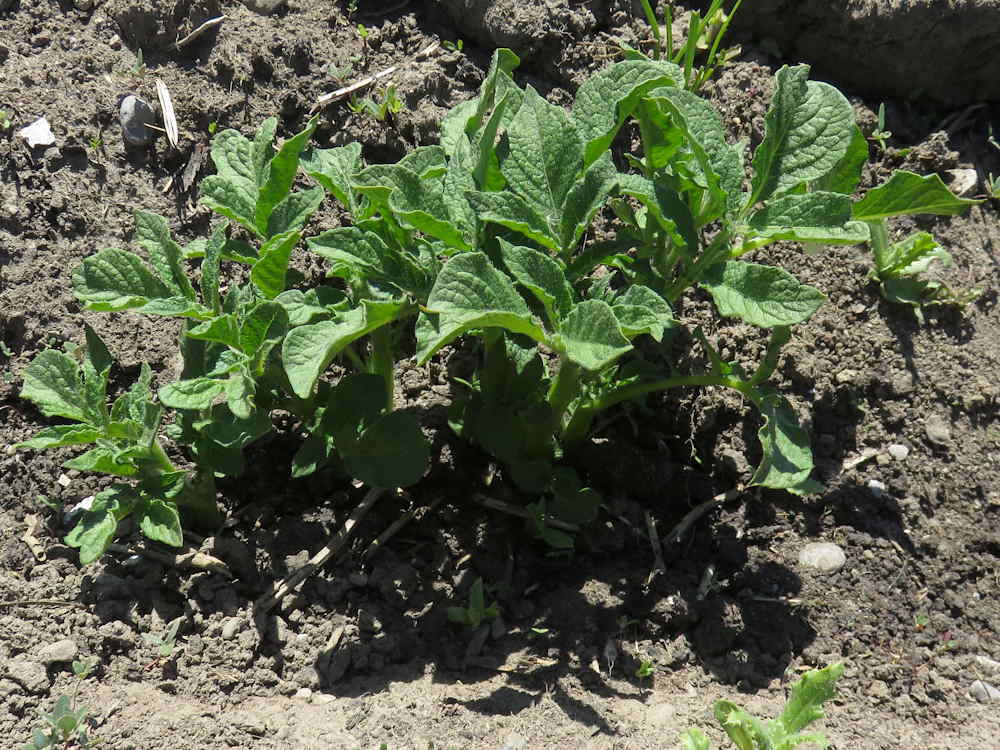
Round about this point in the growing season every year, I probably notice the same things, have similar thoughts. Late this morning, I happened to pay attention to the shadow of this happy little potato plant. That immediately led to thinking about how, as they grow, the veggies do their bit in helping you keep the garden going in the direction you want, that is, healthy crops not savaged by predators or overrun with weeds. The veg are like…partners! A pleasant way to look at it, though imaginary. In any case, the shade under leafy plants helps suppress weeds, keeps the soil temperature even, and preserves moisture. The bigger the plant gets, the more of the garden it covers! Of course, it works the other way as well!
Pot experiment update #1
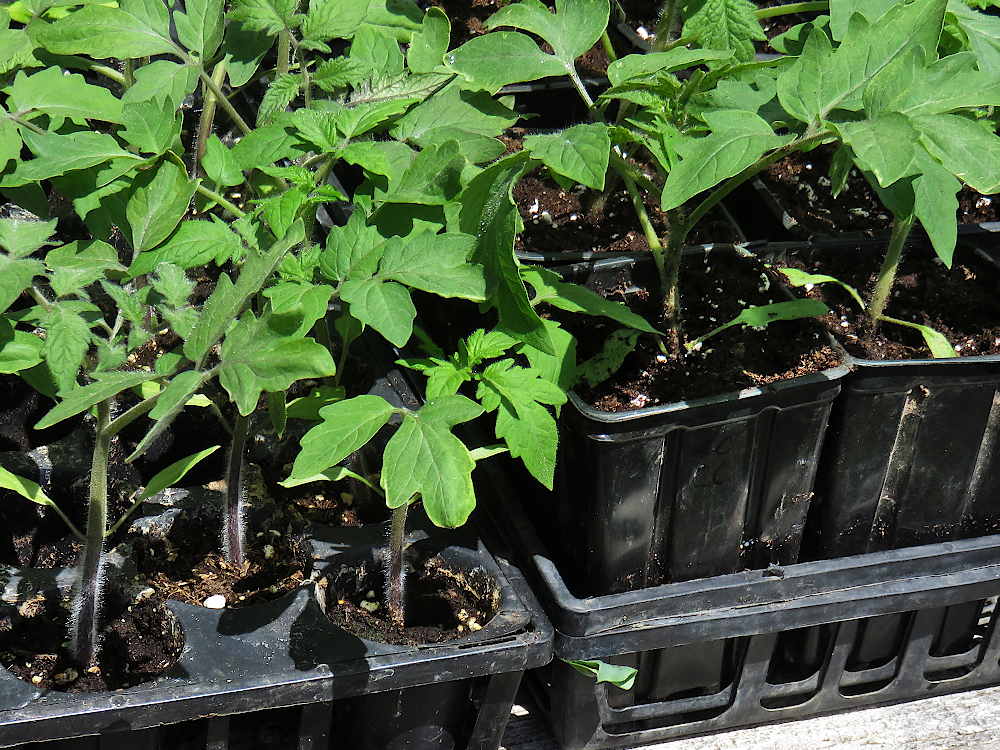
The story so far: Five days ago, 10 tomato seedlings, five each of two varieties, were potted up from the plugsheet where they started, to individual deep pots. The pots measure twice as deep as the cells, though they look taller in the photo. Pretty soon, all the toms will be transplanted at the same time, side by side, to see if deeper rooting leads to bigger, better, faster tomato plants. The ones in pots were also buried up to their seed leaves (that first pair that look like wings)—with their power of adventitious rooting, new roots will develop along the buried stem, so there’ll be a LOT more roots. The leafy parts look about the same between the two, while the real action right now is happening underground. In the plugsheet, roots are already circling around the cell walls. In the pots, it’s a root jailbreak, although they’ll find their new walls pretty quick. But walls that won’t be there forever!
Butterfly man
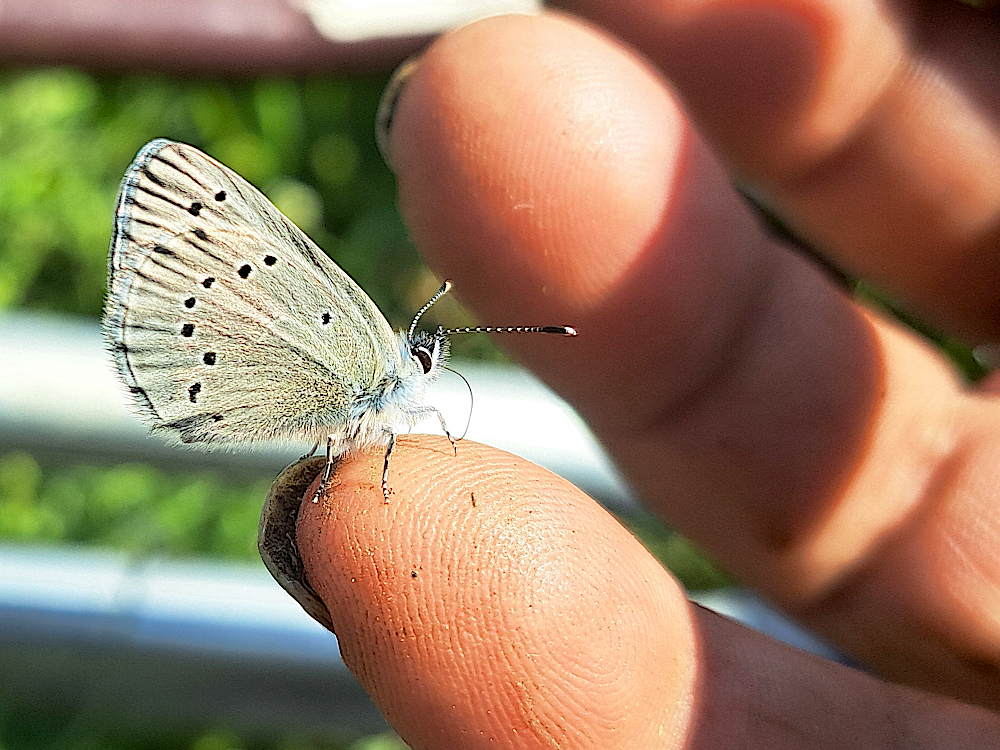
Sure, I know it’s there to suck up the minerals from my sweat. That doesn’t stop my moment of irrational wonder, feeling in harmony with all of Nature. Butterflies land on me!
These guys are always around the wet soil after watering in. They descend in a flutter of half a dozen or more, and land on the wet ground. Today, my hand was damp from the hose, so I slowly extended it toward them. And that’s when I received this sure sign that I’m one with the universe. To prove its intention, it gave me all the time in the world to get my camera from a bucket of gear nearby and capture the moment using my wrong hand!
As far as names for things, I’ll go with it’s a Silvery Blue (Glaucopsyche lygdamus), from my generally accurate or at least ballpark iNaturalist app. I looked into it at some point: they’re apparently after minerals and other nutrients they don’t get from nectar, and the behavior is called “puddling”. Hm.
Next generation
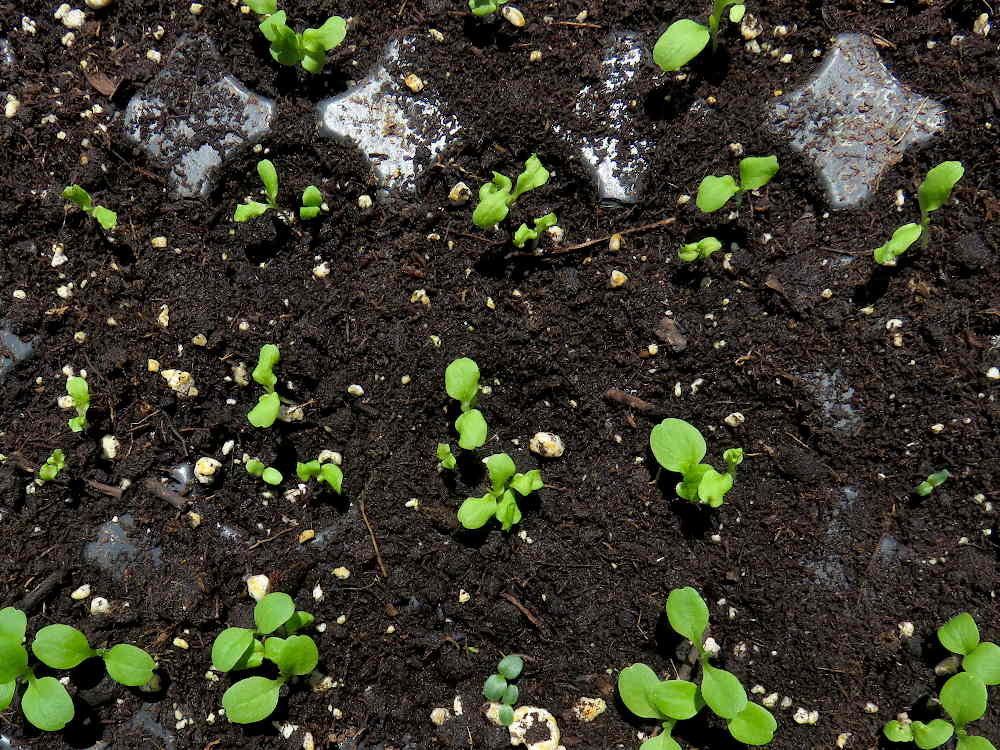
The second round of lettuce isn’t a next generation in a people having kids way, but it feels like one, as one seeding of lettuce grows to tasty salad size, while another is just getting started to take its place. Achieving an endless harvest is super rewarding (not to mention, necessary, if you’re going to market every week)—succession planting so that quick-to-mature, pick-once crops are steadily available at their peak all through the growing season. Salad greens like lettuce, mustard and arugula, baby bok choi and kale, also spinach, radish, summer turnip, green onions, and more can be planted repeatedly. Work out the timing, as things grow fast early on and slow down into end of summer and fall.
Oddly, in the hundreds or thousands of home veg gardening chats I’ve had, I can’t remember anyone beaming with satisfaction over their succession planting successes. It’s as if home garden seeding only happens in spring. Maybe lots of home tiny farmers do it, and just don’t like talking about it. It makes sense, it’s useful, and it’s fun to mention!