
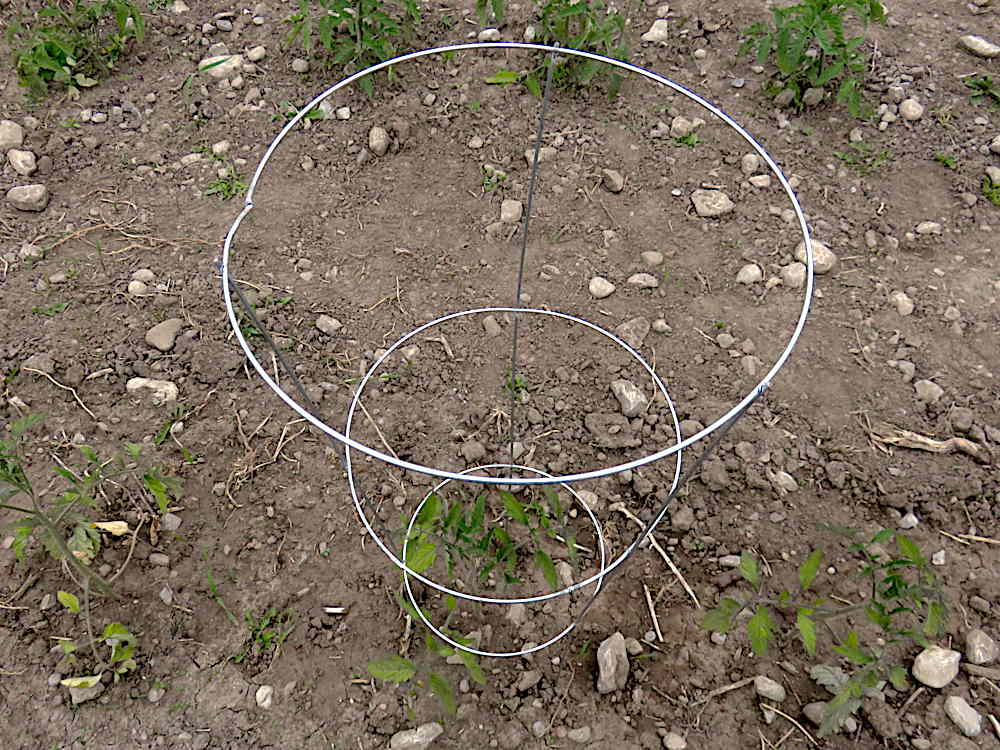
Ran into these cheapest of tomato cages in town, two bucks a pop, so I picked up a few. They’ve been around unchanged since I started growing veg over a couple of decades ago: three hoops flimsily spot welded to three support legs. Can’t speak for every last use, but from first-hand field tests, they’re pretty useless—a nice, neat-looking gesture to being in control when the toms are tiny, but prone to sag or tilt or snap at the joints under the weight of grown plants. Not great for a home veg garden, and really not for any sort of tiny production quantities. So why bother now? Well, one can always hope and dream. Since these toms went in late, given our short season, and the small number of plants, I can imagine carefully tending them—suckering enough to keep them productively compact, harvesting regularly before they get heavy. Plus, they take literally 30 seconds to place, and, at first at least, they look kinda cool and organized. Like a Jetsons garden. We’ll see how it goes!
Layers of protection
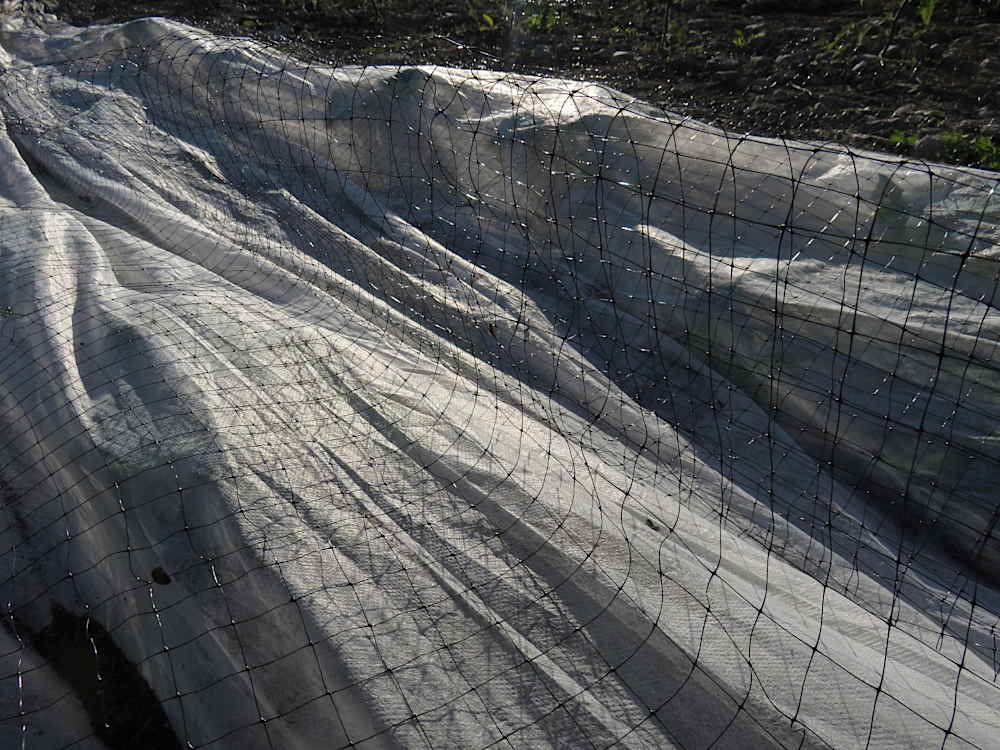
Layered protection for beds of cabbage and cauliflower. First, row cover for the flea beetles, who are out in force as usual. Loosely laid on top, deer netting, that doesn’t actually work for deer (it didn’t for the deer around here) but will hopefully deter the groundhogs. The net could easily be chewed through, but it’s springy, tensile tough and very easy to get tangled in. That may be enough!
Birds 2 – Beans 1
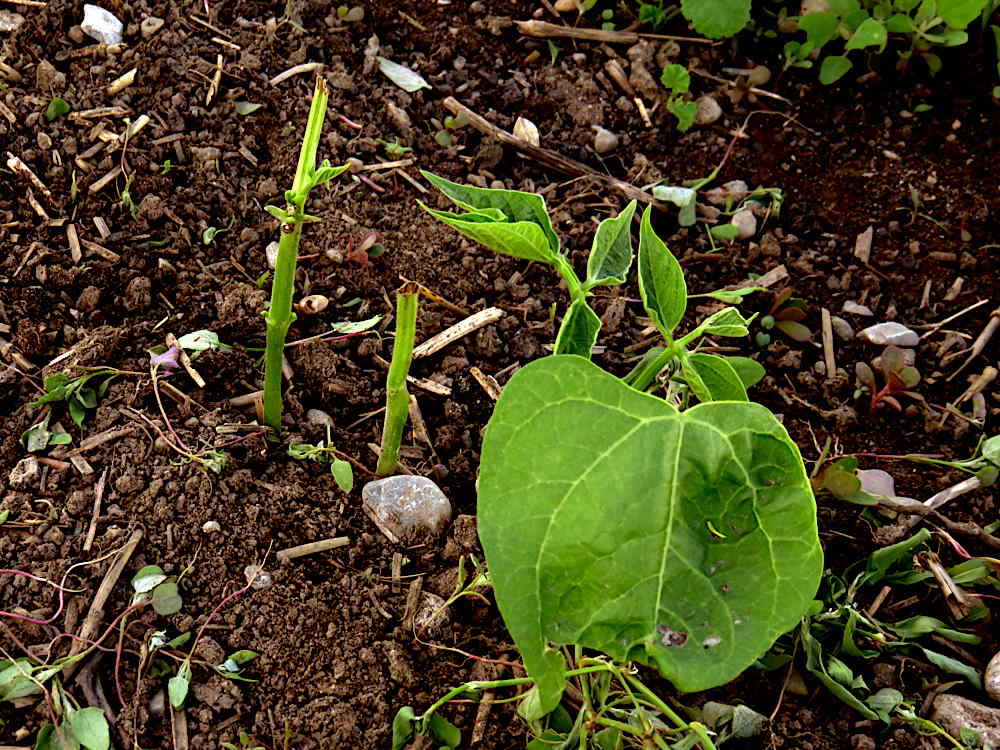
The first small bed of green beans was coming up fine—then I lapsed for a moment, and the beans were mercilessly attacked. So it goes in the rough-and-tumble world of the country veggie garden. I suspect birds. Can’t be sure but I’m pretty sure. I’ve seen them in action before. The ragged tops of the stems seem to point to pecking action, not the clean angled slice of creatures with teeth.
Instead of seed leaves, beans emerge with the actual bean split in two right on top of the stem, like an irresistible treat on a stick. Not sure what sort of garden raider survival strategy that represents. I usually put out anti-bird measures: inflatable scare balls or aluminum pie plates suspended on string. Or toss on some row cover—the duct tape of the garden—until a few leaves develop.
Here I didn’t act as soon as I saw the first signs of emerging beans. Also, I’m not used to hand-seeding and probably got a little too precise and seed-saving. With a seeder, plenty of seed drops, so there’s room for thinning, even by birds. Unforced human errors!
Anyhow, there are still enough plants for a decent first harvest, and a bigger bed is seeded and underway, with pie plates heading to the field. Bonus quarter point for the beans—you can see a tiny new leaf on one of the bare stems as it goes for a comeback!
The puddle returns!
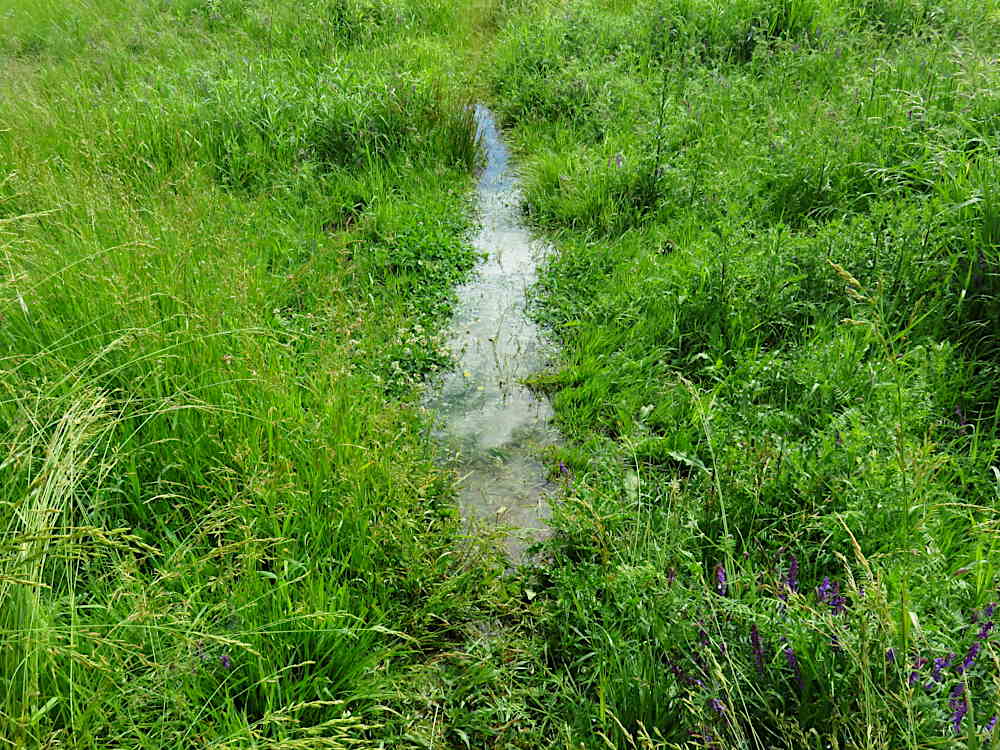
After a pretty impressive inch and a half (3.75 cm) of overnight rain, my water table indicator puddle is back. Not usual this far into June, but there has been a lot of falling water recently. You can see the water in the tamped down route of my path to the veg field, but it also extends into the grass on both sides. A mini-Everglades. If the veggies were planted right here, it would be a problem: plants breathe through their roots, so they’d be spluttering for air, in danger of drowning! Luckily, the veg patch starts not far off, but up a gentle slope, so, pretty much high and drier. With the clouds and rain of this May extending into June, and a few days of a heat wave-ish break, the weather pattern of the last 20 years holds true—there is no pattern!
Pot experiment update #2b
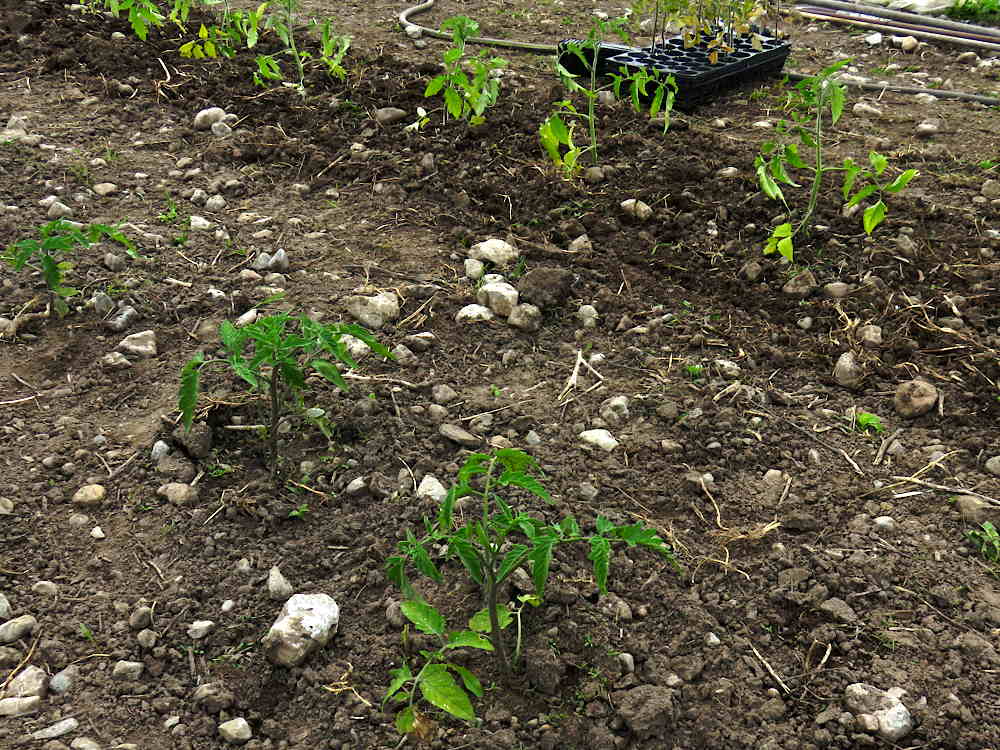
Here it is, the final phase of the tomato pot size experiment: side by side and in the ground. It’s a little hard to compare, so far apart and in this weird semi-overcast sunlight. The deep pot toms across the way went in late yesterday, and the plug sheet seedlings, up close, were transplanted 10 days ago. It’s a bit of an odd match-up for an experiment, but this was all an afterthought. The plugs have a big headstart in getting fully rooted, while the potted toms are starting in pretty much twice as big, with a lot more root mass. And they’re off…!
Pot experiment update #2
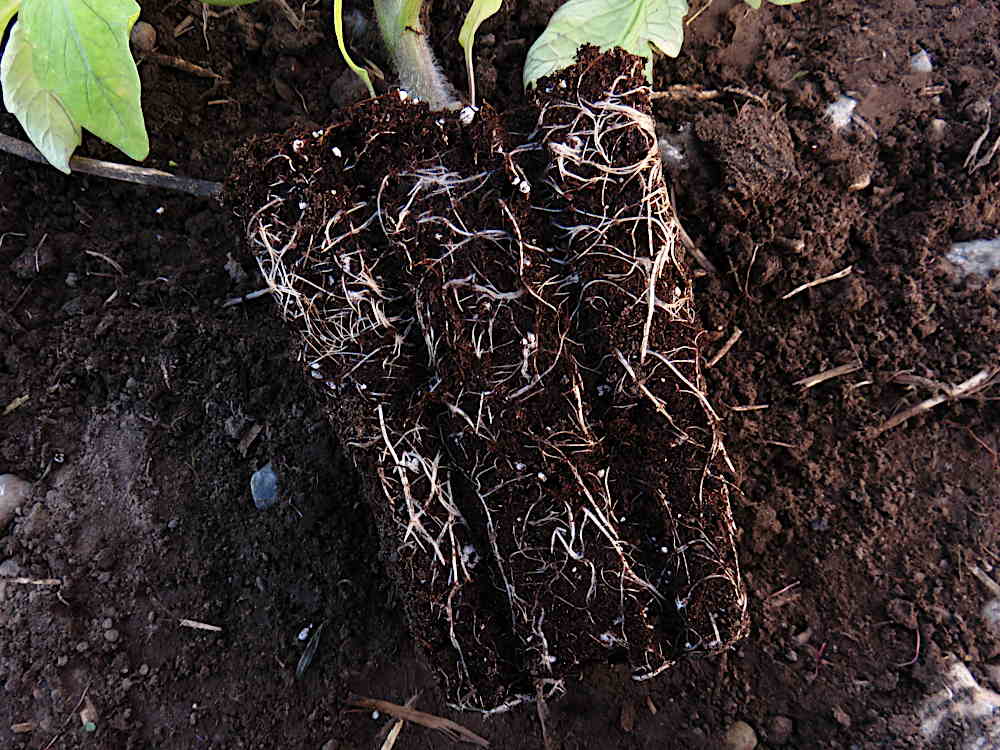
This evening was transplant time for the toms. Mosquitoes attended. Given our short season, with peak sun and warmth ending in August, there was no more time to wait. And the roots look good to me.
To find out how these Early Girls and Better Boys got here, you can refer back to Pot Experiment Update #1. Three weeks later, and the roots have taken advantage of their extra deep pots. Not crowded, but worked all the way through. Seems like a perfect time to leave the shelter of the pot and jack into the planet. In they go!
Plants just wanna have sun
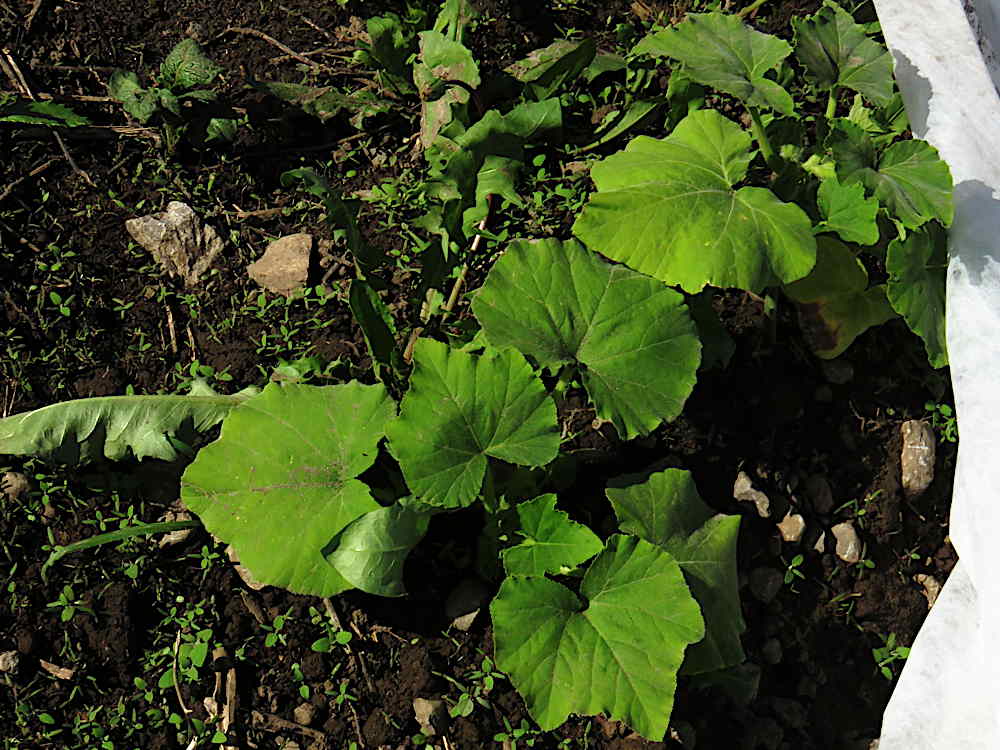
These winter squash are looking a little pale and thin, with those deprived-looking almost lime green leaves. No wonder, to go along with all the rain, most of the last few days have been cloudy. The garden veg really aren’t demanding. All they want is decently fertile soil—composted cow manure and a handful of alfalfa pellets will handle that—ample water, warm but not searing temperatures, and sun. Also, not being devoured by animals, insects or disease, or smashed to tatters by golf ball-sized hail, of course. This season so far, all conditions met. Except for the sun. The forecast continues cloudy with chance of rain for the next week. If that holds up, no rich, deep green leaves and satisfyingly sudden growth spurts for a while.