
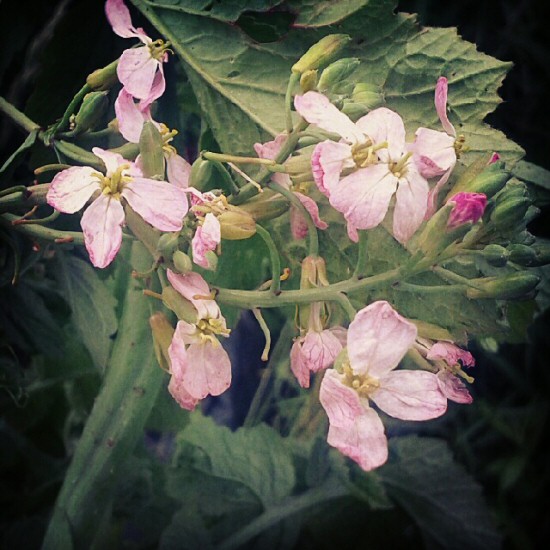
Radish flowers, a little past their prime, and a mildly unusual sight at any stage…but you just have to let the radish grow. :)
flowering
Jerusalem artichoke in full flower
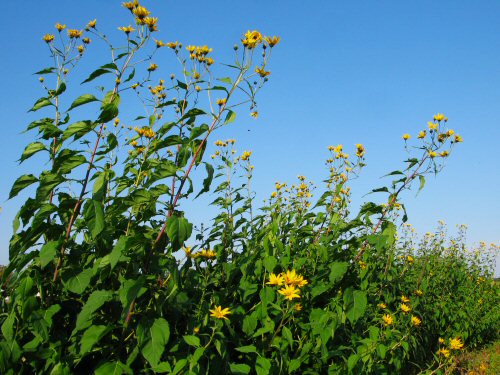
Last seen simply soaring up above 7′ (2m), the Jerusalem artichoke recently exploded with flowers. Last year, flowers appeared on some plants, and I read that flowering chokes isn’t that common. You couldn’t tell from here… The plants continue to thrive, weathering pretty heavy wind recently with only a bit of a lean. I haven’t dug around to see what the tuber harvest may be like, but I expect it’ll be massive…
Potato fruit
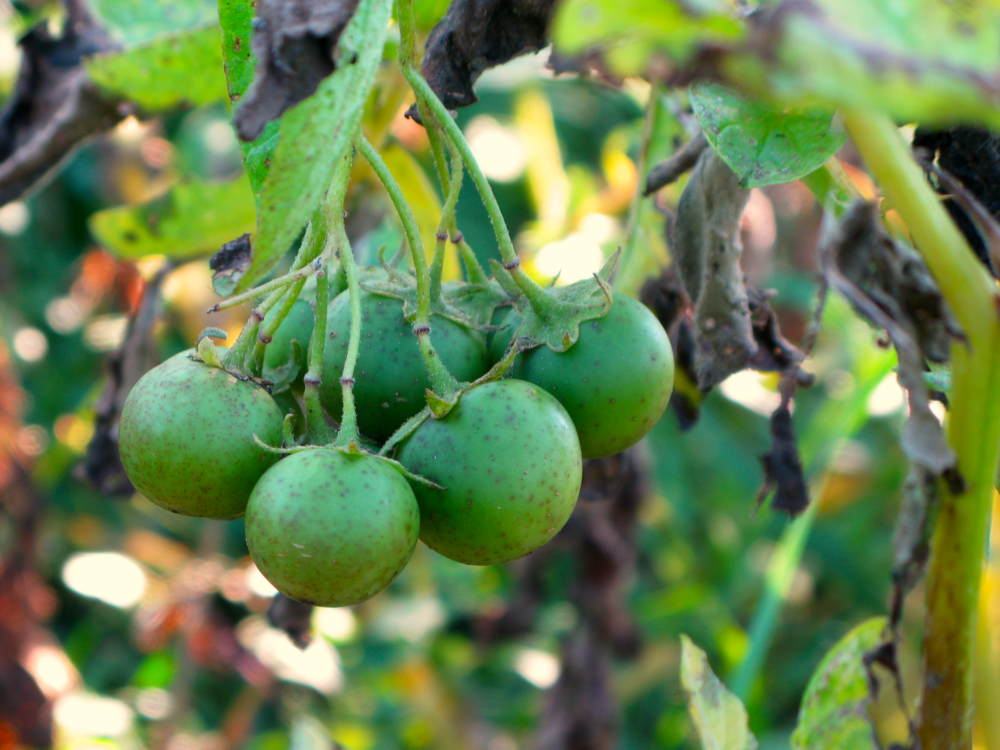
Here’s something I haven’t seen before in my, uh, six years of growing potatoes: green, tomato-like, walnut-sized potato fruit. Bob hadn’t seen ’em either, in 40 plus years of farming. I hit the web for education.
These are genuine fruit (also called berries), but not that common. Usually, potato flowers just drop off. Pollination can be an issue, but even when pollinated, little details of the season’s growing conditions can make the the difference. When fruit do form, they’re more likely found on certain varieties, like Yukon Gold. This year, there were fruit on just about every Chieftain plant, here and there on the Kennebec, and none that I noticed on the Yukon Gold. Since they suddenly appeared this year on two varieties I regularly grow, I’d guess it was about the weather!
Each fruit contains 300-500 seeds that don’t come true: planting them doesn’t result in the same potatoes as the parent plant or each other, there’s lots of genetic variation, each seed will produce a genetically different plant! Potato breeders plant out thousands of seeds, check out the results, then keep replanting the most desirable potatoes for many years or generations to get new commercial varieties—this is the traditional way new potatoes are bred.
Meanwhile, it takes only two seasons and one generation to breed a new potato, so for the small farm or home garden, as opposed to the big potato breeder, this seems worth a try. At least as an experiment. Harvest seed one season—you can hand-pollinate to cross two varieties—plant out the next and select the best-looking plants. The tubers (potatoes) from each individual plant are ready to go: planting out the tubers will produce genetically identical plants.
But there’s a kinda big BUT: even though a potato grown from a tuber is genetically the same, you can’t be sure how its genetic makeup will react to different growing conditions. For example, it may be the perfect potato after a wet summer, and quite different after a dry one. (That’s why professional breeders check over several generations, and now there’s also high tech genetic analysis, to make sure it will be the same potato in the full range of growing conditions.) Still, at the very least, fun to see what happens!
And, the fruit are poisonous, rich in solanine, not for eating. Potatoes, tomatoes, peppers, eggplant and tobacco are all members of the “deadly nightshade” family, all prone to having toxic parts (potato fruit are somewhat similar to little, hard green tomatoes). Interesting!
Since this is such a popular post, being dug up over and over via Google, I’ve started to update the article as I discover more. The post sounds the same as it always did, just surgically filled out a bit with more info. This is unusual. In general, I don’t edit old blog posts, and clearly mark the updates when I do!
Flowers galore
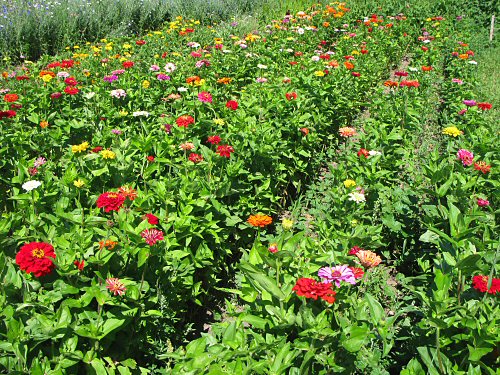
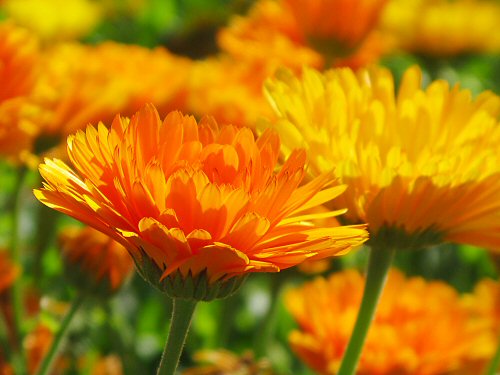
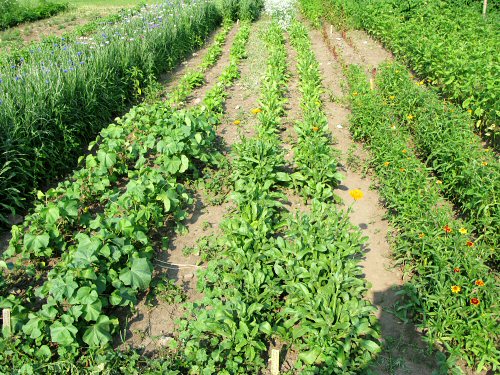
The flower sections have pretty well taken off over the last month, with the several beds of zinnias (above, directly below) offering up the biggest splash of color. We’re not harvesting the flowers, this season is a trial run, but they get regularly cut by everyone working in the field, and by a couple of CSA members, so they’re not out of control or going to waste. Besides, they’re pretty to look at, right there at the bottom of the field…
Since we’re not harvesting, I’m really not learning much about the world of cut flowers, beyond the growing. There’s lots of detail, like exactly when to cut for maximum vase life, and where to cut on multi-flowered plants. Right now I’m somehow not focussed on learning cut flower stuff that I don’t have an immediate, practical use for. So I just watch and enjoy…
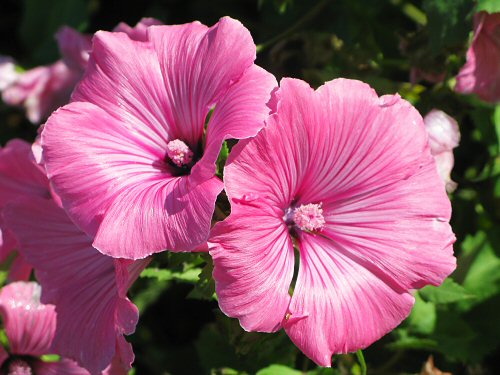
Lavatera has broken out in the last couple of weeks.
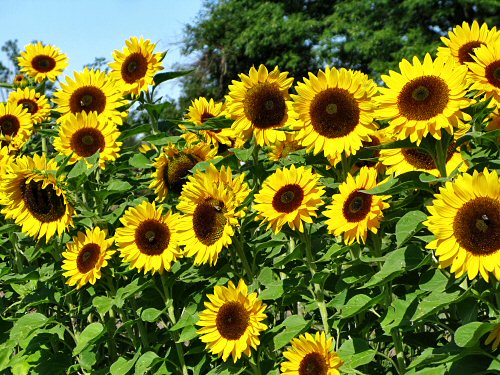
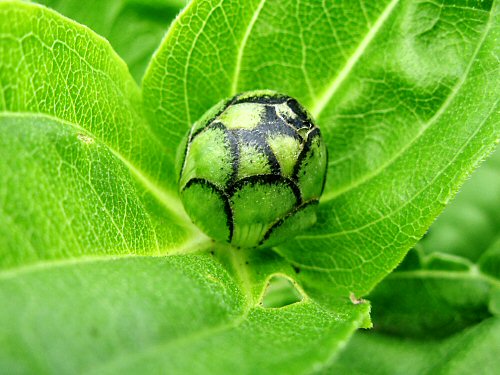
And sunflowers are in fine form (this variety’s called Sunrich Pro)…!
Cut flowers arrive
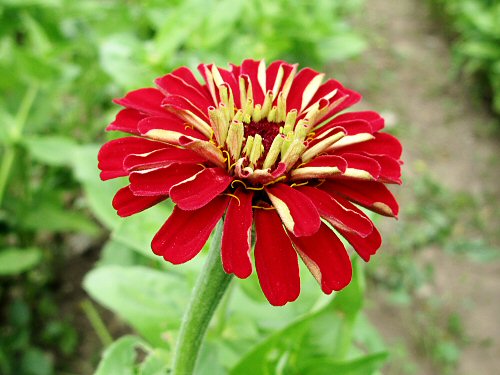
Zinnias bloom! At least, a few varieties are starting, along with many of the other cut flowers in this year’s trial bed. Much of last year’s first trial bed wound up worse for the wear after drought and infrequent weeding. This year, I tripled the amount of the same flower selection, about a dozen direct-seeded annuals, divided into two sections.
With all of the rain and and more attention, they’re doing a lot better…
Broccoli flowers (flashback!)
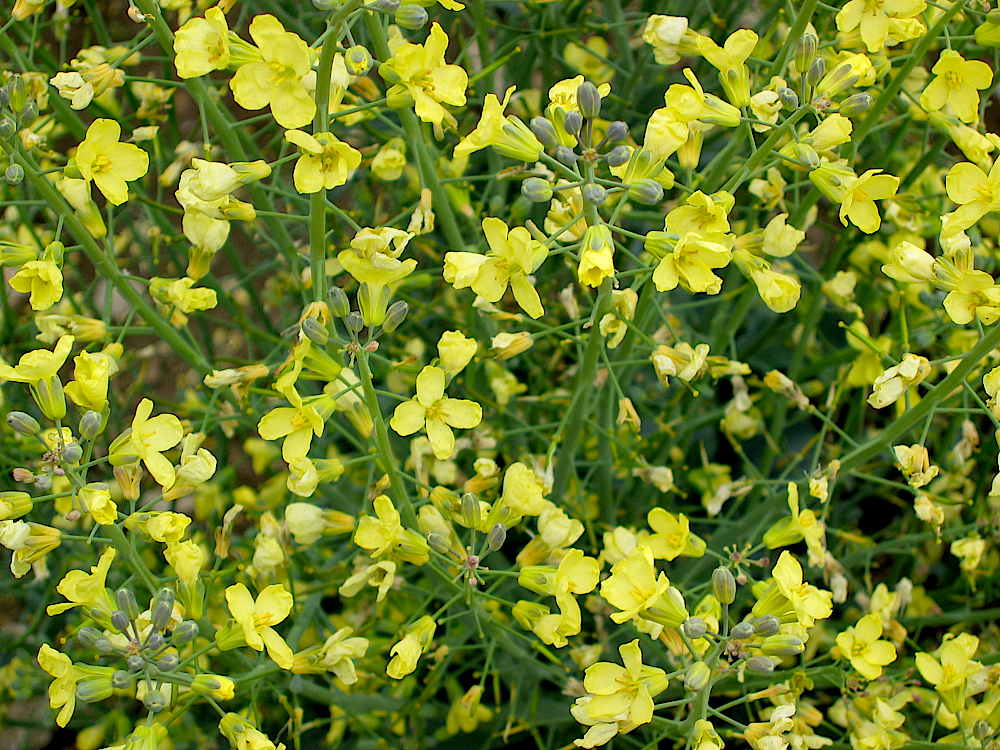
No real farming action today, but here’s an alternate entry from 2-Oct-2007—never let a perfectly serviceable post go to waste!: On my way to seed saving, I tend to let things go to seed! Here, the secondary shoots in a bed of Early Dividend broccoli have exploded, the tiny green beads turning into a gently rolling sea of miniature flowers on long thin stems. Unfortunately, the eventual seed from this hybrid variety wouldn’t be reliable…but it’s a step in the right direction! Also going to seed around the field: lettuce, radish, cauliflower… There’s some cleaning up to do. :)
Update: As mentioned in the comments below, these little guys are delicious as edible flowers, slightly sweet, tasting mildly of broccoli. We take them to market to offer as a free garnish for salad mix.
Jerusalem artichoke flowers
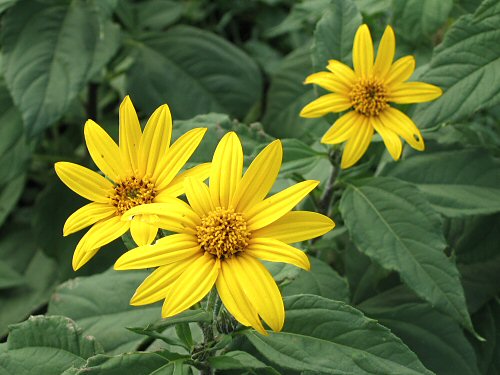
Sometime over the last few days, the Jerusalem artichoke have started to produce pretty yellow flowers. That’s interesting. Without all this warm, way-past-normal- frost-date weather, what would they have done? They did go in a little late… And why do they look so…familiar? A couple of minutes online and it’s apparent that flowering is optional, largely dependant on location and conditions. And, no wonder, they—Helianthus tuberosus, aka sunchoke, sunroot, topinambour—are close relatives of the majestic sunflower (Helianthus annuus). Small world…