50 Things I’ve Learned from Tiny Farming: #38 Use a pencil

50 Things I've Leaned from Tiny Farming: #38

See the growing list of 50 Things I’ve Learned from Tiny Farming:

#38 – Use a pencil: You can find no finer quick-planning and sketching technology than the PENCIL, used with a crisp sheet of paper, a supporting clipboard, and a quality white eraser. There is a curious kind of commitment only a pencil can bring to the start of something. The impermanence, the erasability, the chance to begin now but make sweeping changes later, is the cool thing. Pencils are perfect for roughing out garden maps, preliminarily filling in tricky forms, and sketching all sorts of construction and fabrication projects, mobile chicken coops to better farm stand shelving (even crudely done, a picture is worth…a lot). Forget digital—lappies, tablets, smartphones, batteries, cables, software, formats and files—there’s nothing like good old straightforward no-frills paper and pencil (traditional or mechanical) for freeing you up to think!

Enter the Riot Garden

Tending the Riot Garden

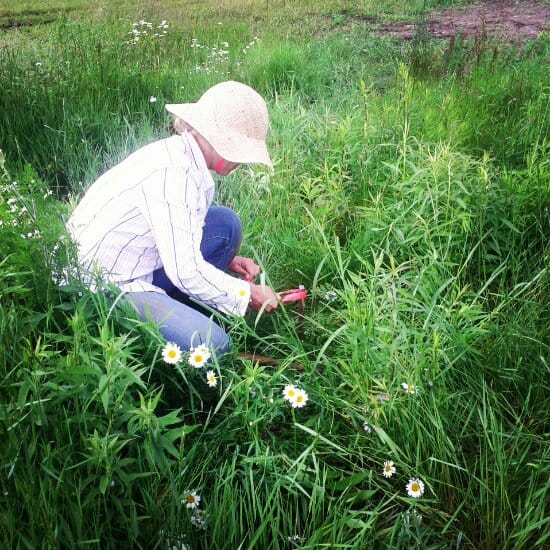
Tried this a couple of times before, to varying degrees of success, a small garden within the market garden, a kinda test/demo back yard-sized plot. One year, it was an elaborate set-up we called Home Garden, masterminded by Shannon: after a great start, I think it eventually went to the weeds, being lower on the weeding list than many other things… This year, it’s a simple 10’x20′ rectangle, being measured, squared and staked out for tilling by Ashley. This version is called the Riot Garden because the plan is no plan, just throw in odds and ends of leftover seedlings and seeds, and edit as we go…what could be easier, right?!

Chicken Tractor: The Book

Chicken Tractor book

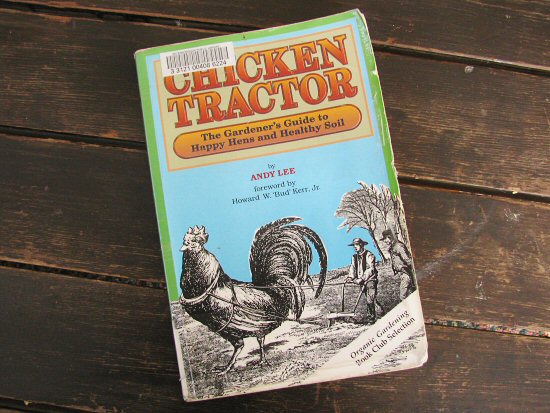
CHICKEN TRACTOR! My book-of-the-moment, a happy find at the municipal library (thanks to Kendall, I rediscovered LIBRARIES a couple of months ago—haven’t held a library card since school days, long, long ago).

The chicken tractor concept is simple, and it’s been chatted about around here quite often over the last few years…but not yet tried. The idea is to provide a mobile enclosure for your chickens, and move them to new sections of land every day or so, rather than keeping them in the usual chickenhouse and yard set-up. The chickens work up a small area of ground and fertilize it with their manure, and then it’s on to the next patch—the birds are always happy with fresh places to scratch and bits to eat, and a large area can be improved in no time. The rig can be any design you come up with that keeps the chickens in, predators out, offers shelter from the weather, and is easily moved. Easy!

Like most good things in smaller-scale farming, the chicken tractor is a startlingly simple and inexpensive approach that offers deep returns on many levels, from food quality to all-round satisfaction. It’s also kind of the EXACT OPPOSITE of high-tech industrial farming gear and methods that make so little sense to me. And the system works for various other farm animals as well, as in well-known (celebrity!) indie farmer Joel Salatin’s chicken-and-beef rotation at Polyface Farm.

So simple, why do you need a book? Well, it’s WINTER around here, all is snow, and reading about growing is the next best thing! In this case, Chicken Tractor, like its to-the-point title, is a perfect example of an energizing just-do-it how-to book, written in enthusiastic, full-on farmer-scientist mode. It’s jam packed with practical instructions and advice, the text assisted by numerous charts and illustrations, with a non-oppressive serving of sustainability philosophy and general food politics worked in, plus chicken trivia (the term “chicken tractor” was apparently coined by permaculture founder Bill Mollison, so now I know).

It’s cool to see this copy so considerately well-worn, although this being the original edition from the mid-1990’s, maybe it hasn’t seen that much use. It was published in 1994, quickly followed in 1998 by an “All New Straw Bale Edition,” with the subtitle upgraded from “The Gardener’s Guide to Happy Hens and Healthy Soil,” to the better-keyworded, “The Permaculture Guide to Happy Hens and Healthy Soil.” In any case, this edition is fun tiny farm reading from the library.

Anyhow, so much for the book review, let’s see how well this year’s chicken tractor plans actually fly! :)

Extending the chickenhouse

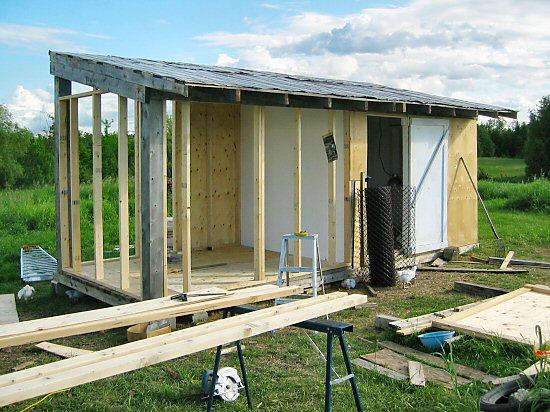
First day of summer, and the day before the arrival of 25 20-week-old, ready-to-lay Shaver Red Sex Link CHICKENS. Clearly, time to begin building out their new home. It shouldn’t take too long! :) Working on and off through the day, the frame went up, and by early evening, the plywood flooring is down, the door is built (on the right) and even a first plywood panel is up. A little more work tomorrow, and we should be good to go. No problem!

Fully enclosed, at last

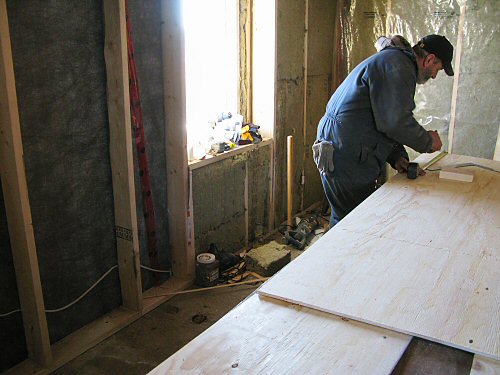
A 10-hour day with Bob, and plywood is up on the four walls of the new seedling room. It’s rough work, with an uneven floor and really uneven joists to cut around, either spend forever measuring and marking, or recut by increments for tight fits, or do the cut-outs generously and get things done quick. We took the rougher, faster route…and got done. There’s still the ceiling to go, but the room is already snug enough to heat, so the move is next! This feels like a weekly installment TV show, it seems to be taking so long. No wonder, we’ve only been averaging a day or two of building a week. But other things are moving forward as well, and the end of this little project is really just around the bend. That’s good!

New seedling room: getting there!

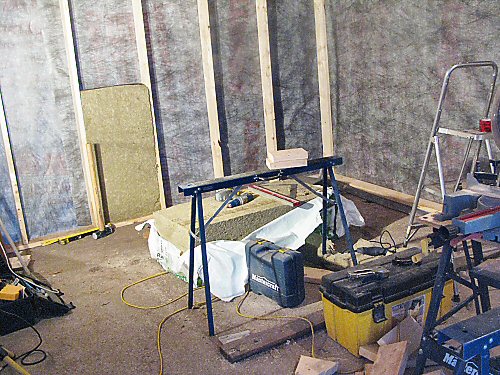
It’s slow and steady with the new seedling room. I’ve only managed to commute to the new farm for one or two days a week this month. It’s a little frustrating, watching the time go by, but I guess it’s good for building up energy for all the stuff to come in the next three months—meanwhile, I’m working on the garden map and other plans at the old farm end! Today, it was more building, with Bob lending his old school, all-purpose expertise, and we got a lot done. A good day! The last wall, the open one (the other three are against concrete block), is in and covered with Typar weather wrap (above). This finally makes four walls to keep a little HEAT in. Now, instead of working in subzero temperatures, we can work in the comfort of a few degrees above. It really makes a difference! So, the wall framing is done, with only the ceiling to go.

Doors and windows? One of the two doors is hung. The other one was a bit of a concern. A standard door was still a couple of inches (5cm) too high. Choices: either build a door, pay hundreds of dollars for a custom built one, OR, bash the concrete sill, made of concrete blocks filled with concrete and stones, to make the extra height. We chose option #3. It actually didn’t take too long to sledgehammer and clean with a masonry chisel, maybe half an hour, and now we have a good 6 inches (15cm) to play with. The openings for the two windows are fine, they’re framed, the windows have to be shimmed and screwed in place. Two or three more good work days, and the new seedling room will be snug enough to set up the light racks and start some onions! And leek!

Tiny farming in January

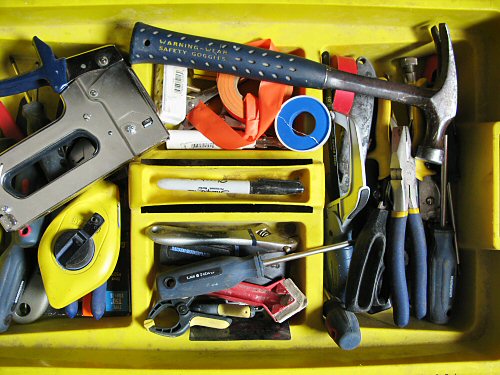
If I happened to be looking for monthly tiny farming themes, this particular January is clearly all about chickens and tools (and thinking about stuff!). It’s not the usual January routine around here. Normally, I’d be hanging the lights back on the light racks, checking out my seed starting gear—plug sheets, trays and the like get hit by a certain amount of damage and destruction each year—and generally cleaning up and rearranging the Milkhouse for seedling production. This year, with the move to the new farm, there’s nothing much to do on this end, until the new seedling room is built. So, it’s been back and forth—this weekend was there. The tools in the photo, a fairly small part of my ever-expanding collection of essential farm maintenance gear, aren’t what’s mostly being used, it’s mainly the chop saw, sawzall, cordless drill, and a lot of measuring and marking as we frame and insulate the lower barn space. But I’ve been lugging this chest each way, just in case I need tools at either end… As for the chickens, well, it’s water, feed and eggs every day!