Tiny farm moving – Part 3

Headed to the old farm to pick up the greenhouse. It’s only been a month since the main move, but the return to a place where I spent practically every day of the last six years felt strange. Inside the farmhouse, it was just a familiar space, but rounding the corner into the  barnyard, surrounded by all the old red buildings—barn, goat barn, drive shed—and then, walking into the field, that was different.

I guess this is the first real attachment to LAND that I’ve experienced. It was definitely unusual, not at all emotional, just a really strong, quiet sensation, a deep familiarity maybe describes it. I suppose the memories of all that thinking, observing, and working, tying together place and weather and ground conditions and seasons coming and going in one long, continuous arc, couldn’t help but leave their own type of mark. So that was interesting! :)

Bob had already started dismantling the farm stand, but that was so solidly put together, with thick, rough-cut cedar, heavy old fence boards, and 3″ nails (if you ever expect to move the things you build, for a few dollars more, consider screws!), that’s gonna be for another day. On to the hoophouse teardown…

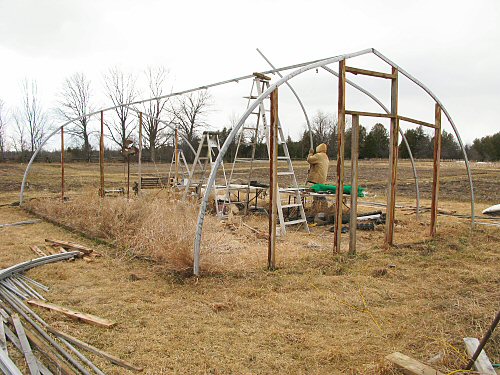
The hoophouse is all screwed together, so taking it apart was easy. I’d considered lining up some extra hands for removing the plastic—there was a breeze, gusting to 4-5 mph (6-8kmph)—but Bob thought we’d be fine. And we were: the plastic skinned off amazingly easily, without catching the wind at all, and it didn’t disintegrate or tear…it will live again.

Around five hours later, and it’s all in pieces, ready to load up and take down the road. Going up and coming down are exactly the same, so I decided to take step-by-step pictures when we put it up again at the new farm…
Fully enclosed, at last

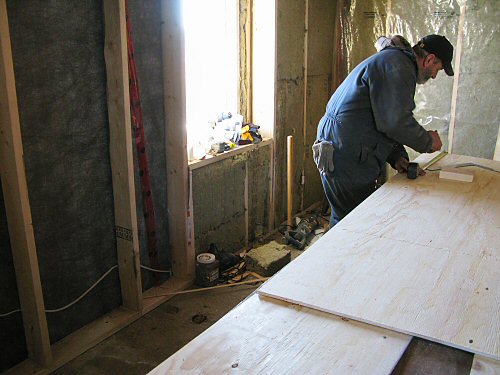
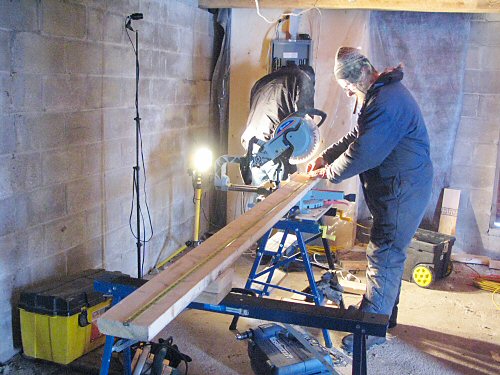
A 10-hour day with Bob, and plywood is up on the four walls of the new seedling room. It’s rough work, with an uneven floor and really uneven joists to cut around, either spend forever measuring and marking, or recut by increments for tight fits, or do the cut-outs generously and get things done quick. We took the rougher, faster route…and got done. There’s still the ceiling to go, but the room is already snug enough to heat, so the move is next! This feels like a weekly installment TV show, it seems to be taking so long. No wonder, we’ve only been averaging a day or two of building a week. But other things are moving forward as well, and the end of this little project is really just around the bend. That’s good!

More cold-weather construction

A fairly productive Saturday of building out the new seedling room in the freezing cold (-15°C/5°F), with Michael and Bob (he dropped by to help for the day). By sundown, we had about half of the framing done, slow going with the cold, and the joists in the ceiling to work around. The propane space heater I used to use for emergency greenhouse heat barely made a difference with all of the drafts around the old barn doors and windows.  This winter work is nowhere near as fun as rough carpentry in warm weather, but it felt good to get stuff done.  And we’re still on schedule—seedlings soon have to start!

Bringing in the pipe

Bit of unusual fieldwork on the menu today, something we don’t do every year. Bob and I brought in about 1,000′ (305m) of 1″ (2.5cm) and 1-1/2″ plastic irrigation pipe, that ran all the way from the pond to the gate into the garden field. Why wasn’t this done in better weather, when, besides having no snow to deal with, warmer plastic would’ve been a lot easier to handle, especially to BEND? There’s no good answer, except maybe, “Didn’t think it’d be this cold and snowy so soon!” Anyhow, it got done, and probably in exactly the same time…

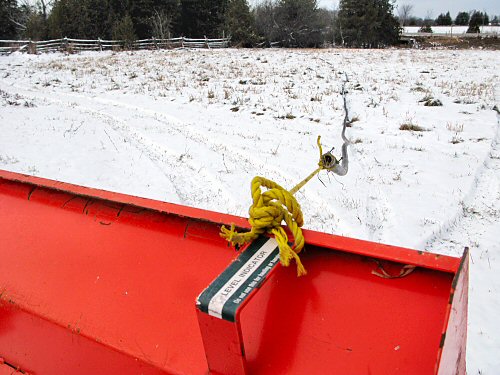
I used the Kubota compact tractor to drag the pipe in three 300′ sections, right into the barnyard (the rope is tied to the front end loader bucket; in the pic, this is at the very end of the garden, where it meets the hay, so all that stubble is mainly long grass). Backing up down the field, I worked it from the far end for the section that lay in the unmown grass right near the fence, so that it could more easily tear its way out of the overgrowth. Then, some coiling (that’s Bob), tying off the loops every few turns with baler twine (plastic twine used to bale hay, it’s all over the place)… Easy!

Donkey care

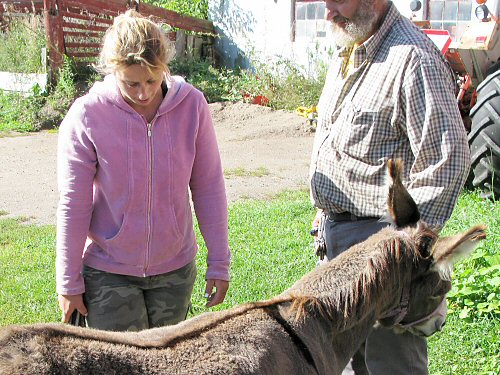
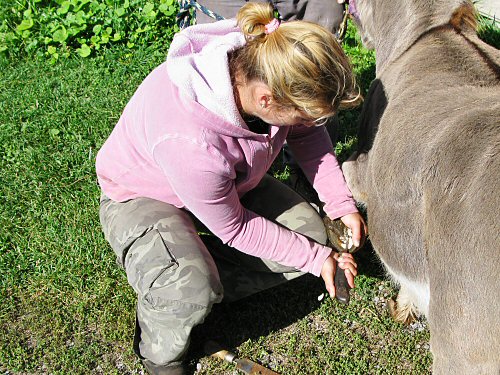
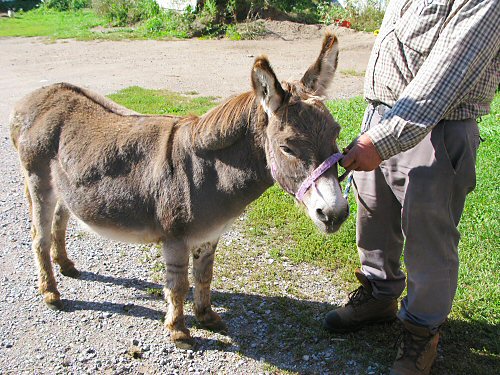
Tanya the Farrier drops in on Jack the Miniature Donkey every 6-8 weeks to clean and trim his hooves. It’s a pretty quick operation, maybe 20 minutes. You might expect trouble, Jack being a fairly frisky, 400+ pounds of muscle, hard head and hoof, but he’s also easy-going, and Tanya seems to have established authority way back. I’ve been watching this routine for the six years I’ve been here. Bob does the holding, and Tanya goes to work…

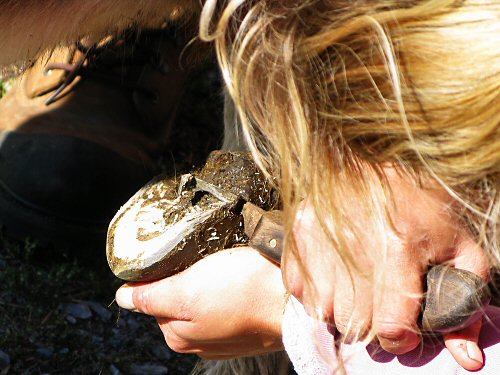
…using a hooked knife to prying out built up gunk…

…and trim down the hoof.

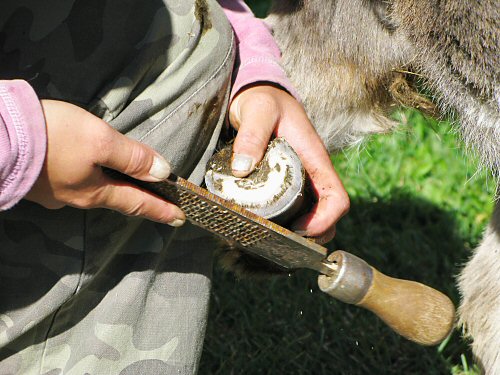
A rasp is used for finishing touches…

…and in no time, Tanya’s gone and Jack’s good to go…

Chickens to the slaughter

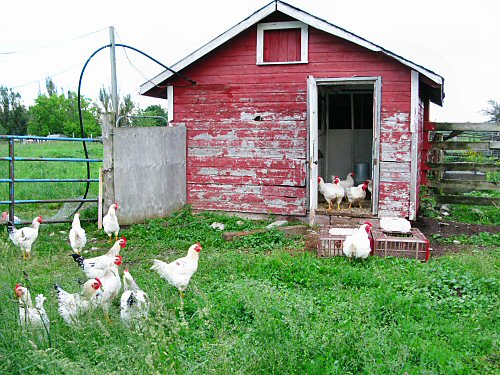
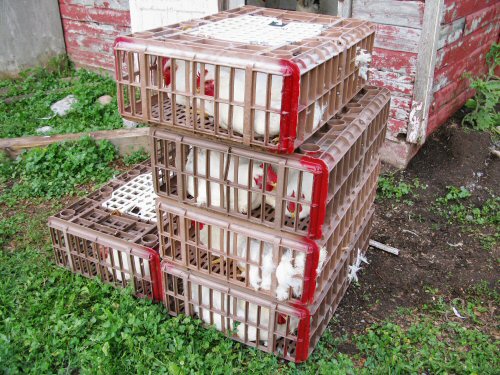
Raising your first chickens, killing them, and eating them has gotta rank up there with other Firsts worth a little attention. Now, I’m at least part of the way there: the killing this time was done behind closed doors, with me on the outside—chicken PROCESSING. Still, first enough to be worth a few photos… I’d been cutting it close with booking a processing day for the White Rocks, the local processor is known to get solidly booked for weeks. I finally called yesterday, looking for a date in two weeks, and was told there was also a cancellation for tomorrow (today!). I checked out the WRs, and, man, how could I imagine them getting any bigger (I think I was mesmerized, waiting for them to explode)? So I called back and booked. We drove over last night to pick up crates (20 minutes each way), then it was up at 5:30 this morning to load ’em. As soon as I opened the door, all of the Frey’s dual purpose darted out immediately, as usual, while the WRs, who mostly go nowhere, stayed in: it was kinda fitting that the Frey’s stood around in unfenced-in freedom, ready to run (and they would’ve!), while the WRs kinda dumbly looked out at their crates (above).

Five to a crate, 25 in all, 30 minutes or so to loaded…no need to chase down these lumbering beasts (while I was packing, most of the Frey’s figured out no good was afoot and entirely disappeared around the other side of the chickenhouse, something they’d never done before, while a couple stayed to watch).

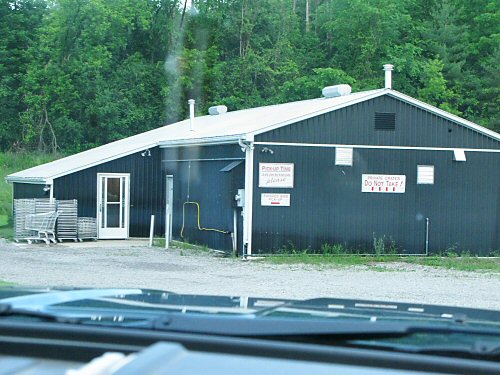
The processor is on a farm, a low building where birds go in live on one side, and come out the other, cleaned and chilled, weighed and government-inspected, ready to go…

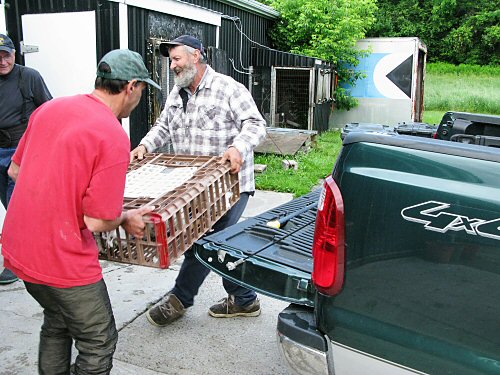
Bob and a processing guy unload. It’s 6:45am. The paperwork is quick and painless, I didn’t even have to write or sign anything. The only sign of bureaucracy in action is the required chicken purchase number, a serial number that’s on the form that you fill out when purchasing the chicks. And the on-premises government inspector popped out and did a little of his own paperwork. Other than that, just processing choices. For a few cents more (like 75-85), you can have the chickens halved and put in separate bags, or halved or quartered in the same bag. We got 10 halved and separated, for when cooking a whole fat chicken would be a little too much. Modern conveniences?! :) I also chose to get the organs back (in the black bag; below).

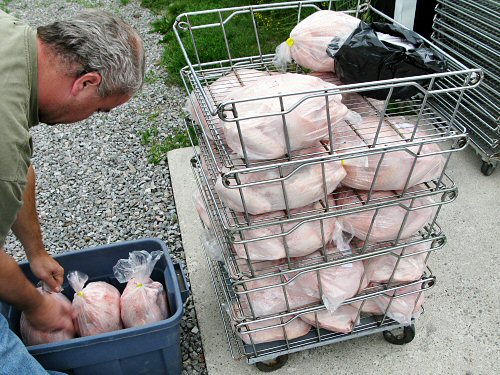
Eleven hours later, it’s 5:30pm and we’re back. Matthew helps pack the big birds for the trip home and into the freezer. Average weight is around 8lbs (3.6kg), where the Frey’s are maybe barely 3lbs. Hmmm… Not the most satisfying little adventure, with three 40-minute round trip drives, and the chickens disappearing through yet another middleman, reappearing neatly packaged for $3 more… With the processing fee tacked on for good measure, these are EXPENSIVE chickens, but I’ll do the math, and review the overall, somewhat unsettling White Rock Experience…later. On the other hand, you can’t beat the results: a lotta REALLY plump chickens! Next up in Meat Birds, Take 1: waiting for the free-ranging Frey’s to bulk up, and THEN it’ll be a fully DIY field-to-table chicken dinner!

The Drive Shed

The Drive Shed

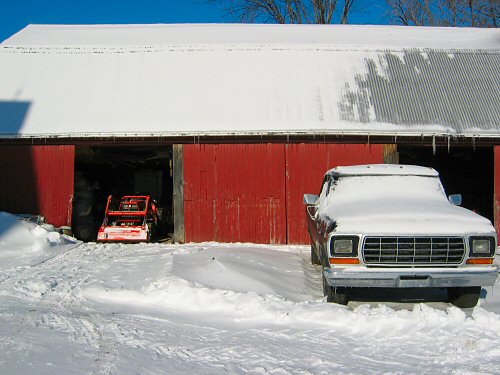
Finally got the tiny tractors in out of the weather. The diesel Kubota took hours and some warming and recharging to get started (I should’ve put ’em in sooner, but I wasn’t believing in the COLD). You can just make out the John Deere riding mower, parked sideways and in for the winter. The Kubota I fire up every few days to keep it limber, and it goes on snow clearing outings, mainly to make paths to the greenhouse. Unheated and uninsulated, the Drive Shed is still the place to be for machines in the cold! This version was built in the 1940s (here’s a view from the other side, it’s sticking in on the left), and like most things on the farm, has quite the history of…uses. All manner of vehicles, probably in the hundreds, have been stored or repaired here: tractors, cars and trucks, dirt bikes, snowmobiles, buggies and sleighs (that’s a 1977 Ford F-150 pick-up on the right, slowly being repaired by Bob’s son, Robert). The upper level is quite huge. It’s now mainly crammed with parts and pieces—assorted useful “junk”—but back in the day, a pulley system raised and lowered a wooden platform (it’s a manual, open elevator), and as the seasons changed, the farm’s various horse-drawn carts and buggies would be swapped up and down with sleds and sleighs for different purposes. Now, they’re long gone—one sleigh and no horses remain—but maybe they’ll be back!