New year, new farm!

It’s a new day rising in a new year, perfect timing for Tiny Farm Blog to officially become a tale of TWO (tiny) farms: where I started out on this surprise growing adventure six seasons ago, and what comes next. There’s a long and complicated story here, not without its drama and prickly points, but luckily, all that is really beyond what TFB is about, so I don’t have to go into it here! Yay. The new situation is as much of an unusual and unlikely set-up as the current one was unexpected, a more or less instant meeting of minds. There were more, well, logical options, but this feels right. It’s very real tiny farming, with all of the hard (though fun!) work and financial challenges to face, PLUS, the prospect of a whole new start-up in the field…which is the really exciting, critical part.

The new farm is just down the road, only about 30km (19mi) away, but with the many lakes in between, getting there by road doubles the distance. I won’t lose touch with the PEOPLE I’ve come to know and the friends I’ve made, but it means a complete change in my I-don’t-drive local. The garden and facilities are also nearly starting from scratch. I’m going from a farm refined over several generations for this one purpose—a fantastically practical agricultural infrastructure, you could say, with Bob a living part of it, carrying forward a couple of centuries of classic farm maintenance skills—to loosely tended hay fields and a small, bare barn.

I guess for me it comes down to challenge, perseverance and a self-test (although I really don’t like…testing!!): How transferable is the “tiny” spirit, how much have I REALLY learned, and how far can tiny farming go, without becoming just another small business (let alone, just another mortgage payment)? I’ll include more details of the old and the new, as they fit. In any case, this should make for interesting times on the blog. As I understand it so far, tiny farming is about growing, about people as much as crops, and it’s about change… Let’s see what happens! :)
Hail damage reassessed

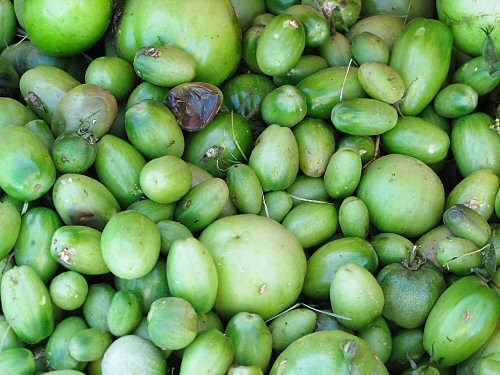
Three days after the nasty hail storm, and the full extent of the crop damage is more evident. It’s quite a bit worse than it first appeared. The plants will bounce back, but we’ve lost a lot of the fruit that were furthest along. Little nicks in maybe 70% of the toms and eggplant and peppers means that the first harvest of these veggies will be…small. Curiously, but not really suprisingly, I’m quite unfazed by this turn. I can really fret about setbacks that I could have avoided, like deciding not to overnight frost protect with row cover, then getting hit with frost, or not seeding a crop when it’s dry, then getting a week of rain and mucky, unworkable ground. But where it’s purely a Mother Nature play, I’m instantly in half-full mode, seeing the good side of things automatically: well, we’ll have SOME first-round tomatoes…and there are lots of other, undamaged crops… So I’m good. But even from my relatively small (and small-scale) experiences with losses due to weather, I can imagine how nerve-racking large-scale monoculture must be, especially in these crazy weather times, when you have dozens or hundreds or thousands of acres tied up in just one thing. That sounds like really bad stress…and mixed crop tiny farming seems by that measure alone, much…better.

Three minutes of mayhem

What at first seemed like a mild three-minute hail storm this afternoon did an impressive amount of crop damage right across the market garden. One of those sudden, short storms that’ve been popping up more or less several times a day built up, rain started to come down quite heavily, this time with a sharp wind, and after a couple of minutes, HAIL joined the action. I went out to check on the trays of seedlings sitting outside the Milkhouse: you could hardly feel the ice pellets on bare arms and the seedlings didn’t seem bothered by the brief pounding. The pellets were pea-sized, in two configurations: smooth, and jagged (the sample in the pic is from a few minutes after the storm ended, with the sharper edges on the rougher pieces already melted off). The hail soon stopped, a few minutes later the rain ended and…sunshine. Great! Not particularly concerned, I went out to inspect (we’ve had small hail a couple of times with absolutely no plant effect that I could notice). Well, SURPRISE!

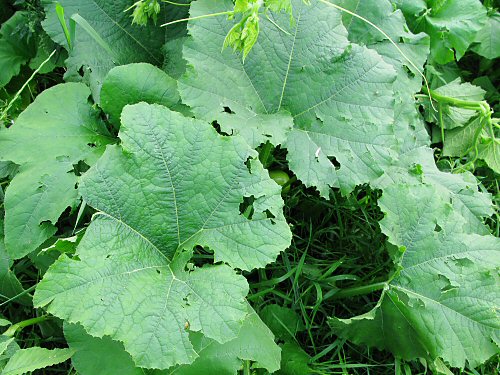
Crops with fairly large leaves, the squash here and more mature beets, had leaf edges sliced and holes punched right through.

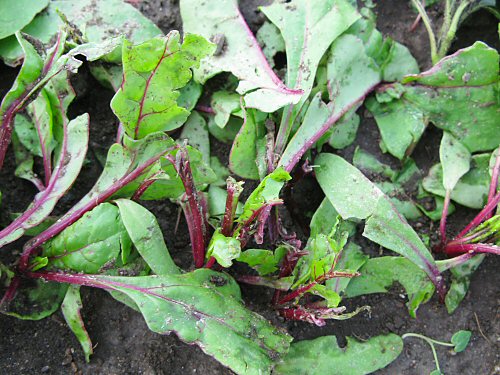
Snapped stems was the most surprising effect. Here, beets were pummeled…

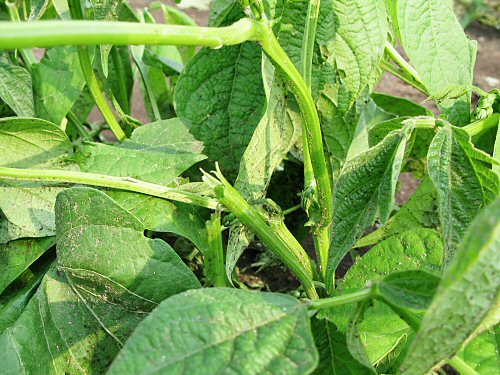
…beans were also quite heavily hit, with severed tops of plants lying in the paths…

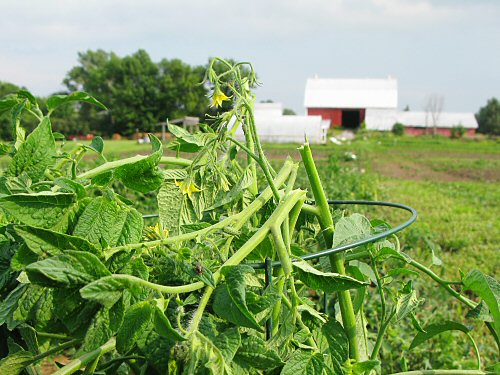
…and tomatoes took a good hit as well. I didn’t closely examine the developing fruit, like tomatoes, peppers and eggplant. It looks like there’s some bruising, but I’ll wait a couple of days when any damage will be easier to spot. Overall, not the end of the world, but a definite setback…not welcome.

The Endless Salad…

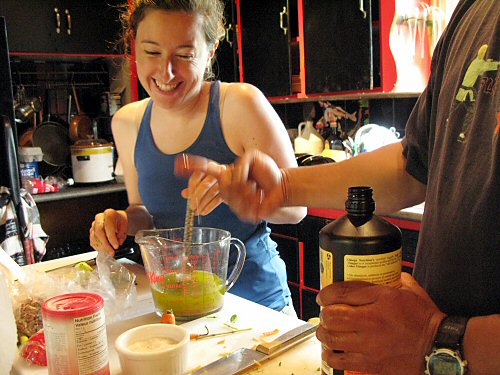
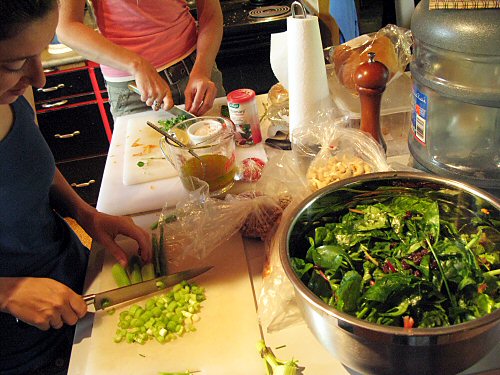
Lunch has turned into a collaborative cooking affair, built around the near-infinite possibilities of the Endless SALAD. Everyone who’s around pitches in: here, Lynn and Melissa chop. We build it from what’s available in the field, plus supplies from the farmers’ market and from the supermarket (with mixed feelings, I’m now buying mostly organic), a variety of raw nuts, and sometimes meat (turkey, chicken, fish, so far). We pick the ingredients, and there can be MANY, by whatever sounds good together. It always works! The salads started last month, when I asked to join Shannon in her vegetarian lunches, and Lynn and Raechelle would fill out the table on the days they were here. This direct connection between growing and cooking and eating and people started last season, with Friday evening dinners after harvest, and the first, occasional all-local-food mini-barbecues, and now it’s become part of everything…

Thinking about it now, this deepening food awareness is happening over what seems like a curiously loooong time, this being Year 6 in the garden. For the first couple of years, I was out in the field alone, spending 10-12 hour days at least six days a week during the main growing season. At the end of the day, I ate TONS of veggies. It was normal to harvest several types of greens for a salad, plus whatever was around for a sauteed side dish, and every three-four days, I’d roast a bunch of root crops. Meat was definitely in there, regular supermarket fare, but almost as a garnish, a small steak or a big pork chop or a chicken breast, on top of a mountain of veggies. I relished dinner every day, partly from the novelty of having grown the better part of my meal, a lot because I has HUNGRY, and mostly, as I remember it, because it simply attracted me: the taste, the super-simple preparation, but also the physical feeling of satisfaction these meals brought. Then, I wasn’t giving much personal thought to nutrition or “local food” or anything like that, it wasn’t a calculated, conscious enjoyment, it seemed simpler, more common sense. During the winters, in between gardens, my old eating habits didn’t change: not much junk food, no instant microwave meals, still, the regular parade of meat-and-starch industrial food type eating, straight from the convenience of the supermarket aisles. It seems a little odd now that this didn’t concern me. Then again, I wasn’t tiny farming to save my health or save the planet, this wasn’t any sort of cause, instead, something I had wandered into, seemingly by chance, that took hold: there was no agenda, only an unfolding path to somewhere cool…hopefully! And then came last year’s people in the field transition. While the garden stayed tiny in size, the intensity increased as really relying on others became a part of it all. Along with that, the food we’re growing has become linked to…daily living, plain and simple, whether it’s sharing meals from the field, or people stocking up on things to take home at the end of the day (not so different from the farmers’ market or CSA, but even more…personal). And this increasingly deeper connection to FOOD, not based on concepts or conscious direction but just on what’s happening, is surprisingly new to me, yet another part of the tiny farm experience, where what should be obvious to us all is revealed in unexpected ways… (Guest photo: Lynn laughing, me tasting, by Raechelle.)

What I’m not up to…

Pesticide fill-up

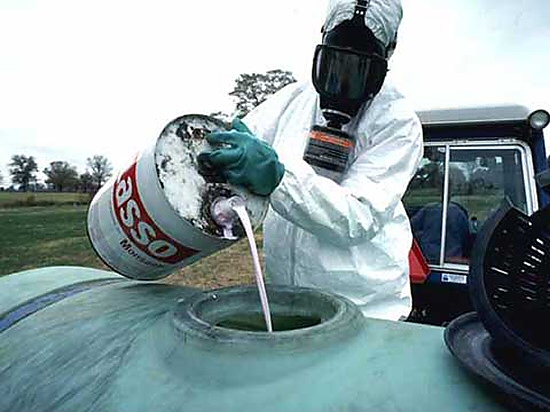
Don’t know who that is in the photo…it’s not me! I last posted this image—I found it online; I think it’s public domain; he’s loading up a herbicide called alachlor—in an October, 2007 post, And now for something completely different… I like the image. It’s a way for me to make quick sense of this organic tiny farming, so I guess I’ll post it every so often, as a reminder, until something better comes along… I have zero first-hand experience with industrial agriculture or its direct effects, all I know about it is what I’ve read and eaten (and I think I’m doing OK so far). I do know that things are never the same when you’re on the inside, so when I think Big Ag is all wrong, it’s just a semi-educated guess. I haven’t seen it DO wrong in person, and (unfortunately), it still feeds me part of the time. But when I see a picture like this, and compare it with what I do in the field, the contrast is pretty clear. With all of the mind-numbing complexities of the green/what-have-we-done-to-the-planet-and-what-should-we-do-now- to-fix-it/save-ourselves debate, I can simplify: I immensely enjoy growing food for people, and I don’t want to be that guy…

Meet my garden spirit guide

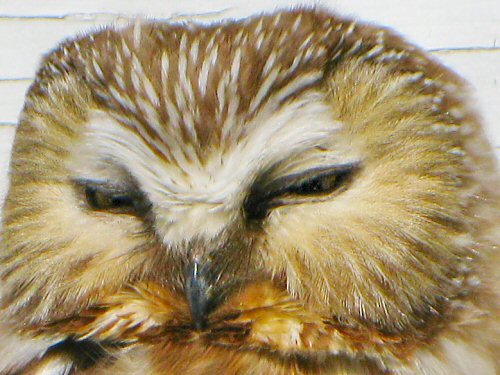
So I’m heading into the house this morning, by the winter front door, which is a door cut into the attached-garage door (it’s easier to keep clear of snow than the real front door…). Kinda zoned out and lost in thought, I was on my final step, arm out, automatically reaching for the door handle, when suddenly, whoaaa!, I froze and stepped back. By mere inches, I’d almost grabbed a handful of OWL. There’ve been owls in the barn, and an owl can be seen once in a while sitting on a pole in the farmhouse backyard, but we definitely don’t have owls calmly hanging out on the front door handle. This had to mean something. This had to be a Sign! The owl was just perched there, perfectly laid back, kinda squinty, looking at me. It didn’t flinch. I took another few steps back to check things out. It watched me, unperturbed. Hmmm… I checked it out for a couple of minutes, kinda walking around, moved closer again, slowly reached towards it. No problem, it just watched me back. Then I headed to the Milkhouse for my camera, returned, and still the owl. It let me come as close as I liked. It really didn’t seem to mind me being well within touching distance, a couple of feet away. A few minutes later, Bob went by and I called him over. The owl was unfazed by TWO people looming around (since it was my owl encounter, maybe at that moment, Bob didn’t really exist?). After a couple more minutes, looking perfectly airworthy, it calmly flew away through the four feet of space between us… And it was gone. So what was up with the owl? Could be that, with youthful naivety (it looked…young), and the natural confidence of a predator high on the food chain, and maybe being tired out by too much flying, and having to squint in the bright sun, it just didn’t care. That’s possible. More likely, though, it was simply there to hook me up with forces unseen and the entire spirit world. It gazed at me for a long time and I felt good. At last, my spirit guide revealed! Of course, I had to vet all of this and get more words and meaning, so I rushed inside and hit the Web. Wooo… Glancing at the first search results got me worried, all messenger of death stuff. But, the fantastic thing about the Web is, keep looking and you can find whatever you want! Like this page, much more…REASONABLE, that explained how cool having a personal owl encounter is, with words like “wisdom”, “protector” and “symbolic of inner knowing”. I particularly liked: “If an owl has visited you, an incredible gift has been bestowed.” This is good! Thanks!! Life on this tiny farm now walks with the owls… (It’s a fully-grown adult northern saw-whet owl; thanks to Sharon the BirdChick for ID-ing it in the comments below!)

And now for something completely different…

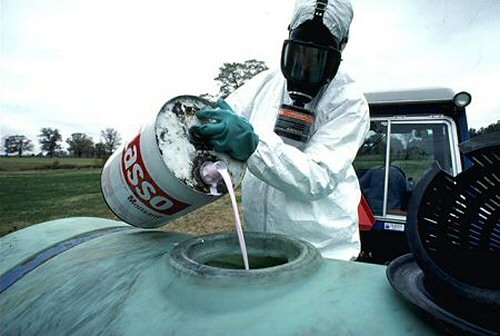
Looking through photos on the computer today, on a rainy afternoon after the farmers’ market, I ran into this one. I’d saved it from somewhere on the Web three or four years back (public domain, I think). It’s a striking shot, although whether it’s advertising safe pesticide handling or the scariness of chemical agriculture, I’m not sure. And, hey, that could be me, all dressed up and getting ready to go—you’re never too tiny to do some spraying! I looked up the pictured product, Monsanto Lasso. It is, or was until recently, the biggest selling agricultural herbicide in the US, used “everywhere” on corn and soybeans. It’s also a “known or probable carcinogen” and apparently messes with human reproductive and developmental functions as well. Hmmm… Luckily, I use a wheel hoe