
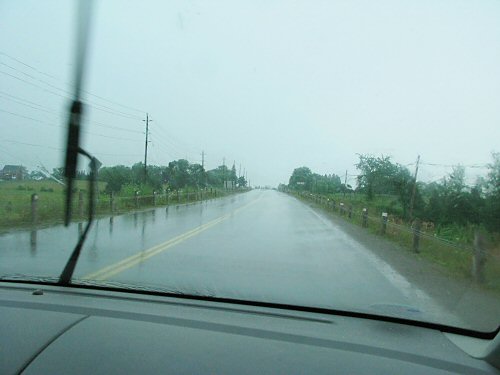
For a the better part of most days for the last couple of months, this, the return view from dropping off Monday CSA shares, has been the Weather. Cloud and rain. There are occasional sunny days. I haven’t been keeping accurate count, but that can’t be far off. We’ve several times enjoyed 2″ (5cm) of rain in a week. I haven’t thought about hoses in weeks, except when moving them out of the way to mow down prolifically multiplying weeds on the garden paths. On the way to the Saturday farmers’ market, I barely glance at the pond to check the level (the pond is out of the way down near the highway, most easily seen when driving by). This summer, water has not been a problem!
watering
Shifting gears for summer…
The spring rush is over, and fieldwork is shifting into summer mode, from mainly planting to mainly weeding and watering, and then, HARVESTING. Seedlings for the most important crops and varieties are in, although there’s still quite a lot to transplant.
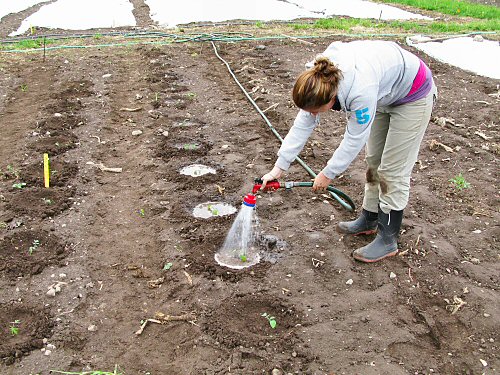
Here, we’ve just finishing another 100 or so tomatoes, with Lynn watering them in (the Redhead water breaker is GREAT, delivers as much water as you’ve got pressure, while softening the flow so that you’re not smashing or burying the seedlings). Creating a little basin around each seedling makes the most of hand watering in.
In my continuing experiment with shortening seedling production time, these are the youngest toms to go out ever, a third set started at the beginning of May, with their first true leaves now just coming in!
There are also more squash, melons, and a few more toms to transplant—in years past, I’d’ve been concerned about the date, but I’m learning to adapt the season’s resources (time, people, irrigation capacity,…) to the WEATHER.
Keep the workflow balanced is my new first mantra, so we also spent a few hours weeding today (Ryan dropped by to help for a few hours, he’s a new CSA-er this year who is also about to move his family to their own tiny farm at the end June!), instead of rushing on the last transplants.
It’s hard to measure, but for this type of small, diverse market gardening, in this time of extreme weather, things quite often don’t work out as they traditionally should. For example, the recent rain and cold, and now, more heat, have created a situation where the dominant weeds—pigweed, mallow, and lamb’s quarters—are seemingly slow, but are in fact about to explode. Weeding now will probably save way more time and deliver more harvest than putting off weeding just to transplant a few more beds a few days earlier.
I dunno, I’m figuring this out as I go, but I think traditonal garden rules and timing have to be increasingly bent as the weather gets crazier… I guess you could say: EXCITING TIMES! :)
How odd…
It’s like we’ve gone directly from winter to summer. Less than a WEEK since the ground dried out enough to walk on it and till it, I’m actually out there WATERING… This is really odd.
I’m sure we’ve had unseasonably hot Aprils before, where watering in newly seeded crops was necessary, still, it’s only common sense to chalk this up as another of the consistently bizarre weather events we’ve been having in the last three years or so… In other words: global warming, I guess.
“Normally,” April is a good month once it warms up, because our rather heavy clay-loam soil holds moisture well, and just post-snow, it’s wet enough that you don’t have to water in what you’ve seeded. A spring bonus!
Instead, what’s going on here is, in a handful of days, the top inch or more of the ground has dried out completely in the unusual heat. That means shallowly-sown seed, like spinach, lettuce, radish, beets, and chard, is sitting in perfectly dry soil.
I put in peas at around 1.5″ (4.25cm), and they were just barely in nice, moist earth. But these other guys, what can I do?
I considered setting the seeder deeper, but that could just bury them too far for good, quick germination (I’ve messed around with too deep before…).
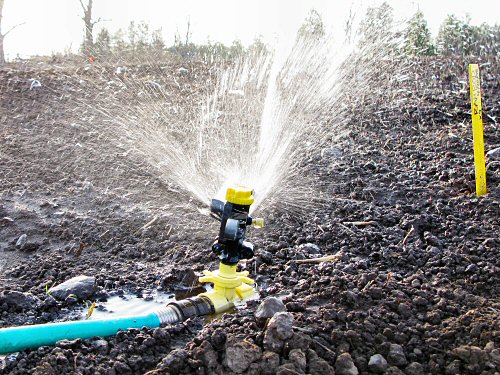
Or, out with the sprinkler.
I don’t like using sprinklers, I don’t have water to waste, but here, it’s much the more reasonable alternative to hand-watering a 50’x100′ area, when there’s so much else to do.
The pond irrigation isn’t yet set up, so the water’s coming from the barn well, where there’s such low pressure that only the cheapest, most lightweight garden sprinkler will oscillate, where better quality, heavier duty ones shoot a stream of water straight ahead and won’t budge.
Irrigation comes early, and cheap gear is every once in a while…good!
Tangling with hoses
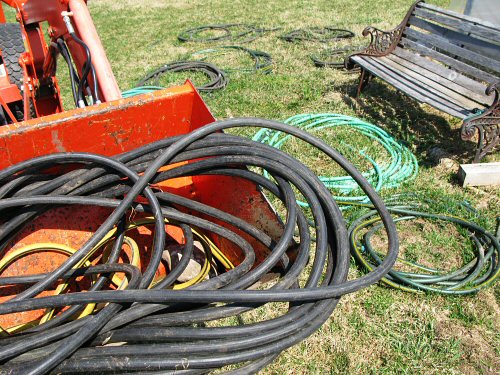
In smaller gardens (tinier farms!), hoses are generally a fact of life. In spring, it’s time to uncoil them all, check the fittings, and get set to deliver water largely by hand.
On BIG veggie farms, “hoses” are usually big pipes (3″/7.5cm and up), part of full-blown irrigation systems that suck up and spew MILLIONS of liters of water a season. Here on this tiny farm, we’re way closer to the garden hose end of the scale.
Our irrigation system is a work in progress. Drip tape is the ultimate goal, but there are obstacles to work around, like the limited water available from the barn well, and the distance to and lack of electricity at the spring-fed pond. Right now, watering is about regular 5/8″ hoses, fed by a 1″ plastic pipe that runs from the barn well to the pond located WAY at the other end of the field, with taps at 100′ intervals.
Actual watering is done with a combination of soaker hoses, sprinklers when there’s no wind, and various hand nozzles for watering in newly seeded beds. Quick connectors are a major convenience when hooking up the various combos of multiple hoses and other attachments. I try to find a balance between not too many hoses, because you can’t leave them lying around, and not so few that you’re moving the same rig all over the plot.
Accidentally tilling hoses that were left snaking around instead of being promptly put away has turned into a not absolutely rare occurrence, and a time-waster (untangling and splicing takes more than a minute). Just put away that 300′ of hose plus 500′ of soaker hose when you’re done! ;)
Spot irrigation with hoses on two acres is a bit tedious, but like everything else, you do get used to it, it’s part of the routine, and it gets the job done, which is satisfying in the end…
That’s the state of the watering art around here as we head into a new season, and I’m promising myself advances on the drip side of things. Of course, it could happen to rain all the time, about an inch (2.5cm) once a week would be fine, and then hoses would largely vanish from the garden landscape. That’s not at all that likely (and when it’s a really rainy year, you wish for hot, sunny hose weather), but…YOU NEVER KNOW!
Early spring rounds
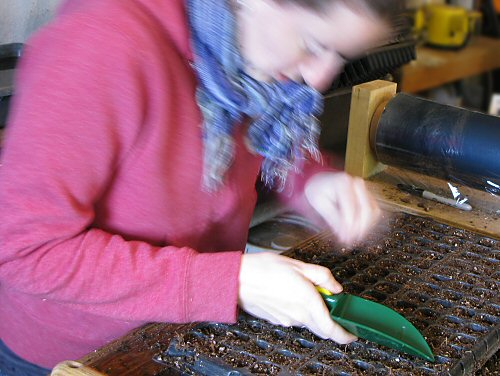
A gray and gloomy, windy day…but WARM. Well, fairly above freezing for the most part, and with a little rain, yesterday’s speeded-up melting continued. But we’re still a ways off from actually doing any work in the field. So, another pretty laid-back day. Lynn came by for her weekly installment of tiny farming. Out in the greenhouse, moving tables around and some hand-watering (those barrels of snow water are coming in handy!). In the Milkhouse, more seed starting: 400 more tomatoes, and a tray of leeks (a little late for this batch, but still better than direct-seeding). For her very first time starting seedlings, Lynn seeded 19 varieties into a 200-cell plug tray (10 each, 20 of one). Clearly, I trust her…accuracy. Working in the tiny cells, changing seed every row, and keeping track of names requires a bit of concentration. A little wandering attention, and who knows what tomatoes would be growing where… Living on the edge! :)
The watering tray
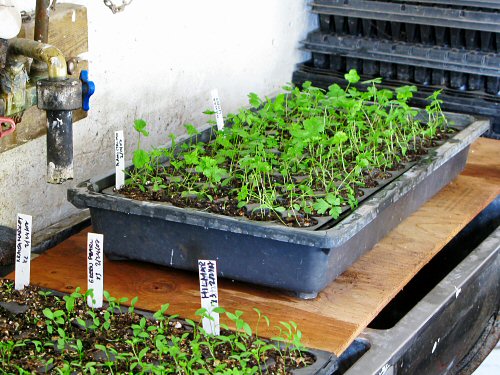
It’s funny how almost random objects can become practically indispensable tools. Like this rigid gray tray, given to me a while back, just the one, amongst a mixed bunch of plastic flower pots from bedding plants, passed along by a local gardener. For four seasons, I’ve used it to water the seedlings (all parsley in the pic): in goes a plug sheet in its webbed tray, sit for 10-15 minutes, then out to drain for a bit over the sink, and it’s back to the grow racks, good for another few days. I’ll keep this up until the seedlings are well-established, three weeks or more, depending on the crop. Perfect, except, at one point I’ll have maybe 50 plug sheets going at once, which means a lot of moving trays and tracking soak time. Not too efficient. I’ve been meaning to build a bigger watering tray, that can handle four or six plug sheets at a time. But I haven’t yet. As odd as it sounds, I’ve grown…attached to the one-at-a-time approach, and this particular, perfectly sized, always reliable gray tray! Every planting gets its own bit of focus each time it’s watered, developing its own little story on the way to the field. It’s part of the fun. Doing batches will be much quicker overall; the attention to what’s in each tray will be slightly less. Not a bad thing, there’s always lots to do with any extra time—continually improving by increments is also a main part tiny farming. With more seedlng starts this year than ever, I suppose I will build that bigger tray… Progress… ;)
Get it in, get it done!
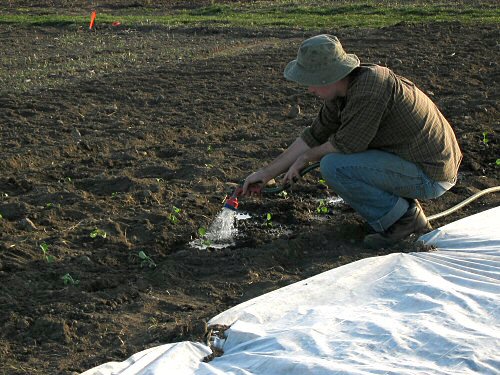
Conall, the all-new organic grower, starting from scratch as our first full-season, full-timer, waters in transplants. Today we set out three more beds of brassicas—so far, there’s cauliflower, broccoli, Brussels sprouts, bok choi—prepared beds for a dozen more crops, set up the irrigation pump for the season, cleaned out the winter storage area of the barn, turned the composting windrow….and more. Still, it’s the rush-to-get-it-in-get-it-done time of the year, and the days never seem long enough (although, they’re getting longer!!).