
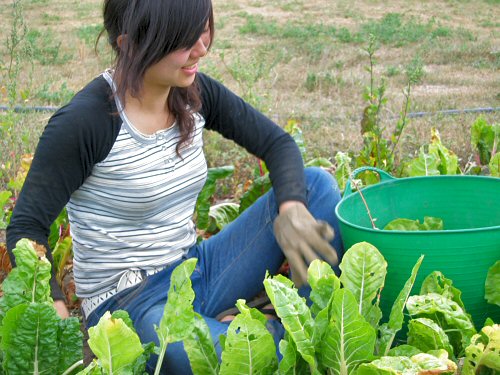
On her last day of a week that flew by, Mami, WWOOFing from Japan, works to rejuvenate a bed of Swiss chard battered by the drought. Despite a fairly formidable language barrier, there was much conversation and laughter about life, times, Hollywood movies, smoking laser printers, the apparently grave state of the world…the usual field chatting fare! For no one reason I can put a finger on, it was an energizing bit of cultural exchange, and a lot of extra fieldwork got done as well. Through this blog, tiny farming has become for me kinda…transnational, and Mami’s visit made that feeling even more real (the ClustrMap comes alive!). It’s really all about People in the Field!!
Month: August 2007
At last, rain!
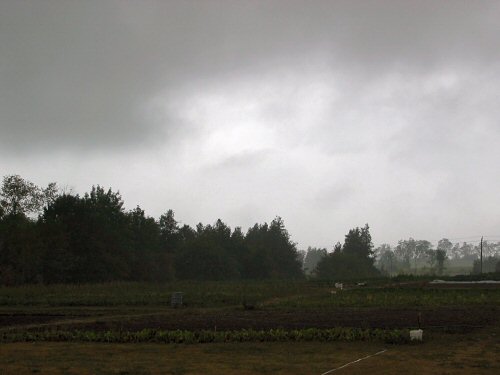
Gloomy, overcast, a typical rainy day…and it actually rained! A couple of heavy downpours and a few gentler extended falls added up to a satisfying full inch (25mm) over a few hours. This is great timing for the second planting of summer squash, which is just starting to produce heavily, and for, well, everything else! Even the pond filled up nicely. It’s too late to make up for nearly three months of near zero rainfall, calculating that effect is best left to the quieter late fall and winter months, when the lessons of the season are reviewed and new year plans get firmed up. Right now, it’s all forward looking, week to week, harvest to harvest. Any decent rain is excellent!
Oats
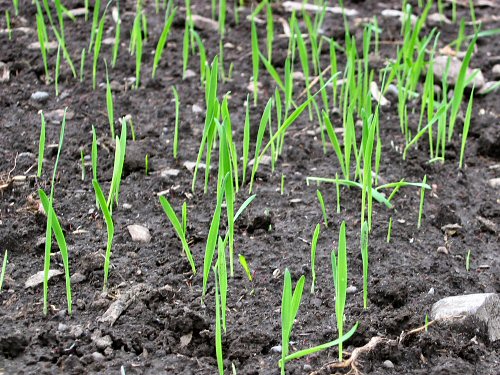
Promptly the day after the first rain in a while, OATS is surging up. Actually, strips of oats in one section planted a few days ago are appearing, the rest to hopefully follow just as vigorously. Oats anywhere but in a breakfast cereal bowl is a first for me. As a fall green manure cover crop, it’s an all new growing experience—if I didn’t know where this had come from, it’d look like an alarmingly healthy new weed attack…but it’s not. A couple of days ago, we seeded most of the open sections with an Earthway broadcast seeder (a simple, fun contraption, a bag with a shoulder strap that flings seed far and wide as you walk along turning the crank). In most sections, I used the rototiller on the Kubota compact tractor to till in the seed, skimming the surface in order to bury the seed no more than an inch or two. A couple of sections were raked so that the oats was lightly covered. In a couple more, the seed was left on the surface, a potential bird buffet. We’ll see what happens! Without the recent rain (we got another 1″/25mm today!), this wouldn’t have had much of a chance (oats needs to germinate by the end of August around here if it’s to get any growth on before winter kill)—we lucked out. So far, I’m liking oats!!
Sunflowers, cut flowers…
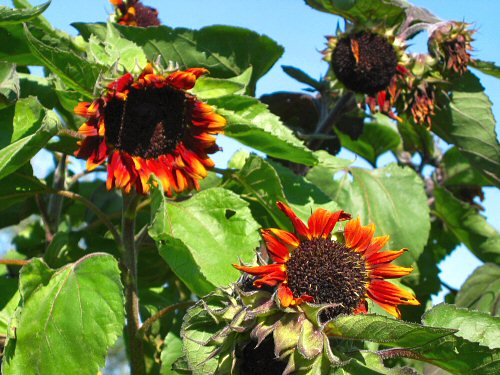
From flowers on my my mind back in the planning days of April, the results have been no better than middling. Germination was fine for all the many varieties, and we’ve had a sprinkling of gypsophilia, calendula, zinnias, cosmos and more over the last month, with a strong showing by all of the sunflowers. Overall, though, the cut flower bed was at the bottom of the watering and weeding list and, of course, pigweed reigned. So there’s been no real cutting involved, the flowers are simply taking their course, a good trial run for next year, and a splash of color every once in a while in the corner of my eye. The Claret sunflowers (pictured) are particularly striking, even as they age and decline…
Tiny farming down the road
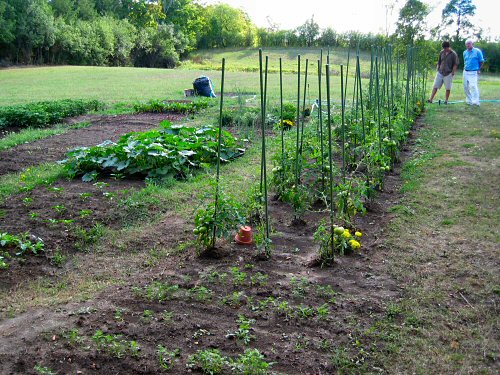
Most of my last four years as a veggie grower have been spent on the farm, like, practically every day (this seems perfectly natural to me, although some wonder how I handle it—they just don’t know how absorbing it is and how much there is to do in and around a big garden!!). This year, with more people in the field, I’ve gotten out a bit. Today, as an extended field break, Conall and I headed a few miles down the road to visit a brand new tiny farming operation, Richard’s home veggie plot. Richard is a physician, taking what I’ve gathered is a fairly new view of nutrition. Over the last two years, he’s dropped by the stand at the farmers’ market to buy nice quantities of veggies (he juices) and we’ve had long chats every week, about growing stuff, food and health, and lots of farther ranging topics. This year, he started a veggie garden on his 100 acres of farmland and forest. It was all hand work and learning as you go. I felt connected from all the conversation, so it only made sense to check it out! The garden was started a little late in the season—Richard sees it as a trial run!—still, lots of tomatoes, summer squash, beets, carrots, potatoes, more. Besides my own TF efforts, this is the first time I’ve seen and heard about and commented on a substantial veggie garden start-up… Next year, he plans to more than double the area to over a quarter acre and go for a full-on effort to supply his own garden veggies. The people part of small farming continues to reveal itself to me!! Fun!
Chives-level view
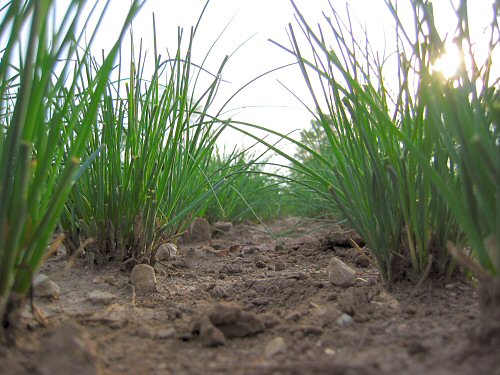
Chives are great. Usually considered a herb, and like many other herbs, chives are extremely low maintenance, compact, prolific, and never fail to please the senses. Cut them and they come back quick. What more could you ask for in the busy veggie garden?! The herbs section this year is serving mainly as a nursery for new crops (tarragon, lovage, a new variety of rosemary) and perennial holding spot, all for future herb production. It would be great to harvest a nice selection every week, but you also need enough of a market to justify the time spent snipping and bundling, and once you start, you have to keep it up: consistency generates word of mouth! And it turns out that most of the 50+ shareholders are picking up off-farm (mainly at the farmers’ market), else they could help themselves. So full tilt herb production is waiting on other things to move ahead. Meanwhile, no waste. Chives, along with curly and flat-leaf parsley, are occasionally making it into CSA shares. And there’s always…personal use!
Radish without holes
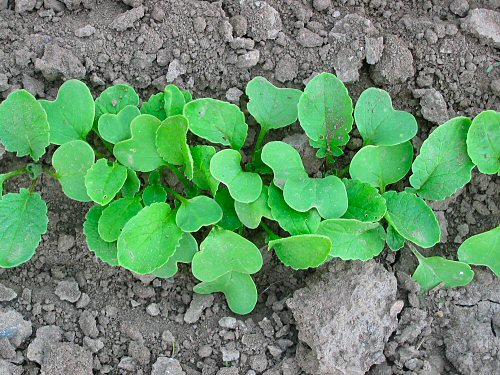
Radishes not riddled by flea beetle bites—it’s a slightly startling and definitely heartwarming sight! The winding down side of the season has its kinda downbeat MINUSES, like frost watch and wholesale row covering/uncovering, and the one special night when most tender crops get toasted by a hard frost and die (even under cover)… It has its PLUSES as well. Round about now, pest pressure declines dramatically, soon to vanish, and that includes PIGWEED, and the tiny but savage flea beetles (cucumber beetles stick around in small, determined numbers right into the subzero nights, but their damaging days are over for the year). Also, the need for irrigation is almost certainly over. These Rebel radishes were planted mid-August and with the recent rain, they’ll do well. Over the last few days, we’ve been laying in more beds of radishes, plus lettuce, spinach, zesty brassicas like arugula for salad greens, even some bok choi, in case we catch an extra measure of sun and warmth during the last of the good growing days. Bonus fall crops? With the pests packing it in, pushing for the latest growing date is the easiest gamble of the year!