
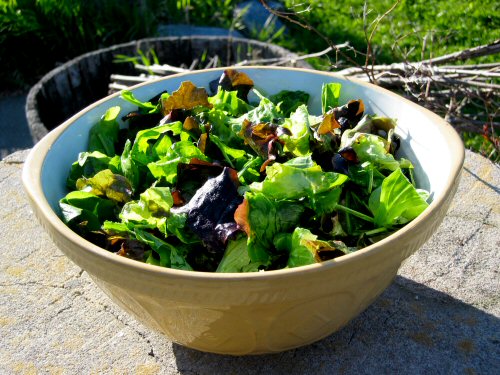
Around here, there is a definite segment of the population for whom salad greens, while accepted as possibly “good” for you, are not really considered proper human food. I might even think it’s an old school, meat-and-potatoes farmer thing, though I haven’t chatted with enough farmers to…generalize. In any case, I’m an all-new first generation farmer and to me, salads are great! This is the first dinner salad harvested this year, picked from the early lettuce aisles. It’s a mix of arugula and four lettuces: Simpson Elite, Granada, Red Salad Bowl, and Sierra, each with its own color, texture and flavor. Lots of fresh veggie variety is an excellent concept. :) Tastes good, too!
Veggies
Potatoes go in
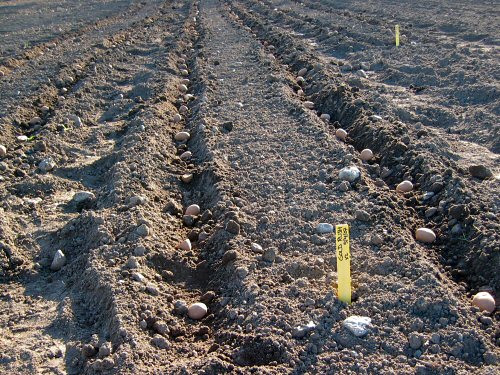
Gold Rush potatoes, ready to be buried. Potatoes are yet another work in progress, as I experiment with simpler, better ways to grow ’em at my particular hand-tended scale. This year’s seeding method: use hoe to make shallow trenches, drop potatoes every 18″ or so (more spaced this time than the usual 12″), walk down each trench stepping them in with ball of foot, fill in trench. Quite relaxing! The selection this year is basic, the usual: Gold Rush, Norland, Yukon Gold, 300 pounds (136 kg) in all.
Greenhouse filling up
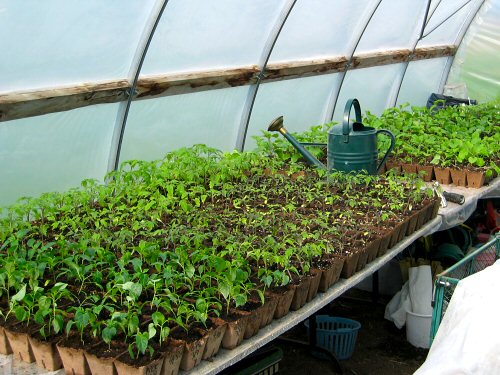
The seedling side of the greenhouse is already almost full. All of the tomatoes, eggplant and peppers in 3″pots (around 700) are out there, which is only almost a quarter of everything that’s going. I’m gonna have to make some space! There are many things to do. Last frost date is approaching and the long-range weather forecast, not worth a lot but still worth looking at, predicts temperatures steadily rising—planting out to the field will likely happen “on schedule” around the 20th. The farmers’ market is also starting, and I need to do some carpentry to finish up the new stand. Two-thirds of the potatoes still have to go in. There’s a whole list of seedlings that need to be started indoors. There are the flowers and herbs to tend to, separate areas on their own. The grass is jumping and the paths need a first mowing now! And so on. If you’re into a little higher pressure gardening, around here, this is the time of year for you!
Lettuce gone wild…
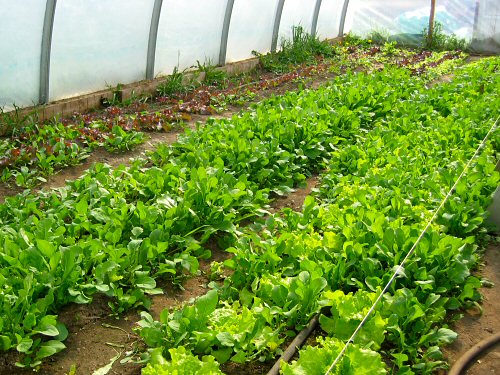
The early lettuce has company. Several other varieties of lettuce, self-seeded from last year’s crop that was left to flower, just took off. Somehow, there’s tasty arugula mixed in as well. To munch on and to fill in where the voles had their fun, I let it all grow. This year’s lettuce is in there, doing fine, and should be ready not for the first day of the farmers’ market, which is this Saturday, but probably for next week. It’s all…good!
Tinier tomatoes
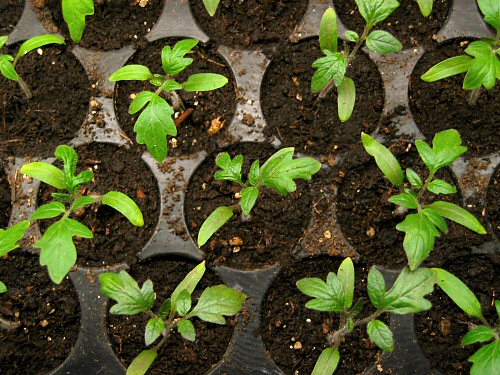
Big experiment. The last 200 tomato seedlings were started only three weeks ago, way late compared to starting dates in the past. They were also quite crowded in 200-cell trays. Now, I’m transplanting them to 38-cell plug sheets, maybe a little over half the volume of the usual 3″ pots. The experimental part is whether they’ll produce as fast as the rest, which were started earlier and are now in bigger pots. I suspect so (or I wouldn’t be trying it!), but you never know. You can get only so much info and advice before you just have to see for yourself (I’ve read that only special extra deep pots makes a difference, a few weeks of extra growth before transplanting doesn’t). I think I’ve been spending too much time producing seedlings that look great if they were for sale, but are unnecessarily big for setting out in the field. If this works out, I’ll save a ton of time next year.
Spot the spinach
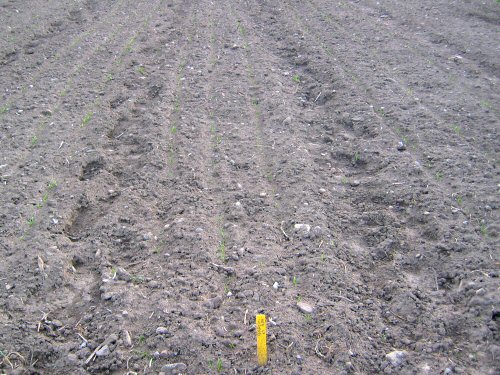
Can you see them? The first thin green lines of the season are emerging. Always exciting! Here, part of the first four beds (650′) of Bloomsdale and Spargo spinach. It’s coming along…
Getting busy
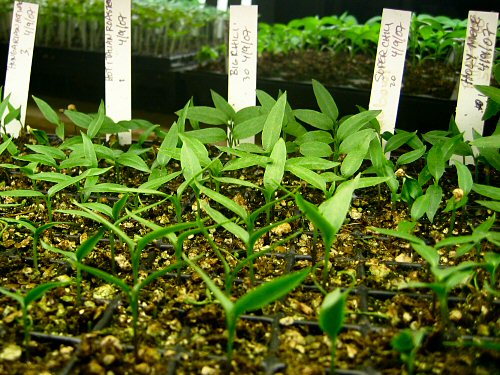
Hot peppers, and tomatoes behind. They’re some of the last set of seedlings, a bit of an experiment to see how late I can start ’em without slowing down later growth in the field. Outdoors, it’s been warm, gray and drizzling for two days now, things are starting to emerge, crops and weeds both, and it’s already time for a second planting of spinach and mesclun. Inside, the last several hundred seedlings are ready to be potted up and moved out to the greenhouse. We’re right at the point when things suddenly start to get intensely busy!