
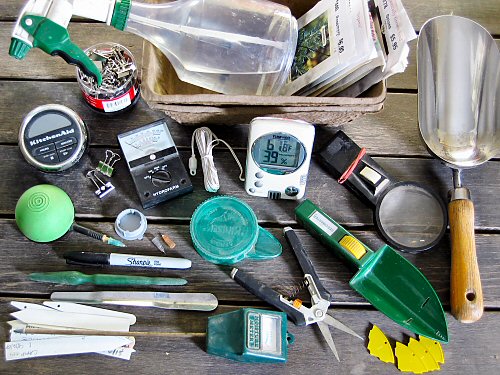
Here are ALL the indoor seed starting tools I have, most of them always-used, a couple not. Nothing special, and FINGERS I’ve found are handiest for most of the work at this scale. In any case, a few details (and there’s more on #1-5 in Seed starting tools, part 1): 1. The Seedmaster, a gadget for trickling out small seed as you rotate the wheel (the yellow pieces are click-in filters for different seed sizes); 2. assorted white plastic plant labels; 3. a dibbler or dibber or whatever, for poking little holes in soil; 4. a fine-point black waterproof marker (I like Sharpies) for labeling; 5. the mini-transplanter is essentially a tiny, stainless steel shoehorn for easy liberation of plugs from their cells; 6. a moisture meter, simply stick it in the soil; 7. plant snips for thinning seedlings; 8. Mini-Sim seeder: fill and shake out; 9. suction seeder with three tip sizes: squeeze the bulb, put the tip on a seed, release to hold, squeeze again to drop… ($25…what was I thinking?!); 10. digital timer for keeping track of repetitive tasks like bottom-watering trays one by one; 11. plant light meter, reads in footcandles, with settings for indoor and out; 12. digital indoor/outdoor min/max thermometer/hygrometer, mainly for keeping track of temperature; 13. magnifying glass with light, for examining seedlings (and GREEN MOSS) up close; 14. soil scoop for filling plug sheets and pots with seedling mix; 15. spray bottle with good quality spray head (more water per pull; I’ve used a wand mister like I have in the greenhouse, but the hose kept getting in the way, I may try one again for the seedling room this year); 16. small fibrepak flats, convenient for holding tools and seed packets on the potting table (left lying, the packets can so easily get wet…); 17. small bulldog clips, useful for all kinds of things, like organizing groups of seed packets. And the winners are…all of them, EXCEPT for: #9, which I found to be useless for my purposes; #8 which is great, but mostly for heavier hand seeding in the field, like for flowers; and #6, 11 & 13, which are more educational toys than essential tools, but still cool! (Wow, that was a lot of blogwork for pretty obvious stuff, but there you go! :)
Simpson Elite
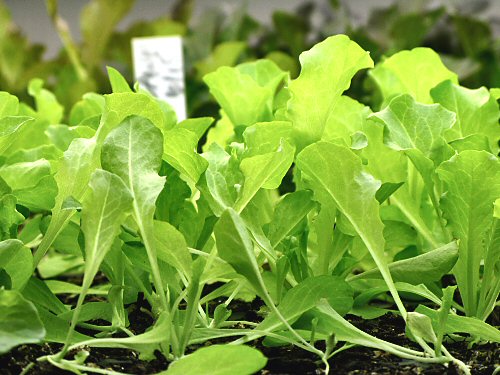
More early lettuce. This is Simpson Elite, an improved variety of Black Seeded Simpson, which is a really fast, reliable heirloom from the 1800’s. I grow both. They have thin, delicate, pale green leaves, but they’ve proven tough in heat, drought and cold. And they’re 40-45 days! These seedlings are now about 3-1/2 weeks old. I still haven’t thinned them from two per cell—all the lettuce looks so…pretty, densely bunch in their trays, and they’re stretching a bit, but just this side of really crowding each other. Anyhow, it’s the super-early lettuce…mostly for fun! (This is also my first tryout of the latest new farm tool, a Canon G9…a sturdy, field-ready bit of gear… :)
Lightbox suspended
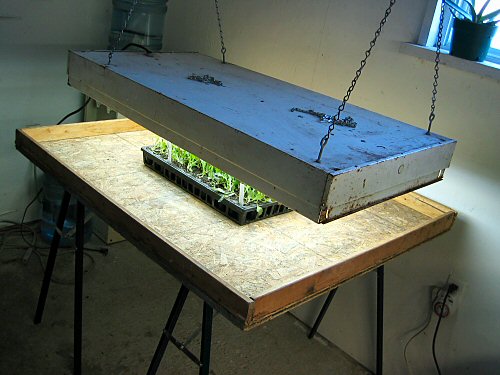
Another seedling room set-up task checked off today: hanging the lightbox. Not exactly a big job—the chains were already there from last year—but having it in place is a big visual reminder in the Milkhouse that we’re heading into spring. The box, given to me two-three years back, has four 48″ fluorescent tubes on 5″ (12.5cm) spacing. Raised up a bit more, it gives pretty good light to the whole tray, which is about 3.5’x4′ (1×1.2m). It’s been a welcome bit of much-needed space for larger seedlings, though this year, with the barely-heated greenhouse plan, maybe it won’t be so critical. I still have to line the tray with plastic, and possibly get round to giving the box a coat of white paint…
My old friend the min-max thermometer
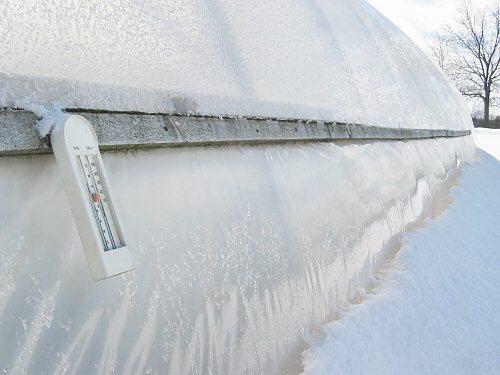
Clearing a path to the hoophouse today, I turned the corner and noticed the original min-max thermometer. I don’t usually. It was one of the first bits of gear acquired in Year 1, when the reality of FROST in the garden was a complete and scary unknown. The thermometer records the lowest and highest temperature that it’s hit; you reset it by pushing the little red button. It’s been hanging on the same nail in the same spot for three or four years, more or less out of sight and mind except in spring and fall, when I check it first thing in the morning to see how cold an overnight cold snap really got. Lately, the min-max is not such a big deal. Each different section of the field, and the particular crop in it, reacts differently to each cold night, so the only way to know what’s happened is to walk around and check things out. And I have confidence in row cover. I still check the thermometer, but it’s not like spring in the first couple of years, when I’d bolt awake at 6:00 a.m. and 10 minutes later be walking through the chill and dewy wet grass, adrenaline pumping, waiting for the verdict from the min-max to see what new transplants may’ve been toasted. It was kinda cool to be reminded, out of the blue, how that’s changed. In the case of gardening, at least, the more you know, the easier going you get!
New rosemary
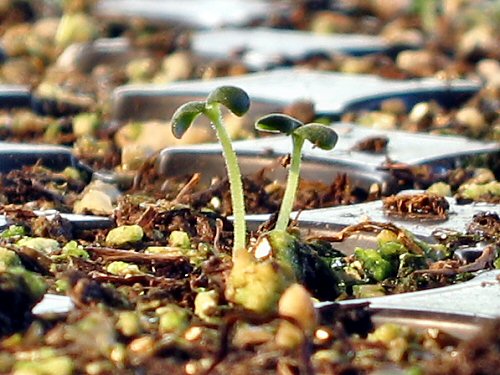
Rosemary, seeded 10 days ago, has been coming up over the last couple of days. I’ve heard that germination for this herb can be hard, under 50%. I’ve usually done better than that. This tray is about half started, and more will come…. Ideally, this would’ve been in at least a month earlier, but I didn’t realize I was out of seed. And it’s so slow to grow… Of course, there are still plants out in the field (I never did bring them in), and although chances are slim, I have high hopes for survivors. I dunno, seems to be something a little off between rosemary and me. I’ve frozen potted up plants by leaving them too long in the hoophouse (after digging them up and putting them in nice big pots), I’ve rescued cuttings at the last minute off of the frozen plants, I’ve left plants in the winter field… It’s odd. I love rosemary! What’s going on? :) Anyhow, there will be rosemary…
Welcome to KeroWorld
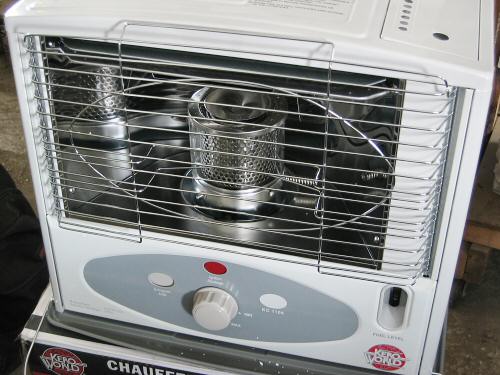
What an odd thought, what image comes to mind: the world of kerosene… And now I’m in it! Purchased new today, at a healthy 35% discount, this small, rather inexpensive, KeroWorld-brand indoor kerosene heater is the core technology in the extended-spring greenhouse plan. The idea is to turn the unheated hoophouse into a barely heated one, by warming it at night so that it stays above 38°F (4°C). That way, I can put out seedlings weeks early, instead of crowding them under scarce indoor lighting until it warms up in April. It should also give the earlier-than-ever lettuce, going into the ground in the greenhouse, a smoother start. This heater is low-powered—10,000 BTU, recommended for 420 sq ft, it’s 640 sq ft out there—but only a wee bit of heat is required. I think. Last year’s propane space heater was quite efficient, but burned too much gas for every-night use, it often went out by itself, and it required lots of ventilation. Plus, I don’t really like relying on pressurized tanks. This heater will hopefully burn low and steady, and it’s pour-to-fill! Aided by a fan to keep the air moving, and row cover on the coldest nights, it should get the job done. This all reminds me of Patrick of Bifurcated Carrots’ comment a while ago about the line between good and bad technology. It seems a personal decision as much as anything. Why don’t I dream about full-blown winter greenhouses, with high-intensity lighting and industrial-strength heating and ventilation, I wonder? Dunno. I just don’t. But an extra growing month in the strengthening sun, and a little less reliance on indoor lights, traded off against some kerosene, well, THAT would be cool!
Parsley!
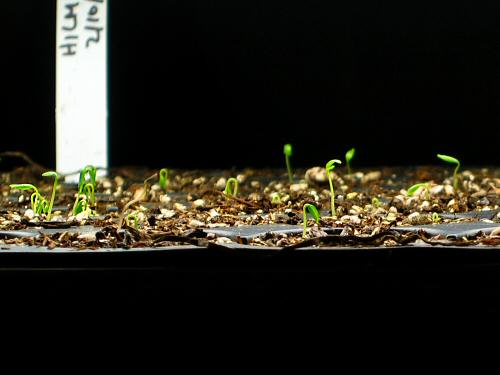
The first flat-leaf parsley has been popping up over the last day. This is Hilmar, a new variety I’m trying for the first time this year, in addition to the regular Plain Italian that’s around every season. Elsewhere in parsley, planted a few days earlier, there are two varieties of curly, Krausa Market and Green River. Altogether, 144 plugs, and I’ll keep two plants per. The quantities are not as worked out as for most of the other crops, because so far, it’s been more of a bonus herb, in CSA shares and occasionally at the farmers’ market. I’ll probably start one more tray of 72, because I have a couple more curly types—Green Pearl and Forest Green—that I’d like to try. Probably won’t need ’em all. I could pot the extra. Anyway, you can never have enough parsley!