Temperature the old way

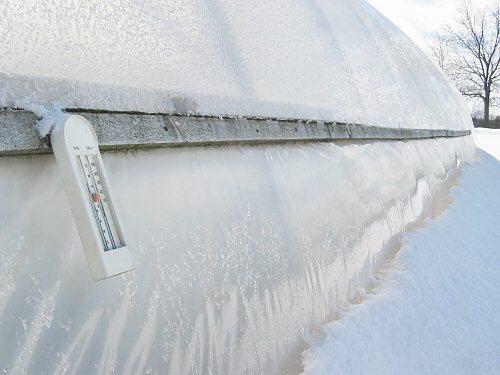
It’s around noon, and an unseasonably, pleasantly warm 62°F/17°C. This cheap old plastic analog thermometer has been hanging in a doorway for at least the last 10 years. It’s a quick and reliable way to see how warm or cold it is. No worrying if batteries are running down. No looking for the right angle to read the screen. Only this column of dyed-red alcohol—safer-than-mercury!—expanding and contracting, going up and down. The simplicity is soothing. The way it’s positioned, the afternoon summer sun hits it on one side, causing it to shoot up. Otherwise, all through the winter, it’s shaded from the direct sun, and it gives a roughly accurate reading of the air temperature, 24/7. Why not reposition it so it’s always shaded? Checking it for the temperature on a hot summer afternoon hasn’t seemed to be a big concern. Not sure why!

For tiny farming, I’ve used a few electronic weather gadgets, alongside analog devices like the trusty old min-max thermometer, and a plastic weather vane/thermometer/rain gauge combo that looked like a toy, that I stuck on a post. The thing about seeing the temperature in real-time, it’s a little late to do anything. It’s mostly about satisfying curiosity. On the other hand, min-max thermometers, that record the lowest and highest temperatures they hit until you reset them, they’re super-useful tools, for example, to monitor how cold it gets in the greenhouse at night and adjust! And soil thermometers, now they can come in handy!

Weather forecasts are another story. A day or so out, I’d say they’re around 60% right maybe a bit more (I could be off, it’s just a guess). Overall, it’s hard to tell how useful they actually are, though if you’re in tornado country, you may have a different view! Since yesterday, there’s been a weather alert on my phone. Not color-coded in alarming red and yellow, so far this one is only grey. Still, it’s a “warning”, not the milder “advisory”… The temperature is may suddenly plunge in the afternoon, with heavy gusting wind, and the chance of instant ice on the roads. A cold front is coming, so, I guess, beware…
1440 onions

1440 onions

I’m sure I’ve taken this photo before, but somehow, it’s still new—the first transplants of the season! This is the look of 1,440 onions, starting out. These are 72-cell plug sheets, and the plan is to multi-plant four onions in each spot. Do a little multiplication—5 trays, 72 cells, 4 onions per—and the results are clear. Whether things will turn out exactly like this, perfect bushels of Red Globe red and Utah sweet Spanish, is anybody’s guess, but I’m quite confident we will get…something! :)

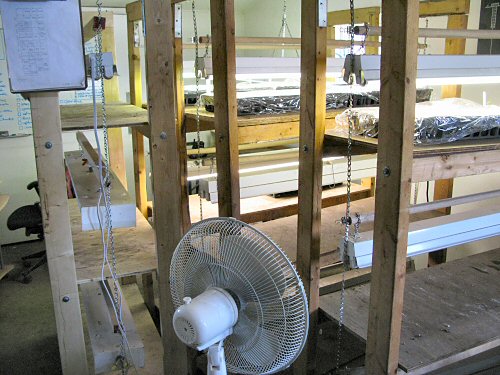
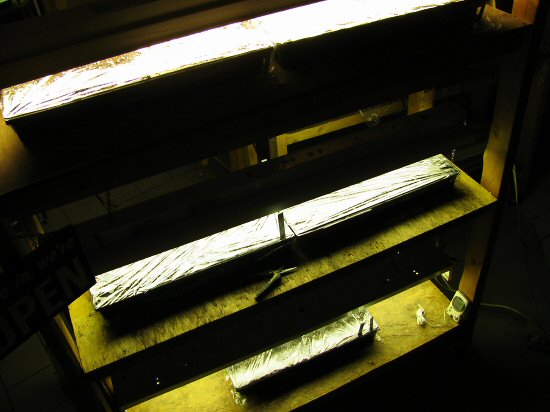
All the usual tools and methods for this tiny farm are back for another run. There are still at least a couple of years left on the roll of donated food-grade plastic wrap that I use (and re-use for the season) to hold moisture and increase heat, just until the tiny seedlings emerge. To check temperatures in this new seedling room, on the lowest shelf of the light rack, where it’s coldest, is one of the minimum/maximum digital recording thermometers. And of course, there are the trusty, home-built light racks themselves, with an assortment of T-12 and T-8 fixtures and Cool White fluorescent tubes, providing the bare minimum of heat and light to get things started.

I’m always up for trying new approaches and new gear, but a lot of the time, if it gets the job done and you’re already having fun, what more could you need?!

Seedlings away!

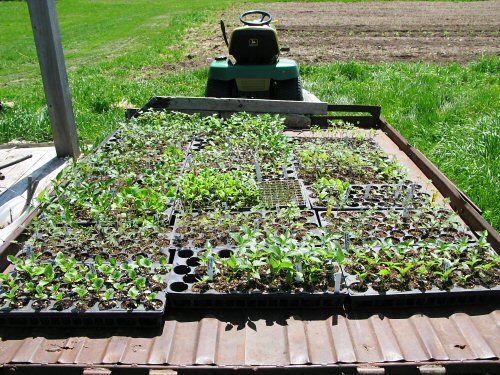
Things can change suddenly on the tiny farm. I picked today to move the majority of seedlings to the greenhouse. Although this was MUCH later than hoped for earlier this year, it’s all about the (recently COLD) weather, and I didn’t want to spend much on heat. But you can’t wait forever. There’ll probably be at least a couple of freezing nights in the next two weeks, but it IS getting to mid-May, and these guys will be out in the field, one way or another, before the end of the month. So, it’s out of the Milkhouse and onto the trailer behind the little John Deere riding mower for a little trip…

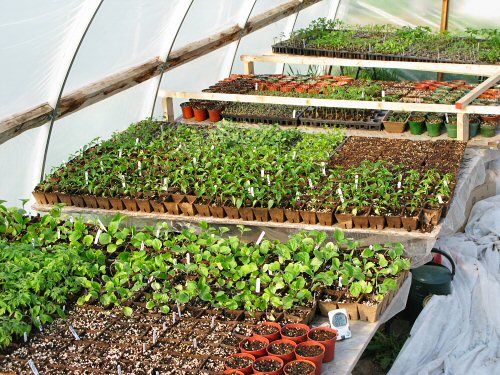
The greenhouse tables are now just about full, and that’s with a fourth one added a week or so ago. Plus, there are a few more trays of plug sheets on the ground off to the right. Lots more seedlings than ever before… On the closest table, there’s the (excellent) digital min-max thermometer/hygrometer, recording critical highs and lows, right after the fact! New this year are those red and green plastic pots (with cukes, squash, pumpkins, melons)—I decided to stop using the 3″ peat pots and try soil blocks, BUT, I didn’t feel like learning about block making right in the rush, so I used the last of the peat and then dipped into the collection of plastic pots I’ve been given over the years. (I’ll get the soil block maker in the summer, so I can play around with it first…)

It’s always a little…sad when bright, cheerful gear goes dark and empty… There are still a few trays of really young tomatoes, brassicas, and a couple of other late-started things, but the grow rack days are just about over for the year. We’ll soon be stowing the lights and chains, and presto, instant rolling racks for harvest bins. Transplants for late spring and summer will get started in the greenhouse…

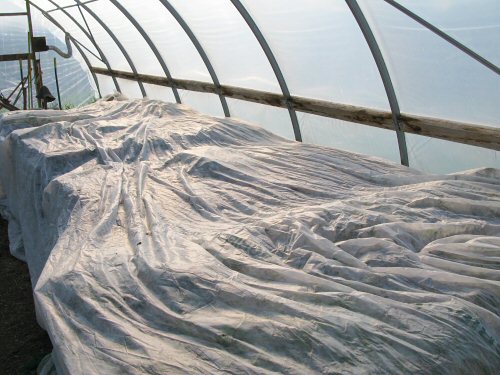
And so, the seedling greenhouse gets tucked in for its first full-house night of the season. Boy, imagine if something WENT WRONG in there… :)

Seed starting tools II

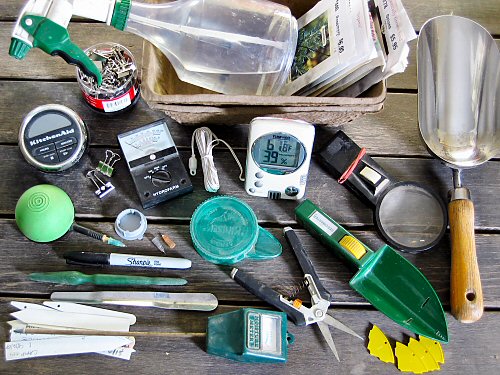
Here are ALL the indoor seed starting tools I have, most of them always-used, a couple not. Nothing special, and FINGERS I’ve found are handiest for most of the work at this scale. In any case, a few details (and there’s more on #1-5 in Seed starting tools, part 1): 1. The Seedmaster, a gadget for trickling out small seed as you rotate the wheel (the yellow pieces are click-in filters for different seed sizes); 2. assorted white plastic plant labels; 3. a dibbler or dibber or whatever, for poking little holes in soil; 4. a fine-point black waterproof marker (I like Sharpies) for labeling; 5. the mini-transplanter is essentially a tiny, stainless steel shoehorn for easy liberation of plugs from their cells; 6. a moisture meter, simply stick it in the soil; 7. plant snips for thinning seedlings; 8. Mini-Sim seeder: fill and shake out; 9. suction seeder with three tip sizes: squeeze the bulb, put the tip on a seed, release to hold, squeeze again to drop… ($25…what was I thinking?!); 10. digital timer for keeping track of repetitive tasks like bottom-watering trays one by one; 11. plant light meter, reads in footcandles, with settings for indoor and out; 12. digital indoor/outdoor min/max thermometer/hygrometer, mainly for keeping track of temperature; 13. magnifying glass with light, for examining seedlings (and GREEN MOSS) up close; 14. soil scoop for filling plug sheets and pots with seedling mix; 15. spray bottle with good quality spray head (more water per pull; I’ve used a wand mister like I have in the greenhouse, but the hose kept getting in the way, I may try one again for the seedling room this year); 16. small fibrepak flats, convenient for holding tools and seed packets on the potting table (left lying, the packets can so easily get wet…); 17. small bulldog clips, useful for all kinds of things, like organizing groups of seed packets. And the winners are…all of them, EXCEPT for: #9, which I found to be useless for my purposes; #8 which is great, but mostly for heavier hand seeding in the field, like for flowers; and #6, 11 & 13, which are more educational toys than essential tools, but still cool! (Wow, that was a lot of blogwork for pretty obvious stuff, but there you go! :)

My old friend the min-max thermometer

Clearing a path to the hoophouse today, I turned the corner and noticed the original min-max thermometer. I don’t usually. It was one of the first bits of gear acquired in Year 1, when the reality of FROST in the garden was a complete and scary unknown. The thermometer records the lowest and highest temperature that it’s hit; you reset it by pushing the little red button. It’s been hanging on the same nail in the same spot for three or four years, more or less out of sight and mind except in spring and fall, when I check it first thing in the morning to see how cold an overnight cold snap really got. Lately, the min-max is not such a big deal. Each different section of the field, and the particular crop in it, reacts differently to each cold night, so the only way to know what’s happened is to walk around and check things out. And I have confidence in row cover. I still check the thermometer, but it’s not like spring in the first couple of years, when I’d bolt awake at 6:00 a.m. and 10 minutes later be walking through the chill and dewy wet grass, adrenaline pumping, waiting for the verdict from the min-max to see what new transplants may’ve been toasted. It was kinda cool to be reminded, out of the blue, how that’s changed. In the case of gardening, at least, the more you know, the easier going you get!

Getting started

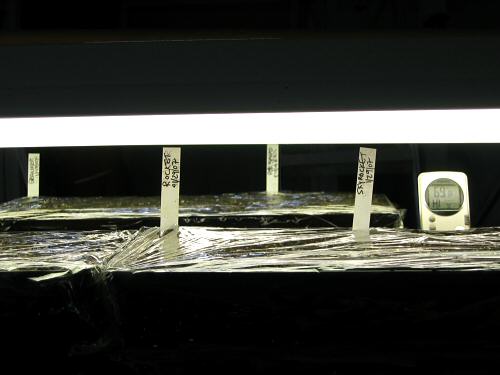
Started the first seeds of the year today: lettuce and arugula. At night, the grow racks remind me of a lab experiment, with the plugsheets in trays, carefully labelled and sheathed in plastic under the intense white light (fluorescents up close are pretty bright). And there’s the digital min/max thermometer, keeping score. The whole set-up looks like what it is. It’s great! In the beginning, I kind of obsessively (and largely unnecessarily) check every few hours to make sure the soil mix is sufficiently moist, the temperature is above 60°F, to see if anything’s emerged and it’s time to take off the plastic. Maybe after another five or 10 years, it will become simply routine, but for now, every single plant to emerge is still cool and exciting… For this, the earliest lettuce attempt yet, I’ve started five varieties, all with maturity dates of 50 days or less. There’s Simpson Elite (a really fast 40-day) and Two Stars, both green leaf, Granada and Red Salad Bowl, both red, and Sierra, which is red tinged. As a salad mix in any combination or all together, they’re a great blend of colors, textures and tastes. The arugula, Rocket and Skyrocket, intended for the mix, is faster growing than lettuce, but I felt like starting some now (I’ll start some more, later). If all goes well, these will hit the unheated greenhouse in the beginning of March, a good three weeks ahead of last year!

Temperature gadget

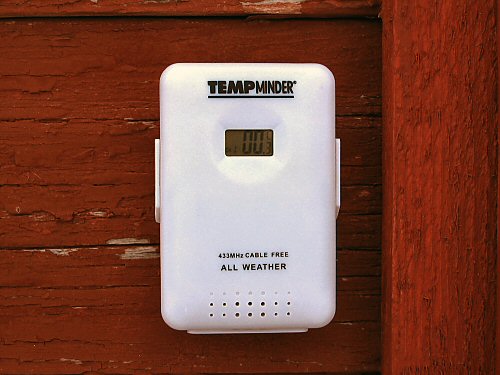
This wireless remote temperature and humidity sensor sits outside, beside the side door to the Milkhouse. Here, it’s reading 0.3°C. Precise! I’m not overly thrilled by technology, but some gadgets I like. Like digital weather stations! They’ve become really CHEAP in the last couple of years. A local hardware chain just stocked a house brand, indoor/outdoor (dual measurements), min/max (stores highs and lows until reset) thermometer/hygrometer (humidity) for 10 bucks! I started tiny farming with a plain old analog min/max thermometer, until the digital ones got cheap about three years ago. Plus they had humidity. I got one, but it soon broke (didn’t like the greenhouse heat and humidity, I guess). The next generation of cheap weather stations had outdoor sensors. Cool! I got two for the greenhouse, one for the seedling room, and they’ve lasted. But, the remote sensor (a bonus!) is on the end of a long wire that I never got round to running… Now, there’s cheap and WIRELESS. That’s REALLY cool. More units, more batteries, but it’s WIRELESS. I banged in a nail and hung it out there in three minutes. It sends temp and humidity to a neat little unit sitting by my computer. It doesn’t store min/max wirelessly, that one’s not as cheap until probably next year. Instead, I glance at it quite often. The remote isn’t protected from direct sunlight, so the highs are too high when the sun hits it, but here it’s on the east side of the barn, so only the morning reading is off… Why do I need real-time outdoor temperature for tiny farming? Hmmm… It’s been just above zero days and most nights lately, and THAT’s interesting? You mightn’t have noticed otherwise that everything is slowly MELTING… Though really, watching the temperature through the day is kinda like watching the balls spin on a lottery draw: it DOESN’T REALLY MATTER! So maybe this wireless thing is yet another clever, largely unnecessary…gadget. I still like it: it’s 32.6°F outside the door, three days to the New Year, and seeds start soon! :)