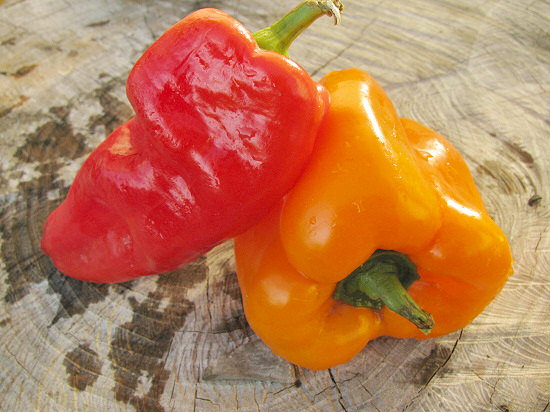
Peppers turn color!

Orange Sun and Gypsy sweet peppers

Red and orange peppers! It’d be nice if this was a normal sight, but with our short season and often as not inconsistent heat and sun—peppers love decent heat—peppers that fully turn color are fairly unusual in this market garden. Because they’re more uncertain, I’ve tended to give them lower priority, often transplanting them at the end of the queue, which doesn’t improve their chances. I also usually don’t mulch—peppers appreciate decent mulch of any sort (plastic especially, it’s so…efficient), the heated earth seems to really help them grow.

This year, we lucked out with the weather—unfortunately, we also planted the smallest amount of peppers ever. Oh, well, that’s how the garden gambling goes! Here we have Gypsy, a tapered hybrid that has a rather quick 65-day maturity, but takes longer to go from its pretty yellow-lime green starting color to…sweet red. I’ve grown this for a while, it always comes through, a tasty, prolific, all-purpose pepper that’s nice even when it’s not red. And then there’s the open-pollinated, heirloom Orange Sun, from seed I’ve had for years, a blocky bell pepper that needs a full 80 to 90 days, that I’ve seldom seen beyond its dark green initial color, now in a satisfyingly deep, rich orange. Taste changes with color, smoothing and sweetening—these guys are delicious!… Read the rest

Yellow Stuffer, a tomato

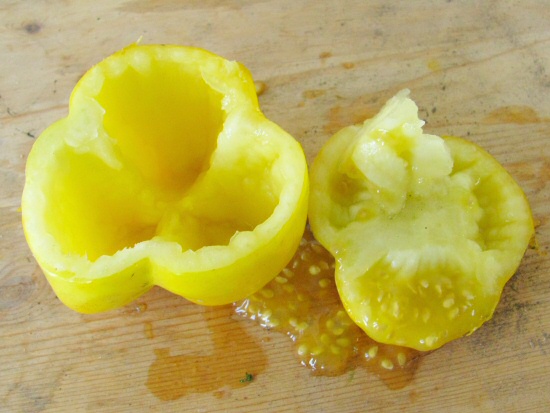
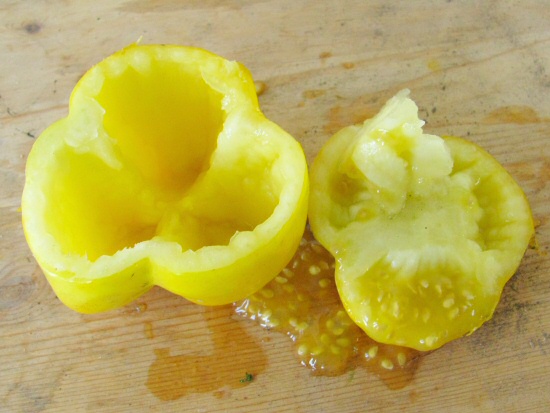
Here’s a fairly unusual heirloom tomato: Yellow Stuffer. The name pretty much says it all, it’s an almost completely hollow tom, ready to be stuffed! As you can see, there are very few seeds in very little gel. I’ve grown these for a several years—this season, only maybe half a dozen plants—mainly for fun, all from the same original packet of seed. In a good year, they’re quite…striking: big and blocky, looking like a bell pepper. This year, they were just OK, not really sized up too big. I haven’t done much with them besides taste—they taste like…tomato—but I imagine with their thick walls, they’d be perfect to stuff with just about anything, and left raw or baked. Interested? Yellow Stuffer is indeterminate and late, about 80 days, and the seed is easy to find. There are quite a number of other stuffer varieties out there as well—here’s a good article all about ’em. And that’s that!… Read the rest

Big, ugly, quite tasty

Black Seaman tomato

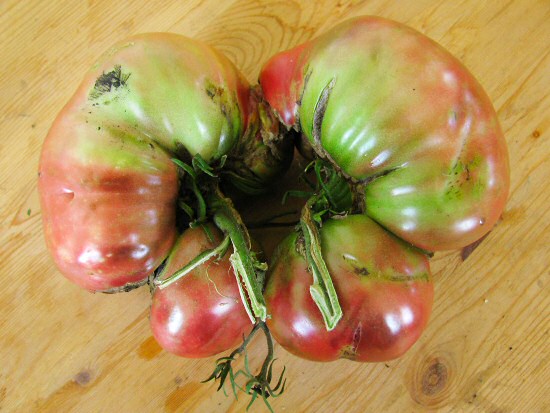
There are thousands of the tomatoes in the field now, and this Black Seaman is just one of ’em, but a big, gnarly one that caught my eye. Didn’t weigh it, but was probably close to 2 lbs (900 g), and grew in a complete circle. Interesting! Most of the fruit are regular beefsteak shape. Anyhow, I gave this one away, and tasted another one at the same time: not bad, the usual complex “black” tomato taste, a little tart, not the best ever, but still…reasonably fantastic! By the book, Black Seaman is a mid-size (12-16 oz/340-454 g), mid-season, determinate, purple-black, potato-leaf, Russian heirloom—that’s what they say. It’s my first season growing them, waiting for more to ripen before PASSING JUDGEMENT. There you have it.… Read the rest

Carrot germination refinement continues

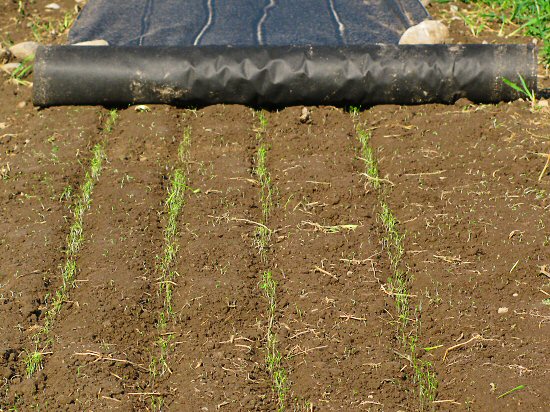
Dense carrot germination from Earthway seeder

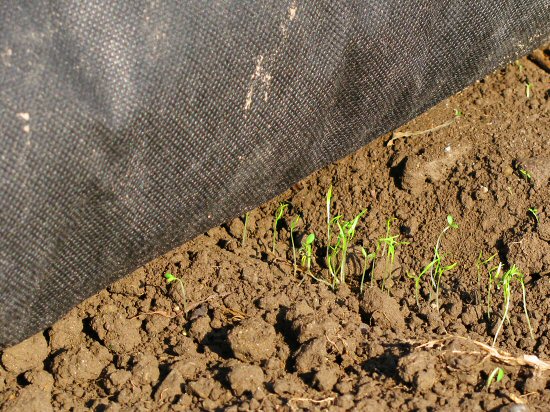
Another successful carrot germination event, with trusty, open-pollinated, heirloom Touchon, and our latest refinement in cover. Although this landscape fabric looks like the stuff we started with last year, it’s a heavier grade that doesn’t tear and become useless after one or two outings—it should last FOREVER, or, hopefully, for at least 10 uses, at which point, the cost will be near zero. This germination, in mainly hot, sunny weather, is exactly one week after seeding, with no watering in. Pretty good! Deprived of light, the seedlings are already stretching—I might’ve taken off the cover a day or two earlier if I’d checked—but they’ll be fine. And if you’ve used an Earthway seeder, and ever doubted the incredible amount of seed it can dump down, don’t (see above): I’d rather see all those carrots pushing up than too few, but the waste from overseeding is quite severe, and major thinning is in order, adding to the labor. Still, it’s all part of the joy of farming largely by hand… :)

Read the rest

In the cold garden

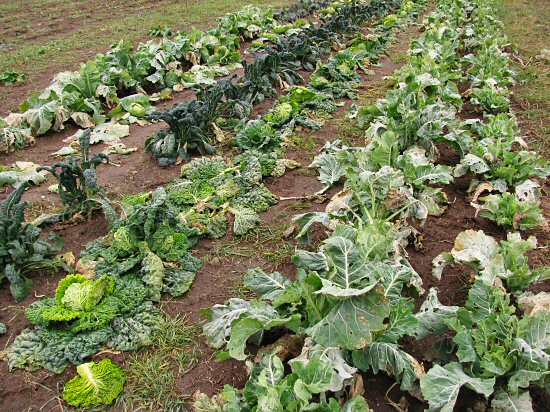
The star by far of the last planting of brassicas, that mostly didn’t size up in time for market or CSA, is without at doubt this unusual Nero Di Toscana strap kale. This Italian heirloom, apparently from Tuscany, is hardly better looking than the cold-beaten rest of the motley-looking crew: tiny cauliflower, mini savoy cabbage, some collards and this kale. But it’s growing back—been picked twice since October—and it’s amazingly, distinctively tasty. In the post-freeze veggie garden, looks aren’t everything! I’ve had the seed for a while, but grew it for the first time this season. It’ll definitely be back.

Read the rest

Tomatoes galore

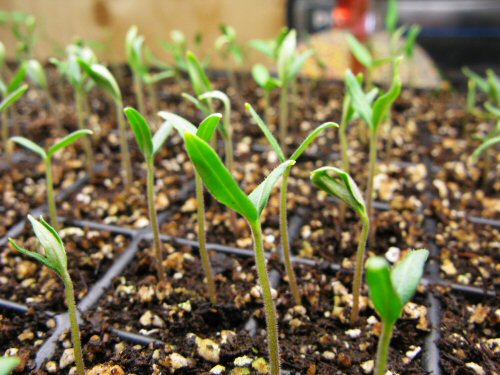
Tomato seedlings are suddenly everywhere! We planted out the whole of this year’s line-up in a couple of days, starting a week ago. The first tray (above) started popping in just 4 days! There are over 60 varieties, including around a dozen cherries. Except for half a dozen hybrids, they’re all heirloom.

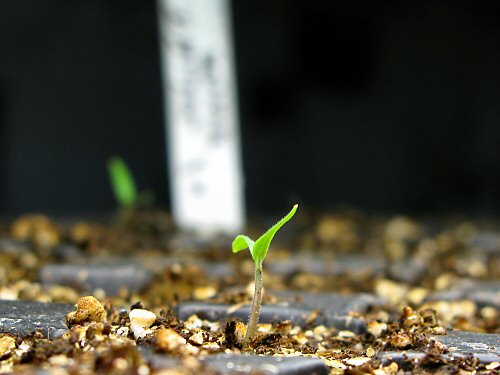
Heirloom tomato seed seems to be more quirky than the hybrids, with noticeably different germination speeds and rates from variety to variety, and year to year. Here, we’re waiting on Cherokee Purple from some leftover 2006 seed—one’s up, there in the distance, the rest may come along soon, or not. Meanwhile, right beside, three rows of 2008 CP are up and at ’em, so we’re covered either way.

I haven’t really looked into all this—setting up more efficient storage than my current airtight-bags-and-cool-place method, whether the plastic lined packets from the big seed companies do better than the plain paper ones from many smaller seed houses, presoaking seed for some crops in a kelp solution or whatever, and so forth—because there isn’t much older seed, and most seem to do just fine. So much to try, so little time… Luckily, it always works out!… Read the rest

First tomato: 2008

Here’s the very first tomato seedling to emerge and spread its seed leaves: a Striped German (a big, bi-color heirloom, one of my top 3-4 favorites over the last couple of years). This is six days after seeding. I don’t usually keep track THIS closely of the seedling action, but with the unusually slow, uneven emergence of most of the peppers and eggplant—new ones are still just breaking out, two weeks after seeding?I’m watching every little move right now with the toms as well. And there’s that fine MACRO feature on the new camera, always happy to take notes…… Read the rest