
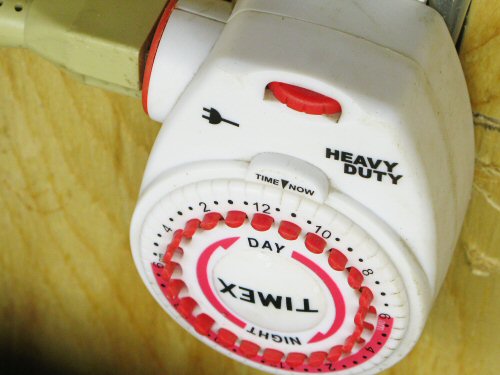
It’s “just” an ordinary C$15 AC timer, but a sophisticated automated lighting control system to me! It’s Heavy Duty for the three months of indoor seedling production in late winter-early spring. After that, this little unit is out of the picture as the transplant action moves to the greenhouse and the sun. Until then, it’s set for 15 hours, turning on and off a total of 30 fluorescent lamps, right on time. (That’s four 3-shelf, double-lamp light stands, one 4-lamp light box, and an extra fixture hung up somewhere…) It’s really quite foolproof. Of course, it’s not…essential. But since we’re critically relying on ELECTRICITY anyway, why not a handy controller? Removing a couple of things from the tiny farming daily to-do list is always good…
Eggplant check
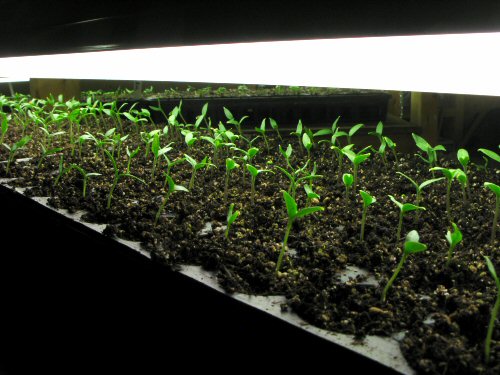
Around 10 days since they first appeared, a little over two weeks from when they were seeded, and the eggplant are doing fine. A few of them already sport the tiniest first true leaf. I imagine they’re as hungry for light as any of the veggies, but eggplant are a little more restrained than some others when it comes to stretching: where every millimeter farther from the light counts, there’s not that much difference between the edge of the tray and the center. It’s kind of intense, the little details you track when you’re raising seedlings under fluorescent lights. Even the eggplant lean isn’t too extreme… These are two of the three 72-cell trays of eggplant for this year. Off in the distance, it’s PEPPERS!
Ah, control…
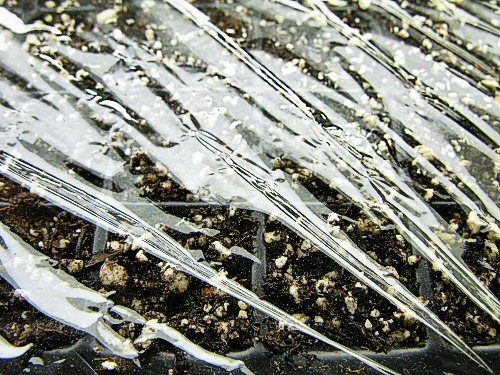
The tiny farming action continues mainly indoors with the SEEDLINGS. I’m still starting away, staggering most things, but doing all of the tomatoes right now, all at once. The daily photos mostly tend to be—surprise!—extreme close-ups… So, while looking over today’s image harvest, the familiar plug trays and flats and well-separated seedlings seen up close for a sudden instant looked completely alien and bizarre. All that segregation and attempt at TOTAL PLANT CONTROL looked kinda…crazy. Plug trays: two seeds per cell, packaged under plastic, stuck under kinda ghastly cool white fluorescent lights. Tiny rosemary and celery seedlings (off to a much later than usual start), partitioned off in their own fibrepak flats. Little plant captives, brightly lit, carefully tended. Fanatically patrolled mini-monocultures. Yikes! Of course, the feeling quickly passed. Guess I just wanna get outdoors! :)
Broccoli shapes up

Broccoli, seeded a couple of weeks ago, is now putting out its second true leaves. This is good, watching the wee seedlings turn into stronger, fully-adapted little guys. This season, with a whole bunch of unknowns in a brand new garden, I’m particularly aware of every little stage, not concerned, but…watchful. Indoors, conditions are pretty well controlled, but there are different factors, like a smaller seedling room, with much lower ceilings and different ventilation and air flow, that COULD make a difference. Probably not. Probably, with the temperature and humidity the same as always (I watch the little min/max thermometer/hygrometer a lot), that’s all that really matters. But maybe not! :) So it’s good to ACTUALLY SEE the seedlings shape up. Nothing wrong with a little extra excitement to top up the spring rush…
Fieldwork: Day 1
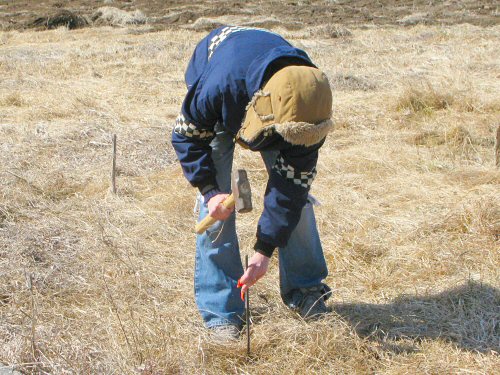
Sunny and quite warm (not as chilly as Mel’s deep-winter-ready, ear-flapped headgear might suggest). Probably 50°F+ (10°C) in the sun. Not the first nice, dry day this season, but this one became this farm’s official first fieldwork day of the year, just like that. We were only out for around three hours (including a walk to check on the beehives—there are some bees!—and the creek), but got a lot done, so it definitely counts as work in the field!
First, we selected a spot for the greenhouse, moving it from where we’d originally planned, to a more sheltered, overall all more PLEASING site. Pound in stakes at the roughly measured-in four corners, and admire the spot. The stakes are graphite tent pole sections Bob got at a yard sale long ago; flagged with orange surveyor’s tape, they’re great field markers. Normally you can just push ’em in, but here, Mel is using a mini-sledgehammer (above), because the ground is still frozen from a couple of inches (5cm) down…
Next up, sort all the hoophouse pieces. The steel ribs and braces are on the right. There’s a surprising amount of wood involved, and that’s now divided into what goes where. And then, we dumped all the hardware out of the barrel it’d been moved in: a bucket of assorted, screws, nuts and bolts, plus springlock (wire that attaches the plastic to the frame) and aluminum springlock channels.
A surprise find: the last five potted wintergreen plants (Mel is chosing some to take home). I’d put them in the barrel on top of a bunch of parts when we were moving the greenhouse, and forgotten them there. After spending an entire winter totally exposed outdoors, and the last couple of weeks tumbled down into a barrel full of wiry metal, they’re still alive and looking cheerful. Tough and pretty. With minty berries…
And so, the return of the greenhouse is underway. The GH is sorely missed and really needed! Just gotta wait till the ground thaws, so the area can be tilled up and the 3′ (0.9m) t-bar anchors that keep it from blowing away can be driven into the ground…!
Different kind of compost heap
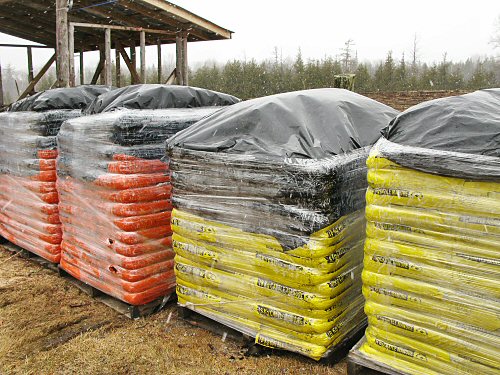
Back to cold and wet, with a bit of snow… Today was an interesting first in my brief tiny farming career: compost on skids! Fertility delivered! How convenient… This is about 5.5 tons (5,000kg) of fully composted, certified organic cow and sheep manure (half and half). According to the people who make it, at this point there’s no appreciable difference between manures, it’s all just high-grade compost now. Our organic certifier agrees: it’s “legal” to use any time, unlike any type of manure, which has to be spread a minimum of 90 days before veggie crops are planted. So here it is, from around 65 miles (96km) away, via flatbed truck and forklift up the drive…
This is a one-time thing, part of what we’re doing to start the market garden from a hay field plowed late last November. Unlike at the old farm, where cow manure was well-aged and plentiful, available by the ton, there are so far no animals here.
While I like the idea of animal manure, and find DELIVERY kind of odd and offputting, the current reality does force one to really think about hidden costs. The cows at the old farm ate far more hay than the farm produced, which meant buying in, so all of that free, on-farm manure wasn’t exactly free, or on-farm. Factor in the total cost and complicated logistics of raising and selling local beef, and the relatively low return, and manure on a tiny farm can seem quite unsustainable.
In any case, maintaining fertility here is a whole new game. Green manure, compost, and a small amount of on-farm manure, from chickens first, are this tiny farm’s future. And today’s delivery is the kickstart. Here we go!
After the rain, again

Outdoors: waiting! Today was a cold, dark, wet, oppressively gray day, and then, at the last minute, the sky cleared for a beautiful coppery-golden sunset. I headed outside to check out the light, and for the first time this season, caught that delicious summertime sun-comes-out-after-the-rain feeling. It’s especially sweet when you’re growing stuff because it means: A) it’s sunny again, and B) you got rain! Simple pleasures. What could be finer (with the Weather)? In the photo, the end of the moldboarded section of the south field—it’s all gently thawing out…