
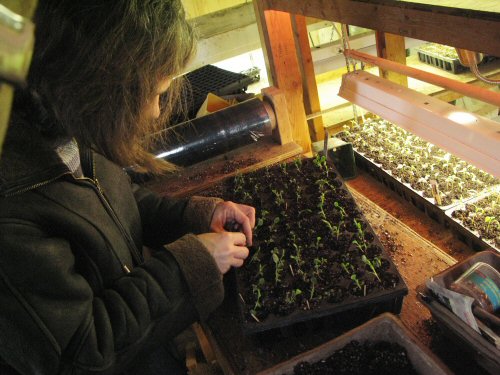
It will soon be time to move many of the seedlings to roomier quarters—there’s only so much space under the lights, so the greenhouse has to go up soon! Timing is getting trickier by the day, but we’re still doing fine. Here, Tara, at the very start of her tiny farming career, manages her first tray of cauliflower, splitting cells with two seedlings, and filling any empty spots. There’s not always time for this sort of micro-gardening, but there is right now…!
Soil inspection
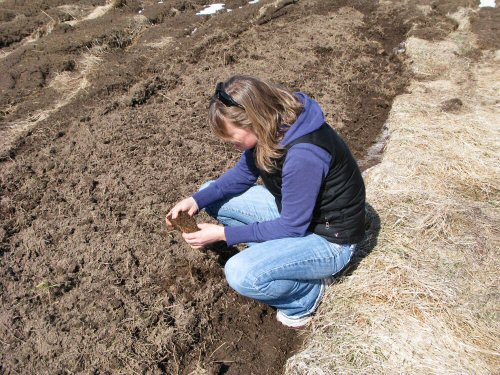
A sunny, still chilly, fairly busy outdoor day. Did some test tilling this morning, with the Kubota compact tractor and 48″ rototiller. The solid ground hasn’t fully thawed out, but the plowed area is already nearly 50°F (10°C) at 6″ (15cm) deep. So I thought I’d have a go on a 30′ (9m) strip, to see how well it’d chop up with the Kubota.
The full plan is for disking—big plow, big tractor—by Peter down the road. That would break up the moldboarded strips, finishing up with the little (but mighty!) Kubota. But between the weather, and unexpected things happening, you never know when a date with off-farm machinery will fall through.
I want to get the early stuff—spinach, garlic (yes, have to try spring planting this year), onions and so forth—in as early as possible. So we’ll probably be prepping an area with just the Kubota.
In the afternoon, Andie (aka Andrea, aka Max) dropped by for the first time, to check things out. She’s finishing up school, and planning to spend a couple of days a week for the summer, learning about small-scale farming the hands-on way… We strolled around, Andie tried out some seed starting with a tray of arugula, and we chatted.
Everyone’s first visit to the farm is a bit different, and there are all kinds of reasons why people want to get out in the field. This time, a good deal of the conversation involved university, graduate studies and the like, along with…tiny farming. It’s good to have an idea of who you’ll be working with, both ways—a comfortable, interesting fit really makes a difference in the tiny farm experience!
This season, there’s a bit of a blog plan: to show a lot more of the people side of the market garden! Today, as often happens, I forgot to take photos while we were actually doing stuff, so right at the end of her visit, Andie checked out the freshly rototilled ground, and I snapped an official Her Day 1 pic. The soil looked good, it’s a clayey loam (pretty much like at the old farm), with the sod breaking up nicely, and Andie seemed happy with the prospects, so we should be checking in again with both real soon! :)
Making space and saving space
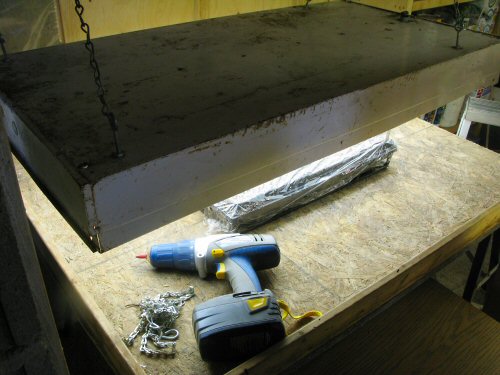
Hanging the lightbox is again this year part of the spring time set-up in the seedling room, when gear comes out of storage for seasonal use. In late winter, the fluorescent lights are put on the light racks, and removed after seedling production is over, usually in June, so the racks can be used as overnight harvest storage. And the lightbox, with its 4 fluorescent tubes, adds extra plant space when it’s need. I put it up today…
At the old farm, in the Extended Milkhouse, there was no space to waste, and it’s the same here in the new seedling room. That means clearing and converting the layout to fit the needs of the moment.
Tight quarters has a lot to do with the weather. Building a space insulated against our fairly brutal Canadian winters, and then keeping it warm enough for seedlings, is relatively expensive, and construction tends to be limited to the minimum you need.
In summer, the same insulation keeps the seedling room cool. It’s good to have a chill-out spot near the field, with phone and Internet (all the modern telecoms conveniences!), tea and cold drinks, chairs and a table…The more room the better. So, the lightbox goes up, and soon it comes down…
Tiny cultivation
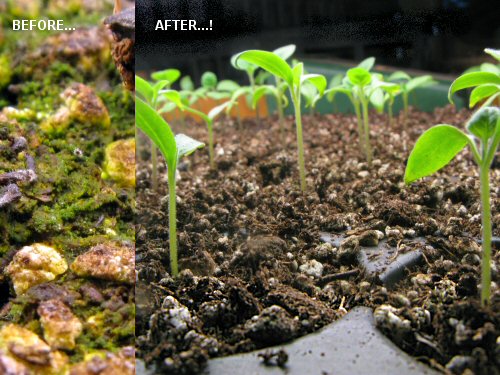
Tending seedlings on this tiny scale is pretty much literally fieldwork in miniature, especially with the pesky GREEN MOSS. The seedlings have to be watered, of course. And with the green moss, they have to be weeded as well. I use something pointy to stir up the surface of the peat-perlite seedling mix…
It comes back quickly, in a day or two, whenever the surface is wet.
I’m not even sure it’s moss, could be algae? Mold? Lichen?! I haven’t been able to ID it for sure, but I’ve often seen it called…green moss.
Not too appetizing to look at, the green moss has been quite harmless. At the old farm, I wondered if it came from the well, but here, we’ve been using filtered water and there it still is. It could be from the peat.
In any case, no worries, just a quick scuffling once in a while to keep it from sealing off the surface while the seedlings are small, which it looks like it would eventually do. I suppose I could find some clever, NATURAL way to kill it off, but I really don’t mind it. Once the mix dries out, the green moss is gone. At least, it disappears…
A brief return to winter
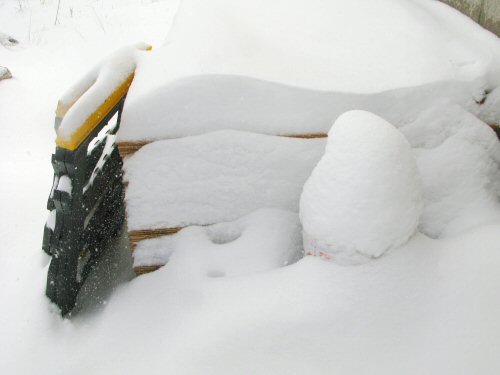
It snowed fairly steadily yesterday and today, transforming everything with that pretty but kinda unwanted winter wonderland effect. Looks like around 4-6″ (10-15cm) so far… (I don’t keep track of snowfall the way I do rain!) This isn’t forecast to last, it should warm up and be all gone in 3-4 days, and then the temperature is supposed to jump. Drying out time…
That first day of being able to actually work the field is always so different each year, especially the last 4-5 crazy weather years. Two years ago, peas went in the first week of April. Last year, it went from too-wet-to-work, to needing irrigation, in one mid-April week. Who knows how it’ll go this time around.
With the new garden, extra steps like disking, rototilling, and waiting a bit for the grass to break down some more, not to mention, prepping the ground for and putting up the greenhouse, make timing particularly critical. The farmers’ market officially starts in less than FOUR WEEKS. CSA shares begin second or third week of June. I can feel the adrenaline bubbling up just writing about it: timing and the WEATHER! :)
Tomatoes galore
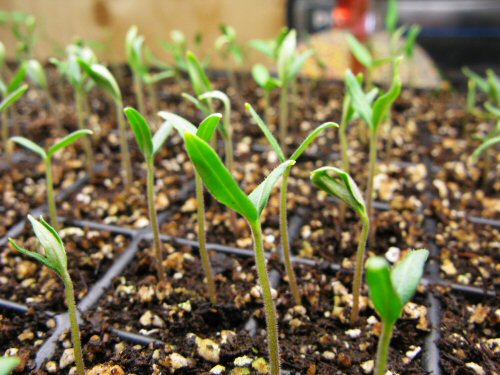
Tomato seedlings are suddenly everywhere! We planted out the whole of this year’s line-up in a couple of days, starting a week ago. The first tray (above) started popping in just 4 days! There are over 60 varieties, including around a dozen cherries. Except for half a dozen hybrids, they’re all heirloom.
Heirloom tomato seed seems to be more quirky than the hybrids, with noticeably different germination speeds and rates from variety to variety, and year to year. Here, we’re waiting on Cherokee Purple from some leftover 2006 seed—one’s up, there in the distance, the rest may come along soon, or not. Meanwhile, right beside, three rows of 2008 CP are up and at ’em, so we’re covered either way.
I haven’t really looked into all this—setting up more efficient storage than my current airtight-bags-and-cool-place method, whether the plastic lined packets from the big seed companies do better than the plain paper ones from many smaller seed houses, presoaking seed for some crops in a kelp solution or whatever, and so forth—because there isn’t much older seed, and most seem to do just fine. So much to try, so little time… Luckily, it always works out!
Grass vs moldboard
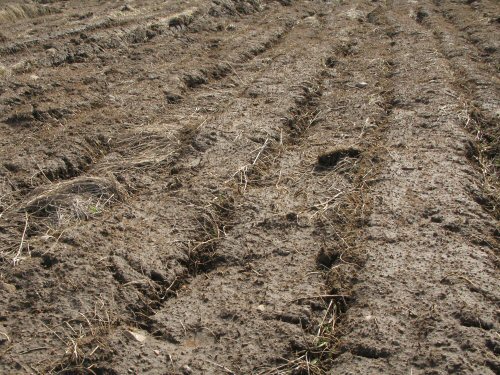
The hay fields were plowed late November, the sod sliced and flipped over by the moldboard, burying the grass so it gets no sun and exposing the severed roots to winterkill. A quick, bold, chemical-free first step in preparing a large clearing for crops. In the couple of garden sections I’ve started like this, it’s been quite effective, but given the slightest break, the grass is ready to come back…
Moldboard plowing—peeling back the land—is usually big-tractor work these days. It takes a lot of energy. If you happen to of soil as a complex living web, an intricately choreographed dance of life taking place mainly in the top 6″ (15cm) or so—sounds good to me!—one look tells you that moldboarding is pretty intense and destructive. Done excessively, with big, modern machines, it is a proven soil killer, encouraging erosion and other unhelpful things. For the tiny farm, this is a one-time-only deal, to start off a new garden area. It’s just the beginning…