
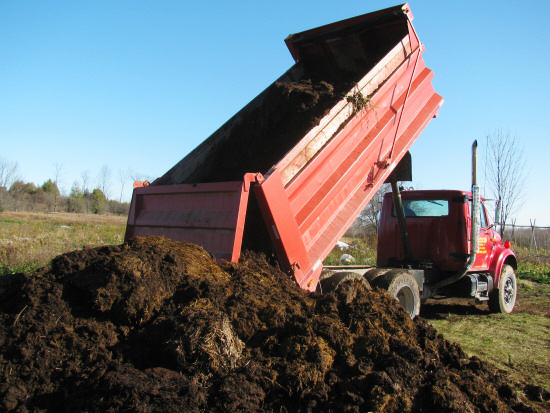
Really can’t think what delivery of basic farm supplies could make me happier than today’s six truckloads of well-aged cow manure. Since we don’t have an on-farm source, getting this from a farm less than a mile (1.6km) down the road, loaded to order and delivered by the farmer himself, is a pretty good Plan B. This has been stacked for average around a year, so the composting action is well underway. I’ll be rearranging it into large windrows with the compact Kubota, for further breakdown till spring, and spreading some now. Heart-warming! :)
manure
Ways to spread
This has gotta be the most painstaking way to plant out two acres of veggies! To recap: different sections of the two fields are at different stages of tillage (Peter down the road has had to come back a couple of times to disc, and there’s STILL a small section to go), and of course there was no time to spread manure in the fall. It’s even a little more complicated, with a fair amount of chopped up sod getting in the way. Sooo, we’re working a few beds at a time, with different treatments depending on the crop.
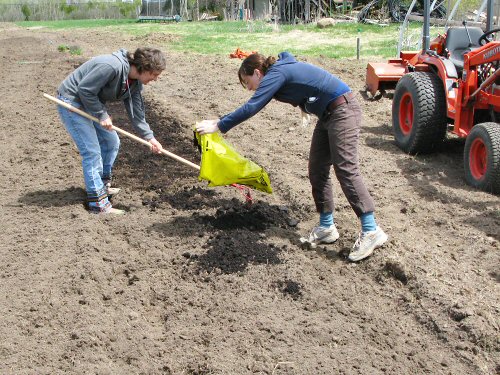
Here, Tara and Lynn prepare a 50′ x 3′ (15.2m x 0.9m) bed for baby lettuce for mesclun. Because it’s seeded densely and grows quickly, we decided to apply a fair amount of that expensive certified organic compost, and then reuse this bed for at least one or two more mesclun plantings later in the season.
Spreading from Bags Method 1: We brought over a stack of 40lb (18kg) bags in the bucket of the Kubota compact tractor, emptied 8 bags one by one, and lightly raked them in. Thinking about it afterwards, it seemed easier to empty the bags into the bucket, use a shovel to spread, then rake it in. An extra step, but overall quicker to incorporate.
Definitely hand-work, especially compared to loading up an 8-ton manure spreader and driving it around with a big tractor, like we mostly used to do! Good thing we’re only giving this special treatment to a few beds for salad greens. And it is all getting done…
Different kind of compost heap
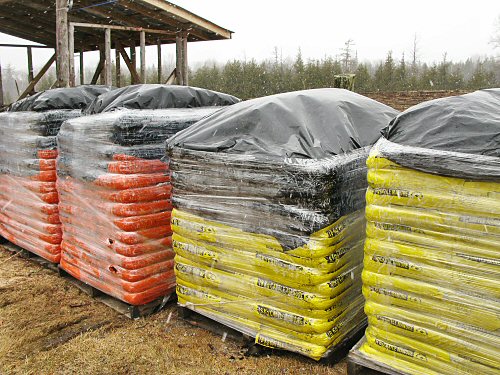
Back to cold and wet, with a bit of snow… Today was an interesting first in my brief tiny farming career: compost on skids! Fertility delivered! How convenient… This is about 5.5 tons (5,000kg) of fully composted, certified organic cow and sheep manure (half and half). According to the people who make it, at this point there’s no appreciable difference between manures, it’s all just high-grade compost now. Our organic certifier agrees: it’s “legal” to use any time, unlike any type of manure, which has to be spread a minimum of 90 days before veggie crops are planted. So here it is, from around 65 miles (96km) away, via flatbed truck and forklift up the drive…
This is a one-time thing, part of what we’re doing to start the market garden from a hay field plowed late last November. Unlike at the old farm, where cow manure was well-aged and plentiful, available by the ton, there are so far no animals here.
While I like the idea of animal manure, and find DELIVERY kind of odd and offputting, the current reality does force one to really think about hidden costs. The cows at the old farm ate far more hay than the farm produced, which meant buying in, so all of that free, on-farm manure wasn’t exactly free, or on-farm. Factor in the total cost and complicated logistics of raising and selling local beef, and the relatively low return, and manure on a tiny farm can seem quite unsustainable.
In any case, maintaining fertility here is a whole new game. Green manure, compost, and a small amount of on-farm manure, from chickens first, are this tiny farm’s future. And today’s delivery is the kickstart. Here we go!
Hitting the books: Composting!
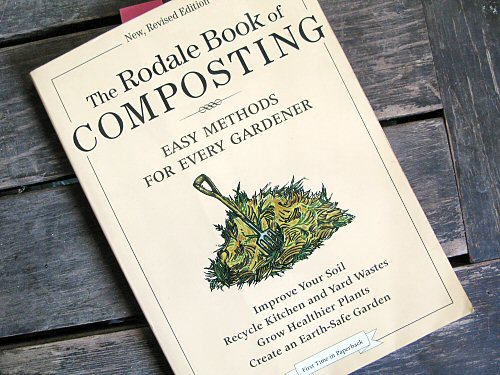
Winters on the tiny farm have always been a time for research and a bit of book learning. My first two seasons were crazy for reading, especially the winter before Year 1, when I had four months to pick up enough, from zero knowledge, using books and the Net, to map out the initial one-acre plot, order seed, get some gear, and “pass” the initial organic certification inspection, in order to start the market garden that spring. That was fun!
Over the last six years, though, a curious thing happened. My original urge to find out how everything worked, to soak up endless technical detail, full of labels and scientific explanations, died down quite a bit—often I’d rather watch a squash decay than read about it…
It seemed more fun to find specific, practical solutions on the farm: how to fix this or improve that. At the same time, I’ve become more and more aware of the growing process as a whole (and really, how relatively little I have to do with it…), not so concerned about its parts. It’s a little hard to explain, though real easy to feel. Maybe it’s just…a phase!
MEANWHILE, this year, Year 7, is a bit of a shake-up. Compared to the old farm, the new farm is pretty bare-bones. One big change: I don’t have the tons of well-aged, almost completely composted cow manure that was available there.
Every year, I made manure-based compost in 50′ (15m) windrows, incorporating crop residue and culled veggies, turning it with the tiny tractor, checking it out, but it wasn’t CRITICAL to fertility. A fall spreading of fine, on-farm, composted manure always did the trick!
Now, with no on-farm animals yet (chickens to come first!), and no prospect of generating huge amounts of manure, compost that relies more on plant sources will be my new friend. Composting and green manure are on my mind.
New necessities require…new learning! So along with everything else over the last 2-3 months, there’s been a more intense hitting of the books, thinking over, chatting, scouring the Net. It’s not exactly like starting over, but it’s definitely…FRESH. I’m excited. More as it happens!
Checking on the beef
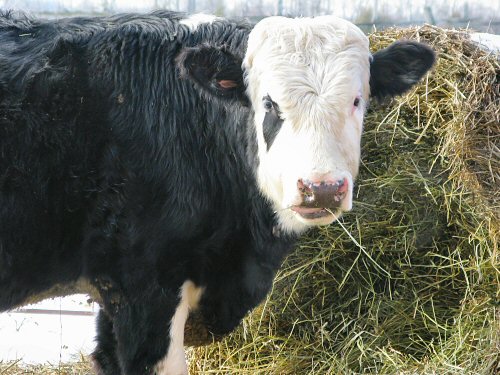
Sammy the Steer, born at 4am in the freezing cold barn last January, is healthy and hefty at around 800lbs (360kg), and approaching the end of his arc as a provider of tasty, mainly grass-fed beef. He and his three pals will likely go off to auction in March. They’re heavier than they’d normally be on a mostly grass diet (supplemented with some grain), because Bob didn’t wean them from their mothers for an extra couple of months. Mother’s milk is good. I’ll miss cows on the new farm. Although I’ve never been involved in their day-to-day, they’ve been close neighbors. My real connection with them is through MANURE, tons and tons of 6- to 12-month-old, air-dried, partially-composted, nutrient-rich goodness in a constant, convenient heap, there for the taking. I don’t see cattle in my near farming future. I hope to get to them eventually, meanwhile, putting some animals in the new tiny farm food chain sooner than later is on my mind. Perhaps goats?
Manure spreading action!
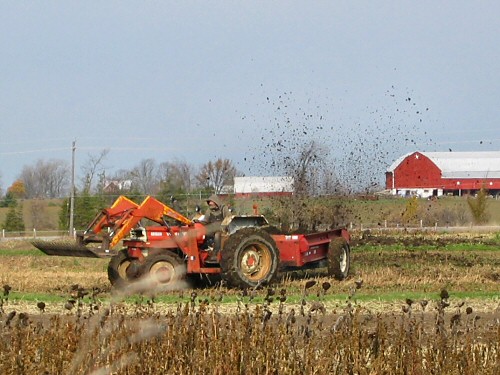
A satisfying few hours today, spreading year-old cow manure on the market garden. Bob and the old White 70hp handled the spreader (and you can see a rock picker attached in front!). I used the Kubota compact tractor to fill from the aging pile in the yard outside the loafing barn. Spreading, and the infrequent moldboard plowing, add up to an average of maybe a couple of full days a year of big tractor action. For 2007, this was a good chunk of it! (Guest photo by Karen.)
The spreader
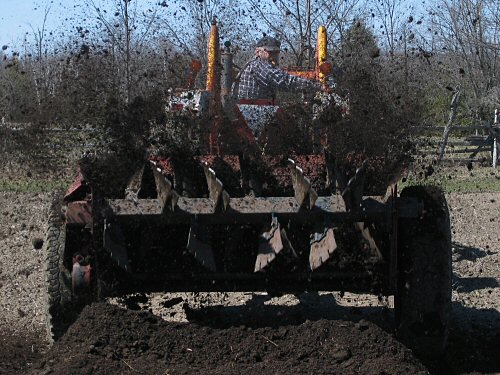
Last of the big machine work! Bob using the spreader to drop off a pile of compost for distribution by shovel (shot two days ago). There is something really satisfying in this crazy world about technology that is straightforward, like a giant fan-blade device for tossing manure far and wide! Today, I finished rototilling the new section, ending the main tractor work. From here, most of the fieldwork is done by hand—the biggest machine is the little Kubota. Later on in the day, it rained, only 5mm but enough to save hours of watering-in newly seeded beds. Time to start keeping track of the rain…