
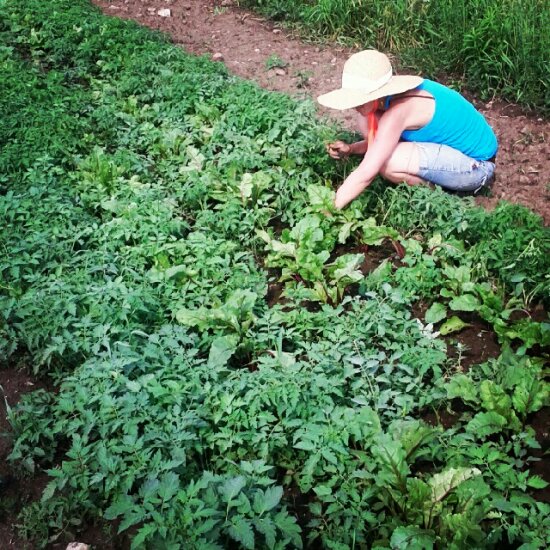
Hand weeding, what can I say, the cornerstone task on a tiny farm. Mel dives in (that’s beets in there, and volunteer tomatoes as weeds). This section has been unusually neglected, and still it’s really not as bad as it might look: in ideal start-of-summer conditions, what a difference just a few days can make, but it’s not too dense or deeply rooted, and a couple of hours of quick hand movements can cover a lot of area. We’ll also wheel hoe down the outside edges of the beds and down the paths, which is at least five times as fast! Give weeds too much of a head start, though, and Hand vs Weed is not a fair fight. Timing!
Mel
Potato digging party
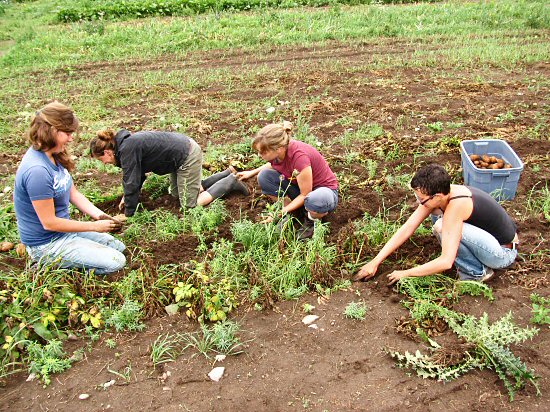
It’ll be hard to top THIS one for extremely labor-intensive tiny farming involving lots of peeps! Here, Libby, Lynn, Andie, and Mel hand-dig potatoes for tomorrow’s farmers’ market. The taters happen to be Gold Rush russets, and they’re in fine form, with a little wireworm damage (surface blemishes or tiny holes) to only a few. We’re right at the end of the first (of three) potato areas of this year, 600′ (183 m), evenly divided between Penta, Chieftan and Gold Rush.
So, what’s with all these people, digging together in a cluster, with just one bin? A little inefficient, pehaps? Well, not really. When there’s a lot of folks happy to mix it up with the dirt, tackling a single task all together can work out! We only needed about 70 lbs of each variety (that blue bin full). With the moist-but-not-mucky soil, pulling plants and scrabbling around was quick and easy. BIG POTATOES helped. Working close together wasn’t a problem because we had so little area to cover. Each bin got filled in maybe 15 minutes. Satisfying!
In the photo, you can also see how relatively good shape we’re in with weeds. The bit of grass growing back is in separate clumps, all the runners haven’t started to reach out and hook up. Further up is a section of more heavily overgrown onions. But that’s actually doing well as well: the onions were thoroughly weeded twice, and hoed a couple more times, so what you see is mainly grass from the last three weeks (without much shading out from the onion plants, everything else grows fast!).
Anyhow, when we tackle the main potato patch, around 2,000′ (609 m), methods will change. But we’ll still be digging in the dirt…!
Dog days of summer (a few)
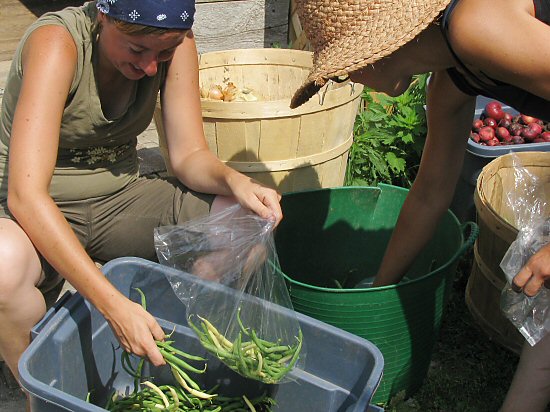
The muggy wave continues, the sixth day or so of bright, swelteringly humid heat. Today was only 21°C (72°F), but the Humidex (or whatever exactly They call it) says it’s the equivalent to us humans of 40°C (110°F). It does feel that way. I can’t recall ever hearing a spread that big—quite weird, or maybe the Humidex got more accurate…
A smaller crew than usual this Monday morning as we harvested for CSA shares. Lynn and Mel (above) were out earlier, hitting the field at 7 am, partly to get a jump on the heat, partly because they both had to leave earlier as well. Michelle arrived around 8:30. Tara was tied up preparing for a short trip. Jordan, another Monday regular, is away for a couple of weeks, on various visits around the north-east.
People in the field. I still find it mildly unlikely and extremely cool each time one of our tiny field crews assembles for a day. Sometimes it’s a crew of two, other times, usually harvest Fridays and Mondays, the numbers swell (big for a tiny farm!).
We all head to the field for different reasons and different returns. The work is never endlessly tedious, we don’t go out and, say, pick beans for 8 hours, but we do get a lot done, and everyone does a bit of everything. You can find a little instant closure, where the start and end of a thing are all right at hand. You can learn to small-scale farm. You can chill out, take time to think—garden meditation while breathing some relatively fresh, country air and dabbling in the dirt. Chatting while veggie gardening can be great. It’s whatever you want it to be…
Today, it was hot. The shares were done by noon as planned. It’s all good! :)
Packing shares: done!
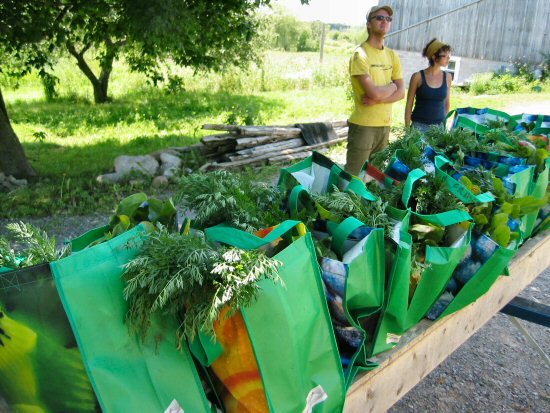
CSA shares are packed for another Monday of on-farm pick-up! It’s one of those great hits of momentary satisfaction to see them all, 100% absolutely and finally done, waiting to be collected. Mel, Jordan (above), Michelle, and Tara were all in the field, and the whole harvest went by kinda quickly, maybe three hours. I’m also figuring out the easiest ways to use different spots around the new farm. Today, as a temporary improvement, we moved the long screen table into a tree-shaded part of the drive, allowing us to line up the bags in one row, instead of grouping them on two smaller tables indoors in a shed (it’s all in the details! :). Keeping the packing space uncluttered is kinda critical if you don’t want to spend half your time rechecking shares to make sure that they’ve got everything. When the set-up works, filling shares is really suprisingly satisfying. On the tiny farm, assembly lines can be fun!
In the share: baby leaf lettuce salad mix, baby zucchini, cauliflower, garlic scapes, young carrots, beets, new potatoes, curly& flat-leaf parsley.
Tiny machine action
Beautiful weather, around 60°F (15°C) in the full-on sun, with a crisp undercurrent of a breeze… What could be nicer for the first full day of fieldwork?! Lynn, Mel and Jordan came by at 8:30 am, and Tara joined in a little later on. We’re still working on preparing the beds, so the main action was raking and ROTOTILLING…busting up that sod. And everyone’s gearing up for the season, learning where things are and how to do…stuff. Like…rototilling! Mel tries her hand at it for the first time (above)—the Kubota compact tractor is as reliable, steady, and undaunting as ever…
Tara also rototills for the first time. Here, she executes what looks like a nimble little turn…
Mel inspects the results of a pass with the rototiller, checking out the effect of tilling at different speeds. And the tiny farming goes on… (Photos 2 and 3 by Mel)
Fieldwork: Day 1
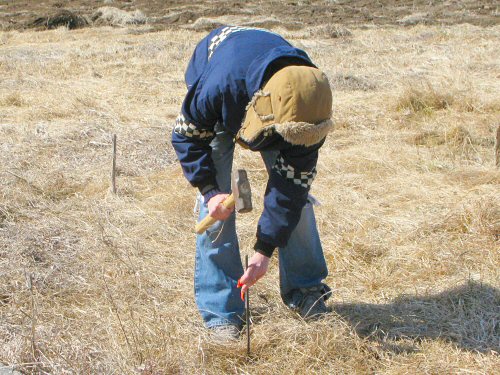
Sunny and quite warm (not as chilly as Mel’s deep-winter-ready, ear-flapped headgear might suggest). Probably 50°F+ (10°C) in the sun. Not the first nice, dry day this season, but this one became this farm’s official first fieldwork day of the year, just like that. We were only out for around three hours (including a walk to check on the beehives—there are some bees!—and the creek), but got a lot done, so it definitely counts as work in the field!
First, we selected a spot for the greenhouse, moving it from where we’d originally planned, to a more sheltered, overall all more PLEASING site. Pound in stakes at the roughly measured-in four corners, and admire the spot. The stakes are graphite tent pole sections Bob got at a yard sale long ago; flagged with orange surveyor’s tape, they’re great field markers. Normally you can just push ’em in, but here, Mel is using a mini-sledgehammer (above), because the ground is still frozen from a couple of inches (5cm) down…
Next up, sort all the hoophouse pieces. The steel ribs and braces are on the right. There’s a surprising amount of wood involved, and that’s now divided into what goes where. And then, we dumped all the hardware out of the barrel it’d been moved in: a bucket of assorted, screws, nuts and bolts, plus springlock (wire that attaches the plastic to the frame) and aluminum springlock channels.
A surprise find: the last five potted wintergreen plants (Mel is chosing some to take home). I’d put them in the barrel on top of a bunch of parts when we were moving the greenhouse, and forgotten them there. After spending an entire winter totally exposed outdoors, and the last couple of weeks tumbled down into a barrel full of wiry metal, they’re still alive and looking cheerful. Tough and pretty. With minty berries…
And so, the return of the greenhouse is underway. The GH is sorely missed and really needed! Just gotta wait till the ground thaws, so the area can be tilled up and the 3′ (0.9m) t-bar anchors that keep it from blowing away can be driven into the ground…!
Trimming garlic
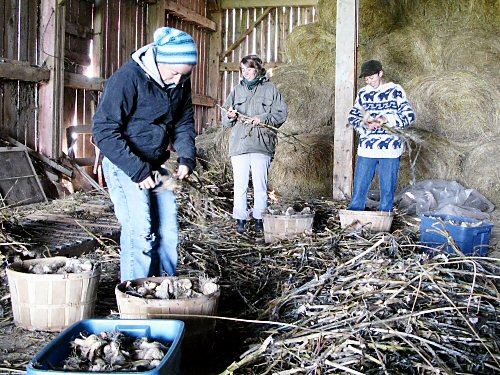
From the long stack of garlic drying in the barn, we’ve been taking out about a bushel a week since harvest began in late July. Today, we finished preparing the rest of the harvest. Lynn, Raechelle and Mel snipped the stems and sorted at the same time. (The roots weren’t trimmed; that can be done for some as we go through the bins and baskets each week for CSA shares and the farmers’ market.) In past years, the sorting was for size: dividing the mostly medium and large bulbs, and putting aside the very few tiny and damaged ones. Garlic does best with a dry final month of growth—this time, coming out of ground that had remained quite wet all summer, the harvest wasn’t in as good shape…
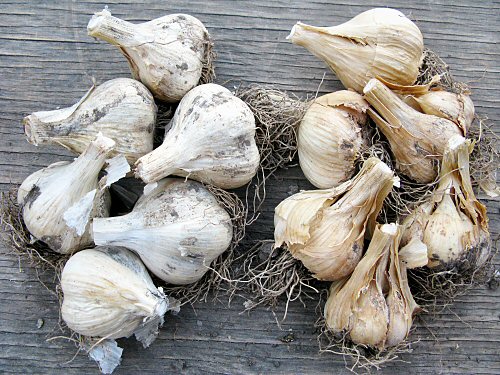
Sizing evened out, with most bulbs about what I call “medium” (this is the most useful size for cooking, but the big ones are so…impressive, everyone loves ’em). A little over half dried not to the usual tight, white skin, instead, to a tan color, wrinkled and split. So, we sorted into “good” and “not so good”… There was also a much higher proportion of really damaged bulbs, maybe 10% compared to a usual couple per hundred. Still, the taste is great, and the cloves themselves are fine. Only appearance and storage life are affected. We’re selling the less pretty, less storable bulbs at a couple of dollars less per pound. They’re good for immediate use (within 3-4 weeks, maybe a little longer) and as seed garlic for fall planting. Overall yield was great, although I’m not sure whether the hugely reduced number of large bulbs was due to weather, or to the more intensive 5-across planting we tried for the first time. As usual, more to observe and learn from. All in all, given the poor garlic weather, it all worked out quite well!