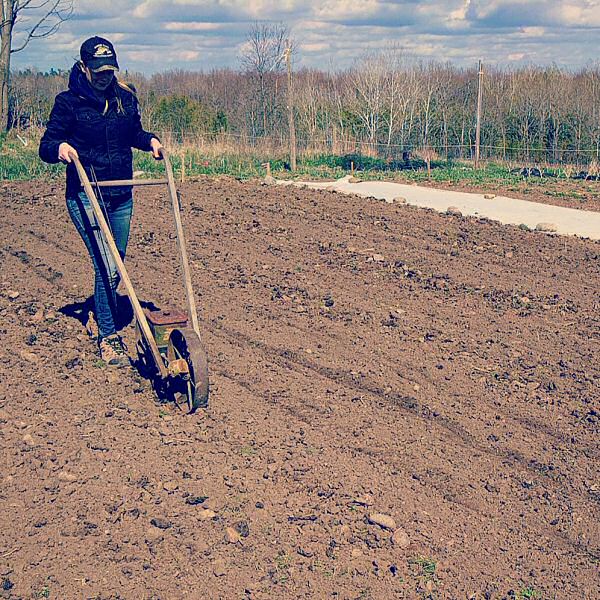
The Planet Jr. rides again. Clara learns the way of the antique seeder, having just laid down three rows of Kestrel beets. This old seeder continues to serve well!
seeder
Rock, pebble, stone
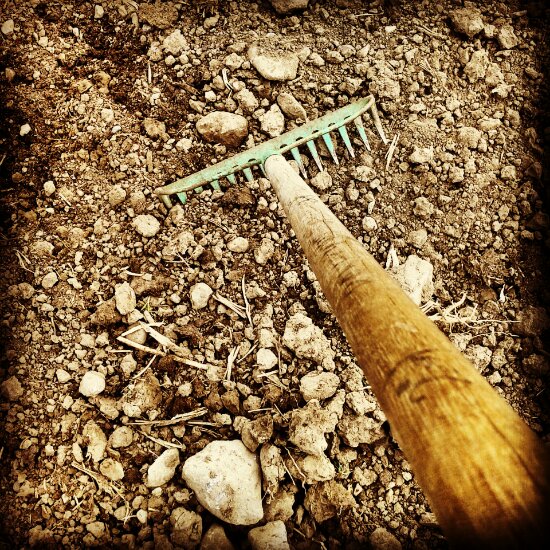
Imagine a world of soil without stones… In the three farming locations I’ve fully worked, they’ve been everywhere and in all sizes. You get used to them: collecting heavier, smoother specimens for weighting row cover, moving even bigger ones to avoid breaking tines on the rototillers, piling up the grapefruit and orange-sized rocks by the tractor bucket load, and raking the smallest out of the way of the seeders. I have experimented a bit with how much I can leave and still have the seeders not bounce around and lay down seed unevenly. Raking as the last step of bed preparation is still the way we go.
Bucket loading
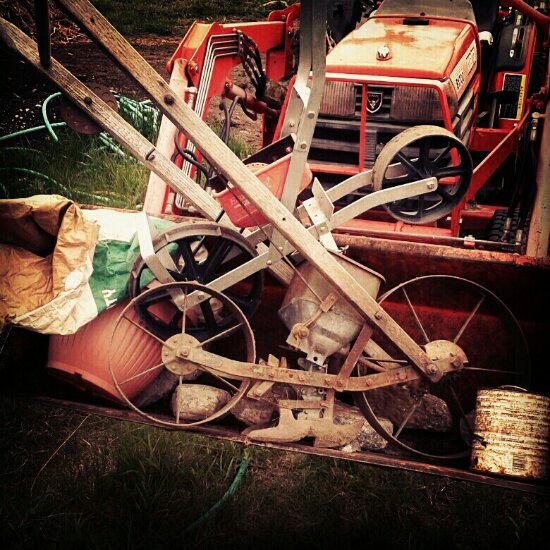
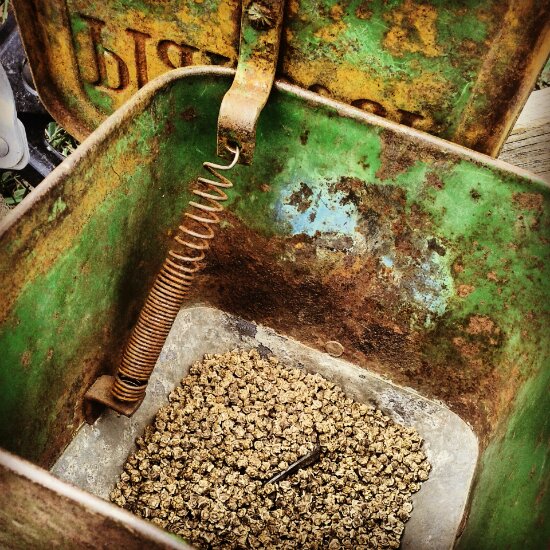
Especially in spring, with constant seeding and transplanting, moving gear around the field is a bigger deal than it may seem. Forget stuff, even little things like a hose fitting or a seed plate or some twine, and you’re heading back the equivalent of practically a city block to get it. A trailer of some sort is the ultimate for a 2-3 acre plot, but with decent packing skills, you can fit a lot into a tiny tractor bucket, too! This carefully balanced load includes everything needed for some direct seeding: the Planet Jr. and Earthway seeders (can’t forget the Earthway seed plates, they’re a perfect fit in that coffee can); seed, clipboard for notes, twine and stakes for row marking (all in that large flower pot); choice rocks for anchoring row cover (it’s never too early to protect brassicas from flea beetles!); and there’s the last of a 50lb bag of snap peas nestled in. It takes a practiced eye to fit everything you need so nothing falls out as you bump along—do it a few times and…easy peasy!
Well-thinned carrots, growing well!
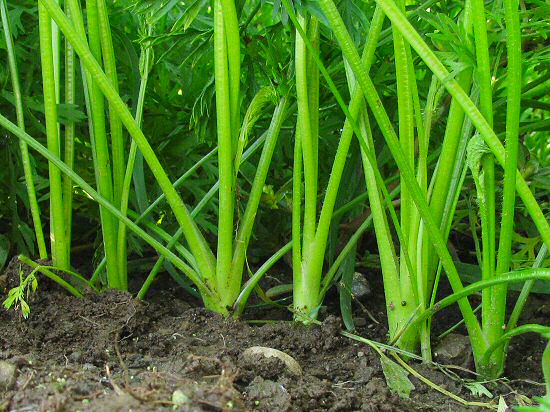
Checking in on the fairly massive time investment we made in thinning 800′ of late-planted Touchon carrots—and it’s paying off! Not that there was any doubt that thinning works, it’s just so…tedious. After laying down carrot seed thick (in other words, after using the Earthway seeder), we spent hours removing thousands of extra seedlings. Because these guys went in so late, I wanted to give ’em every shot at making the best of good weather and sizing up while they could. Now, the effect of 1″ (2.5 cm) spacing really shows. We still kept them pretty tight, thinning a few short stretches to 2″ (5 cm) for comparison, but mostly did them like this, aiming/hoping for a big yield of fairly slender full-size carrots towards the end of October. You can see, second from right, a little one that escaped. It may seem obvious, I’ve found appropriate spacing is easy to overlook or downplay. When you’ve actually seen the massive difference it usually makes, it’s hard to ignore! Think better seeder. :)
Last in!
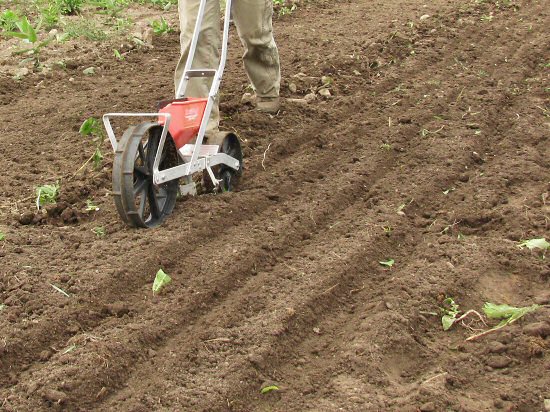
Today, the last direct seeding of the season: spinach, radish, Asian greens mix, arugula, and a lettuce blend for baby leaf… Here, Tracy does the honors with the always-generous Earthway seeder, laying down thick lines of Rebel radish. But is it…too late? Well, who knows?! In good summer conditions, all of these crops can be ready to harvest in 40 days or so from seeding, but the sun is getting weaker now. Hopefully, this round will come up fast, catch the last of the reasonably strong light through September—there WILL be lots of sun!—then continue growing slowly until ready for the last couple of markets through the end of October. That is the…plan. Fresh young veggies at season’s end are a welcome treat! If it doesn’t work out, oh well (and we may get a chance to do a few days at the indoor market in November). In any case, we have the space and the seed, and pushing for the absolute latest planting date seems to me always worth the gamble. Seeing what happens is kinda…exciting!
Carrot germination refinement continues
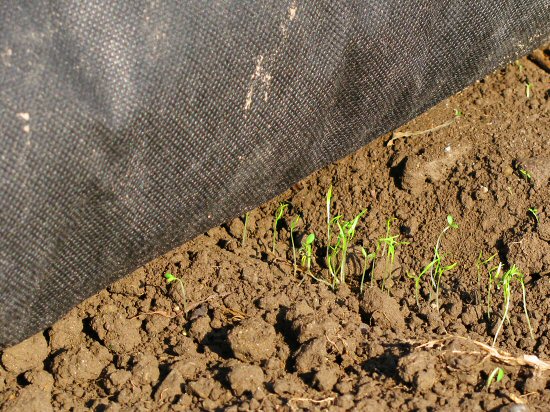
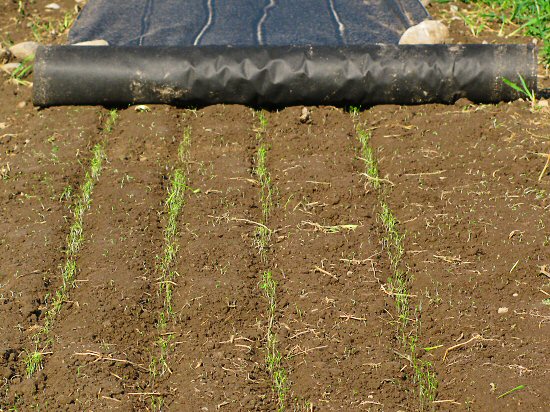
Another successful carrot germination event, with trusty, open-pollinated, heirloom Touchon, and our latest refinement in cover. Although this landscape fabric looks like the stuff we started with last year, it’s a heavier grade that doesn’t tear and become useless after one or two outings—it should last FOREVER, or, hopefully, for at least 10 uses, at which point, the cost will be near zero.
This germination, in mainly hot, sunny weather, is exactly one week after seeding, with no watering in. Pretty good! Deprived of light, the seedlings are already stretching—I might’ve taken off the cover a day or two earlier if I’d checked—but they’ll be fine. And if you’ve used an Earthway seeder, and ever doubted the incredible amount of seed it can dump down, don’t (see above): I’d rather see all those carrots pushing up than too few, but the waste from overseeding is quite severe, and major thinning is in order, adding to the labor. Still, it’s all part of the joy of farming largely by hand… :)