Assessing greenhouse clean-up

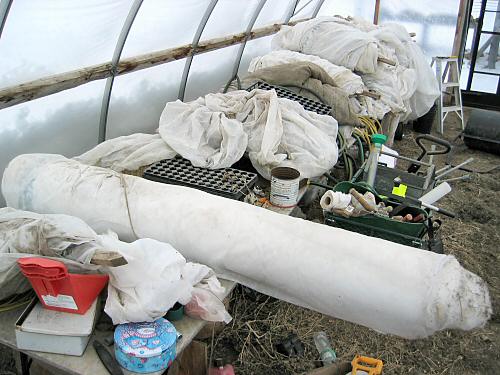
The greenhouse is small, and the layout hasn’t really changed in its three full seasons. A row of tables on the north side are where the seedlings go. On the south side, unshaded by the tables, is an open strip, about 8’x32′ (2.4x9m), where I pursue ever earlier lettuce, trying to have something for the very first farmers’ market of the year (it’s the first Saturday in May; last year’s second Saturday is the earliest so far). It’s a simple set-up. Still, every year, there’s one day when I head out there to assess the clean-up requirements and plan what to do. This year, today was that day. A lot of different gear gets stored on and under the tables. It varies each year. Here, it’s mostly floating row cover, kept up off the ground because, apparently, voles don’t like to climb (voles gnawed a hole through a good part of a roll one year…very annoying, imagine unrolling a neat row of ragged holes). Exposure to UV from the sun is not good for plastics particularly, and I do store most things in the drive shed, or the Milkhouse and barn, or under the tables, but things do get left out… Anyhow, this year’s action plan is settled: clean up!

Return to the trays

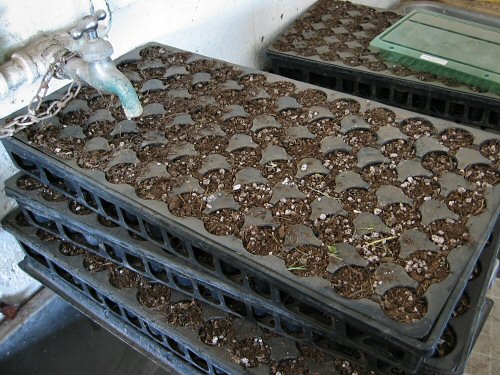
These 72-cell plug sheets, filled with now bone-dry starter mix, have been sitting in the Milkhouse on one half of the double sink since early last summer. They were extras from the final round of seed starting (the last of the brassicas). Now, it’s their time again, as I start the set-up for next year’s seedlings. I usually only do this stuff after the Holidays, but this year, I’m unusually anxious to get going. Maybe it’s a reaction to the unexpected snow and cold. After the recent, freakishly short winters that happened to coincide with my entire farming career, maybe I’m edgy about being cut off from the garden for so long. I mean, all I see is white. I want more greens and browns!! (And there’s the new adventure in fine dining to get started, sparked by Amanda at Apartment Farm’s recent peppy post: “Winter Gardening: Micro Greens”!)

Official: the garden season really is over

Snow-covered field means the garden season's over!

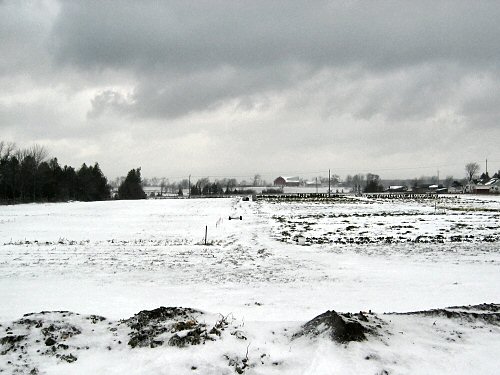
OK, so this garden is really over for the season! Called due to extremely cold, snowy conditions that don’t seem likely to let up any time soon. I’d been counting on one more melt-off, but it’s only been freezing cold and more snow since the fall that covered it all eight days ago. And there’s no let-up in the 15-day forecast… So, I got caught out a bit. There are still carrots under there, that I might not see until spring, and I didn’t finish mulching the garlic (I think I was unconsciously pushing for a side-by-side test of mulch and no mulch, against prudent practice, and now I have one—it will be interesting…). The big experiment (and possibly, gamble) is with leaving the green manure cover crops—oats, rye—over winter, to be tilled in in spring. In the pic, you can see it’s smooth to the left of the main path, and rough on the right (at the very bottom is the composting windrow where the last of the leftovers go). The left side (plus eight sections across the north end, out of sight at the top) is fully prepped and ready to seed as soon as the ground dries out in spring (peas first!). To the right, I’ll have to wait until it’s dry enough to till with the Kubota compact tractor—determined by the weather, this could hold me back a couple of weeks. Or more. After that, again weather-dependent, there’s the minimum wait of a week or two after tilling for the cover crops to break down. But, with two-thirds of the field ready, however the weather goes, it’ll be fine!

Cleaning up

Fall field

Fall clean-up continues

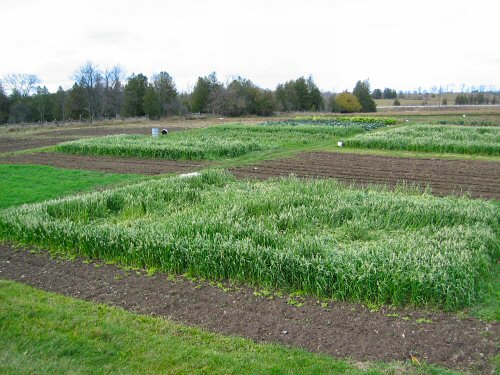
Here’s a look to the north from my new favorite photo spot, on top of the farm stand. We’re down to mainly brassicas, oats and rye (that’s the low, darker green section poking in on the left). The oats has started to die off and topple over, leaving collapsed areas that look as if animals had bedded down… The days lately have mainly been overcast and quite cold, just above 0°F, with a fair bit of rain that leaves the ground mucky. My hours a day spent in the field are winding down, a two or three hour job at a time, weather permitting. Elsewhere, there’s lots of putting in order and stowing away, and clean-up in the Extended Milkhouse where all kinds of junk accumulates over the year. Getting set for winter.

Read more

All clear

Tilled field

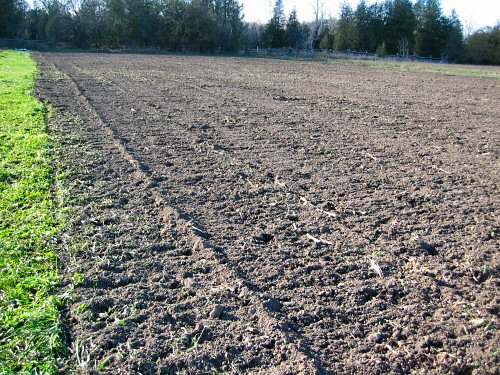
The new section at the north end of the garden, all clear after yesterday’s rototilling. The area is 120’x200′, about half an acre. Although it looks light and crumbly after drying for a few hours in a stiff breeze, the clayey soil is pretty heavy and moist. It never really dries out after mid-October or so, it only gets wetter until it freezes… A low cover crop, to winter-kill and then be tilled under in spring, would be great. I’m working on it, and this is the next best thing: no weeds!!

Compact tractor tricks

Clearing peppers with the compact tractor

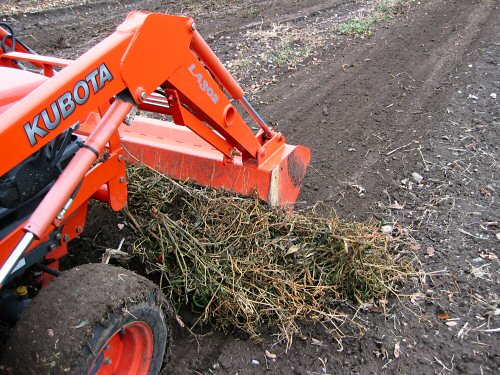
For some reason, I always feel a little guilty when I use the Kubota compact tractor in ways that make things way too easy. For instance… Probably the worst is the clearing technique I came up with a couple of years ago when it was cold and hand work was going slow. If you set the bucket of the front end loader pointing nearly down, and drag backwards, you can completely clear old plants in NO TIME AT ALL. Here, I’m removing a 50′ bed of hot peppers in one pass (the sweet peppers, in another section of the field, were lower growing and got tilled under a couple of days ago…). Is this gratuitous soil compaction, driving the machine over the beds unnecessarily? Well, maybe. But it’s so QUICK, and not an all-the-time thing. Does it drag off valuable topsoil? Not if you start feathering as you go, lifting and lowering the bucket a few inches lets the tangled mass of plants roll, freeing the soil. I try to do most clearing by hand, but sometimes, well, you take the shortcut…!