The great WARM outdoors!

First really warm day of the year!

Ahhh, yes, THIS is what warm weather feels like! For the first time this year, the temperature topped 60°F (15°C), with a hazy sun and a gentle breeze. We’ve had some melt-off days already, but this one tastes like spring! Usually, there’s a day like this sometime in February, so it’s been a long time coming, and makes me wonder how even crazier the rest of the weather will be. No worries…today feels great.

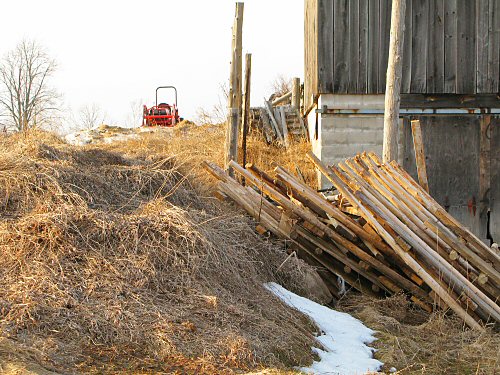
The photo is a good to-do list for when real spring comes and the ground is dry enough to work and get around on. There’s a jumble of spare lumber taken from the barn when we cleared an area for the new seedling room—it needs to be sorted and stacked, and some of it will be the new chickenhouse! (Only patches of snow are left on much of the land, but I’m sure it’ll be back before it’s really gone.) The abundantly overgrown grasses that partially surround the barn and border the moldboarded garden areas is a big clean-up job. And, up the slope, the Kubota compact tractor calmly waits for after the hired-big-tractor disking and the compost spreading, when we do the final tilling of the garden beds. Coming soon. Cool!

Greenhouse overgrown

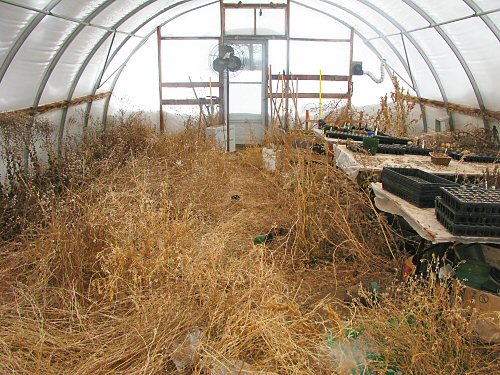
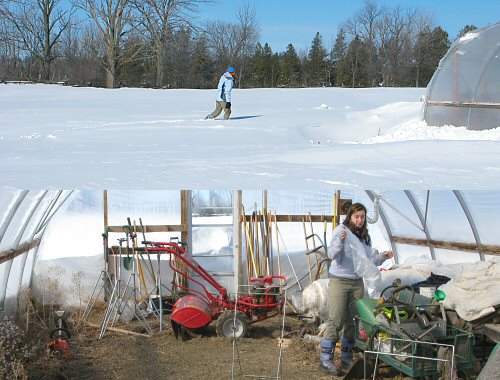
The greenhouse is still snowbound. I cleared away the east-side door to get in and check out what’s left to pack up for the new farm move, coming soon! Usually, I do a bit of greenhouse clean-up in the fall, and then around February, prep half the area for some early greens. This time around, I’ll take out the small stuff—there’s tools, the big industrial fan, a few plug sheets, and tons of plastic pots stored under the tables—lots of good gear! The tables will probably be left till March, after the melt-off, when we come for the greenhouse itself. Once the bubble is removed, this little winter oasis will merge into the rest of the field. The pleasantly golden-brown dead stuff is mainly arugula allowed to go wild…

Drive shed clean-up continues

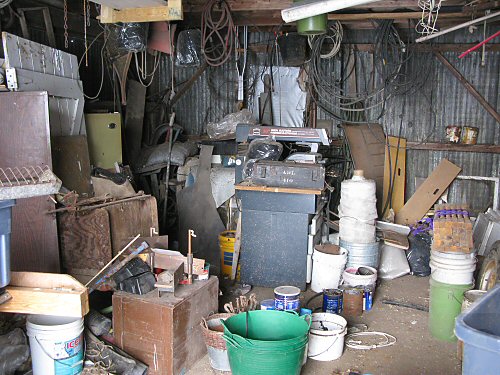
You can see the back wall! The fairly massive, once-in-a-century farm clean-up continues, and the two-floor drive shed, home of a million parts and pieces of not-junk, is an action center. I can’t imagine how one could capture a real feel for all of the stuff that was in there, you had to poke around and experience it first-hand. It was literally packed to the rafters with EVERYTHING. There were all sorts of shelves, racks, parts drawers, crates, boxes, a couple of decommissioned fridges used as storage, stuff hanging off endless nails and hooks, and much of it in murky half-darkness. All of that is being slowly and carefully peeled away. The superficial mess of tiny farming gear from a couple of weeks back is long sorted out. And as cluttered as this one corner still looks, that’s nothing compared to what was there even a few days ago. What impresses me now is not seeing, but FEELING the amount of life and time it’s taken to accumulate all of this, through having built and fixed so many things, with unexpected parts and tools that’ve magically appeared out of there. This is the history of a generations-old family farm recorded in its spare parts, methodically being unravelled… The whole clean-up is fascinating and kinda awesome to observe, in a low-key, mildly melancholy, wheels-keep-turning way… Life on a farm!

Drive shed clean-up

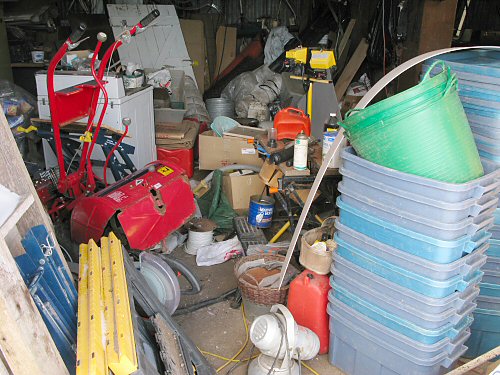
The drive shed is in a transitional mess. I’m part way through the post-season clean-up, delving into shelves, unpacking boxes, dragging things around, sorting it all out. Even with the trusty Troy-Bilt Horse rototiller as a bit of a clue (on the left, in red), to the untrained eye, it might be hard to tell that all of this is essential tiny farming gear. Who’d know that the stacks of Rubbermaid storage bins are in fact our mainstay harvest containers? Or that the weathered cedar trays and folding metal sawhorses (leaning on the left), transform in minutes into the farmers’ market stand. Those indoor/outdoor twin halogen lights are critical lighting components for after-dark veggie sorting and rinsing in the barnyard. That front-loading dryer I’ve kept around for years, in case it could become as useful as its companion the top-loading washer has been as a heavy-duty salad spinner. And so on. Every little item in the pic has its purpose. Much of tiny farming gear is plain, old ordinary stuff, pressed into garden service. And it all works!

After the row cover: weeding!

Weeding after row cover

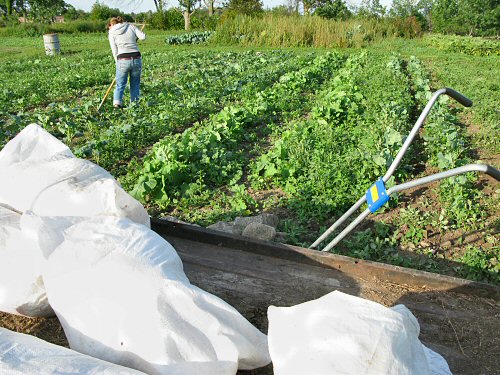
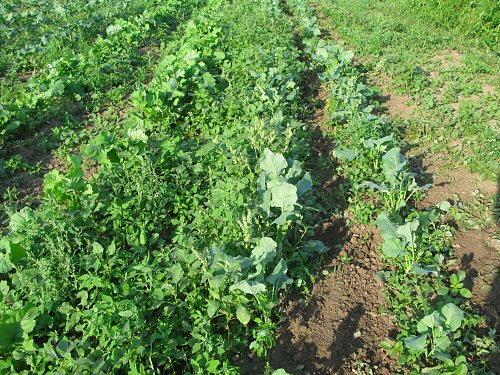
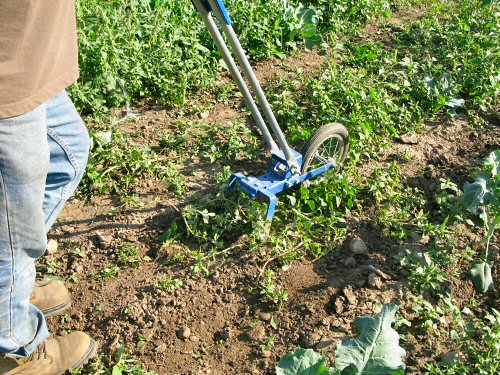
It’s been about six weeks, time to permanently remove the row cover from the last transplanting of fall brassicas! There are two sections, about 20 x 50′ beds in all, with broccoli, caulflower, cabbage, collards, kale. The cover protected against flea beetles, and at this point in the season, the FBs aren’t around much. Which leaves the post-cover weeding! I generally plan to remove the cover earlier, weed, and then replace it quickly, but this seldom seems to happen. Instead, it’s one big weed-a-thon at the end… Here, the mainly pigweed looks fairly big and dense, but it’s actually not much of a problem. The row cover has protected the ground from many days soil-packing rain, so the beds are nice and loose (it’s amazing how much rain can compact clayey soil).  Weeds come out easy! With two people, it’s a relatively quick job, 2-3 hours for a pretty thorough clean-up. We worked with a combination of hoe and wheel hoe, me doing the paths and between-row clearing, and Lynn hand hoeing in-row, between the plants spaced at 18″ (45cm)…

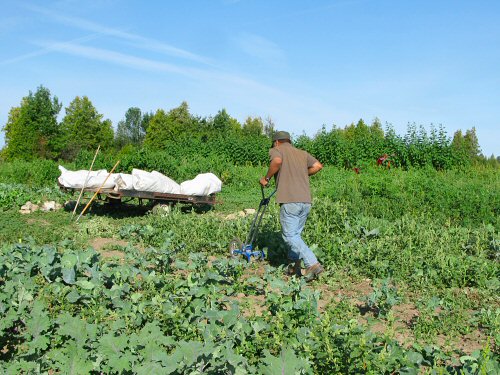
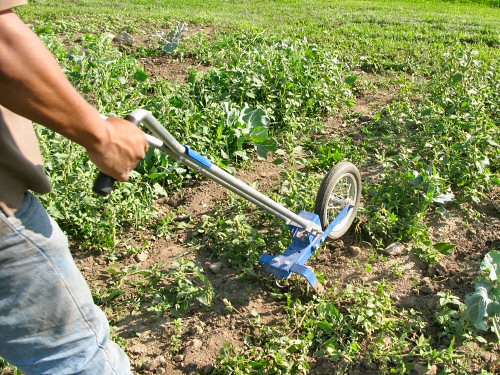
Each time I use the wheel hoe, I grow to love it that much more. So easy, so TIME-SAVING! It’s such a sophisticated yet simple tool, a perfect marriage of wheel, leverage and steel (you could say! :)… Today’s job is heavier work than it’s usually used for, the weeds aren’t just emerging, they’re pretty big. Rather than rolling the wheel hoe continuously down the rows, I’m cutting the weeds with a series of forward and backward strokes that either slice the plants below the surface, or pull them out, roots and all…

Clearing a path (before and after, above) in the loose soil takes maybe 3 minutes for 50′, many times faster than hoeing or hand pulling…

For this heavier weeding work, I use a fairly forceful forward stroke that travels about 1-1.5′ (30-45cm), then raise the blade to clear the felled weeds as I step forward to start the next bit…

The wheel hoe is equally good at cutting on a backstroke, which comes in handy for dense areas and tough specimens… It’s not particularly strenuous work: the blade is sharp, the wheel and angle of the handles give lots of leverage and momentum, and some part of the hoe is always in contact with the ground, so you’re never completely lifting the whole tool. Like most things I do here in the field, I’ve figured out how to use the wheel hoe on my own, by reading instructions, looking at pictures and applying my version of common sense. Techniques no doubt vary. It’ll be interesting to eventually see how others do things! Meanwhile, everything seems to work out…especially, the wheel hoe! (Wheel hoe action photos by Lynn)

Back to the field!

Last seen planting garlic in November as we headed into winter, Lynn is BACK IN THE FIELD, getting a head start on spring. It was great to see her again and…continue! We headed out to the greenhouse and spent three hours or so, bagging the last of the grass mulch, pulling weeds, forking beds, chatting and basking in the sunshiny, 25°C (80°F) greenhouse weather! I also brought out a tray of arugula, couldn’t resist posing it in the snow… It felt excellent to get started out there. Fun!

The wild bunch

Mainly mucking about today. Visited with the goats. Around 15 of ’em. These girls upfront are the current kingpins of the goat yard. Goats have their pecking order (just like the chickens to come!), which mainly means a few get first crack at food, or crowding at the fence, or whatever else they all want to do, while the rest back away and wait or get butted. It’s mostly rank by size, but a vicious streak counts, too. The one in the middle is on top now (with her friend on the right), the brown pair on the left (the Evil Twins), used to be a vicious tag team running the yard, but they lost their edge. Not that they’re always fighting, a brief burst of deterrent action goes a long way. It’s like a soap opera if you watch ’em every day. Goats…

Every year, this little period in the first half of March is kinda like waiting for the starting gun. I’m full of energy and waiting on the weather. A little EDGY. All the early starts are now under lights: onions (first time from seed), celery (another first), more leek and parsley, plus the stuff started around the end of January (leek, parsley, rosemary, arugula, lettuce). It’s another week to the peppers and eggplant, and then the grow racks will start to get full, and I’m also holding off till then to transplant the early lettuce to the greenhouse. As soon as the snow clears and the temperature warms up a bit, there’s outdoor fix-it work, starting with an old ice fishing hut to turn into a home for the composting toilet (an outhouse for the field!) and the chickenhouse to renovate. There’s a list. Plus a lot of garden clean-up, crops left over winter, that should be pulled as soon as I can. MEANWHILE, I’m waiting…