
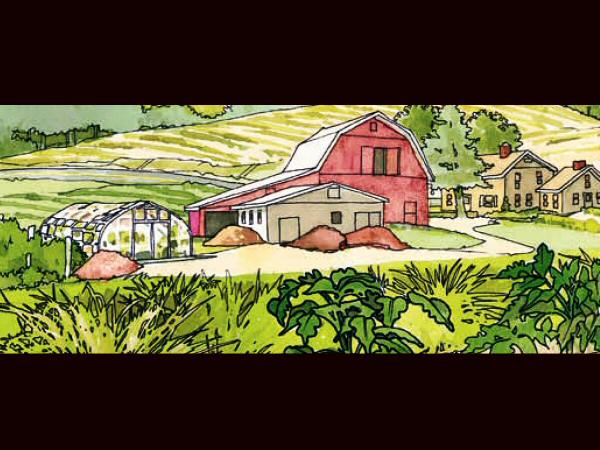
A reminder: Building Soils for Better Crops: Sustainable Soil Management is an excellent, book about soil for growers, free to download, or you can buy a hard copy. Follow the link, or read a bit more where I posted about it quite a while ago. The image above is cropped from the cover, a very specific type of old school farm view and set-up, which happens to be the one I’m familiar with; where you are may be totally different, as may be the soil, but the idea of growing is the same, and chances are this book is useful!
management
Harvesting around the rain
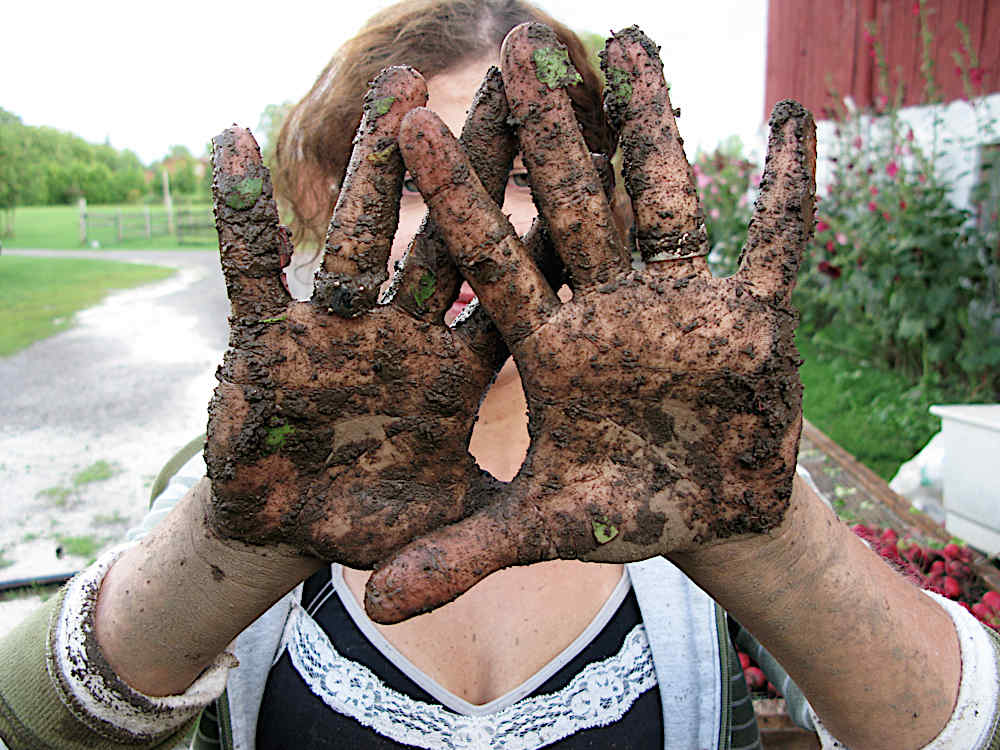
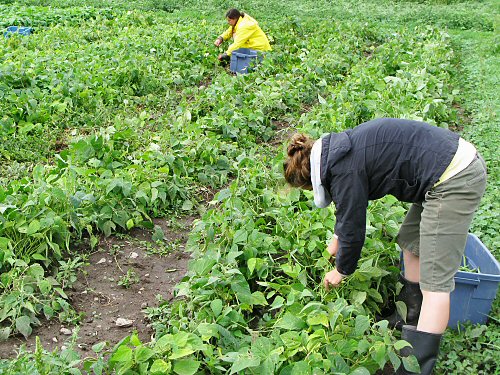
Have I mentioned that it’s been RAINING a lot all summer, like, a few times a day? We’ve taken to planning the Friday harvest to fit the slots between downpours, using…weather radar on the web! It works pretty well, checking the national and local maps, you can see precipitation quite accurately up to 3-4 hours out (it’s a little…high tech, but so is this crazy weather!). To avoid a late morning downpour, we started picking beans—finally, our first snap bean harvest of the year!—first thing in the morning (Maria, Lynn and that’s my bin at the top left of the pic below), so that we wouldn’t be messing with wet bean plants (they really don’t like being touched when wet, they get…diseased). That was pretty satisfying, picking about five bushels before the first shower, which arrived as foreseen. And so it went for the day. You can work between the daily rains, but mud avoidance is not an option—Michelle illustrates!
People in the field update
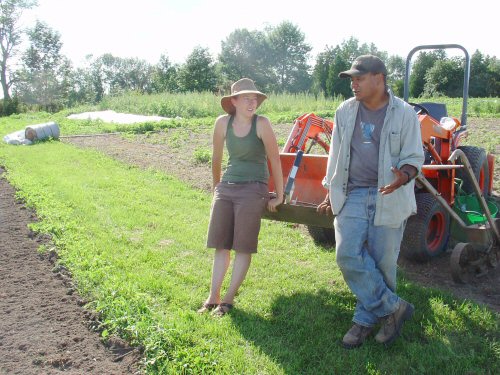
This has been an interesting summer for learning about tiny farming, people, and the ups and downs of growing largely without machines. I’ve had an ongoing debate with Bob over the years about the garden layout, using relatively short, 50′ beds, and hand cultivation, rather than planting long rows and doing most of the between-row weeding by tractor. The tractor approach lets one person, one machine, and some cans of diesel do most of the routine work alone. The hand-grown approach requires lots of labor, and you either settle in and do it yourself with many 10-12 hour days right through the weekfor a good part of the season (as I used to do), or…have help. I’ve found it’s definitely more fun to work with others, BUT, once there’s a bit of a regular crew, there’s the new matter of keeping the group dynamics smooth and making sure everyone’s HAPPY. Long days of often repetitious work, finishing one job only to launch directly into another, and working around the vagaries of the weather—this year is an exceptional case in point—aren’t what most people are used to. And when some of the people live on the farm, for a few days a week like Lynn (chatting with me in the pic), or 24/7 in the case of WWOOFers, things can get even more complicated, like, when is quitting time! At least in the start-up years, tiny farming can be pretty much an all-consuming focus during the growing season, and that’s not something most people really want or can handle, either—you’ve gotta love it! So finding the balance between going all out, and, well, providing a fun taste-of-tiny-farming experience for others, can be a bit of a puzzle. At least, that’s what I’ve found so far. All just another part of the ever-changing TFE…! (Guest photo by Maria)
Tomato seed
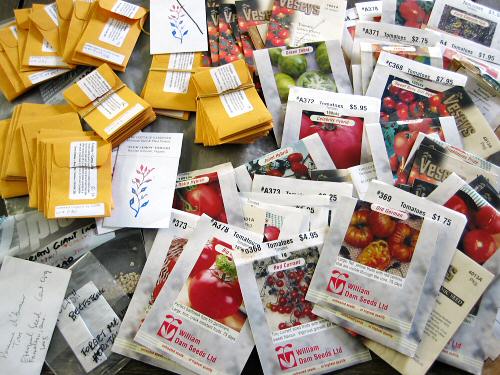
It’s sounds a little odd to call it that, but this is my tomato seed collection. A rough count says there are maybe 150 packets, with another 30 on the way with the just-completed all-heirloom tomato seed order. I’ll get a few more basics, like Juliet, in the last big general seed order, and that’ll be it for the season.
Most of these are different cultivars, there are only a few…doubles. The brown envelopes are heirlooms from a small seed company. The printed packets are mostly hybrids, from my two main seed suppliers. The plastic pouches and plainer white envelopes are various seed given to me to try (I’ll generally only accept seed from trusted sources, people who actually garden and seed-save, to avoid…disease).
Why so much, so many? I dunno. I don’t think of any other veggies in my seed supply as “collections” (like trading cards or tiny action figures). I do clearly remember looking closely at a fuzzy little tomato seed back in Year 1, about to start my first transplants, and thinking, “No way is this little thing is going to turn into a massive tomato plant with 20 lbs of big, fat tomatoes?!” (At that point, all I knew was what I’d read and seen in pictures.) It wasn’t so much disbelief in the powers of the seed, but in my ability to actually manage this obviously intense process—what a tiny seed!—to a reliable, predictable harvest.
Of course, once you’ve watched seeds grow into plants, it becomes…normal: clear the way a bit, and the plants do most of the work! Still, having imprinted themselves on my consciousness FIRST, right at my gardening start, I guess tomatoes have a mild hold on me, and I obsessively plant a few more different varieties every year.
This year, there may be a more manageable 40 varieties (down from over 60 a couple years back). I haven’t finished the starting line-up yet.