
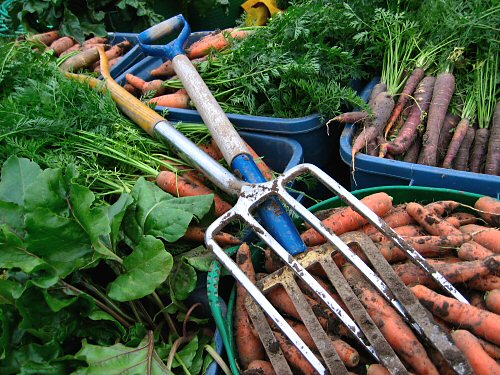
Today’s harvest was the last scheduled one of the season—tomorrow is the final farmers’ market day. Heading out alone felt a little strange, after all the help this summer, but certainly familiar. It’s a completely different…mindset when it’s all entirely up to you! Carrots were featured. There’s lots still in the ground, and some customers at the market will want to double up on the last day. I pulled about 200 lbs (91 kg), not exactly a bulk, root cellaring quantity, but that’s 100 x 2 lb bunches, quite a lot for one market day. That took a little over an hour of digging and pulling, and it’s amazing what a difference the right tool can make. Here, it was a choice between two seemingly similar digging forks. Most of the season, I like the Blue One, with flatter, wider tines that make lifting the soil easy when the ground is fairly dry and loose. BUT, when the ground is cold and wet and dense as it was today—our clay-loam is good at getting that way—the slick stainless steel option, with narrower, pointier tines, simply slides in, where it takes twice the effort to drive down the blue one. No comparison! If the difference sounds slight as described, a few minutes of actual digging and you’d be convinced. It’s the not-so-little things!! It’s in the details… So, lots of carrots, lots of beets, a good haul of cauliflower, bok choi, spinach, kale, plus garlic and onions from storage. A nice cool season selection. Not bad!
techniques
Water work
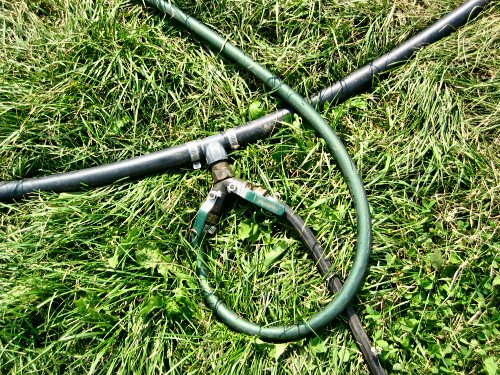
We’ve been watering heavily (well, as heavily as our gear allows) for what seems like weeks. Rain has been teasing us, 5mm a few days ago after an impressive, all-day cloud build-up; last night, 2mm following a brilliant extended lightning show and promising bit of a shower that soon faded away. It’s terrible. Conall has been honing his newly acquired hose rigging and sprinkler positioning skills. For heavier watering, the set-up begins at the pond and continues along a 1″ pipe (a little small, but it’s what I have from Year 1, intended for the much lower capacity barn well) that runs the length of the field. Water arrives through a series of shutoff Y-valves and from the valve of the moment snakes through up to 500′ of 5/8″ garden hose. (Fluid dynamics is something I should apparently be studying, to get a grip on the water-reducing effects of our often convoluted hose, valve and quick coupler combinations.) The hose leads to sprinklers (never too efficient, and quite a waste with anything above a hint of a breeze) and soaker hoses (MUCH better, but a pain to run up and down beds and then move again). The pump can deliver only so much, so it’s a multi-day rotation of gear to get around the entire field. The golden upside: WATER to the crops!! It’s amazing how much energy half an hour of heavy rain can save…!
Cucurbits germinate!
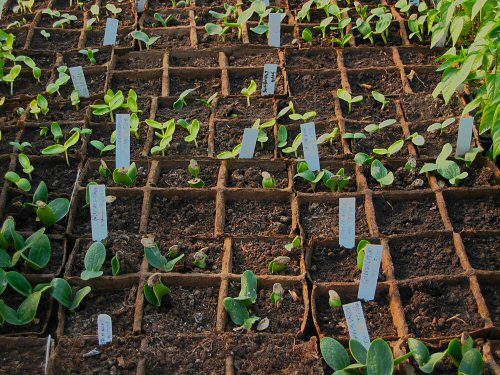
The heat-loving squash-melon-cucumber family are the last of the seedlings to be started. They’re coming up now and headed for the field as soon as they’ve fully emerged, no waiting for true leaves. Depending on the crop, each pot has 2, 3 or 4 seedlings to be transplanted together, with extra space between pots. This replaces single planting and spacing, which saves transplanting time and makes early cultivation easier.
Carrots like burlap!
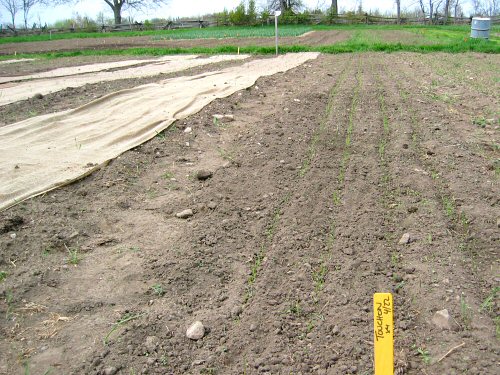
The carrot germination experiment worked like a…charm! They were coming up pretty good three days ago, conditions looked great under there (moist, airy, seedlings nice and green), so I left the burlap on a while longer to push the germination rate a bit more, and that worked as well. This bed just had a 10-minute clean-up of some grass and dandelion, and I test cultivated a few feet at this end for smaller weeds getting started. With the moist soil, it’s all easy. Now it’s off with the rest of the covers and time for a little irrigated rain (since Ma Nature is presently not obliging). Excellent!
Carrot science
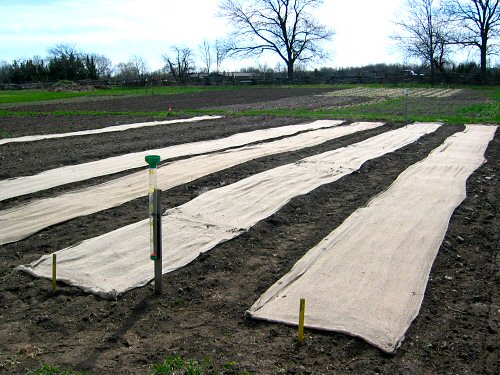
Welcome to my carrot lab! Carrots have been my biggest early spring headache. In cool weather, they take forever to germinate, 2 or 3 weeks, and by that time, the chance of weed competition is pretty good, and just about anything growing around the tiny seedlings makes excruciatingly time-consuming surgical hand weeding a necessity. What to do? Last year, I tried IRT (plastic) mulch over the bed. This worked great, heating up the soil, speeding germination to 7 days, and keeping weeds down. Problem was, miss the germination window (when a good number have emerged) by a few hours or a day, and the seedlings got toasted in the heat. Too delicate a balance. So, a new approach, something I’d read about. It involves a double layer of (untreated!) burlap. Simple. The burlap acts as a mulch to retain moisture and increase soil temperature, and it also allows in water and some light. What could be easier?!?! Now, all it has to do is WORK! (Update: it worked like a charm…)