Bed prep: Step 1

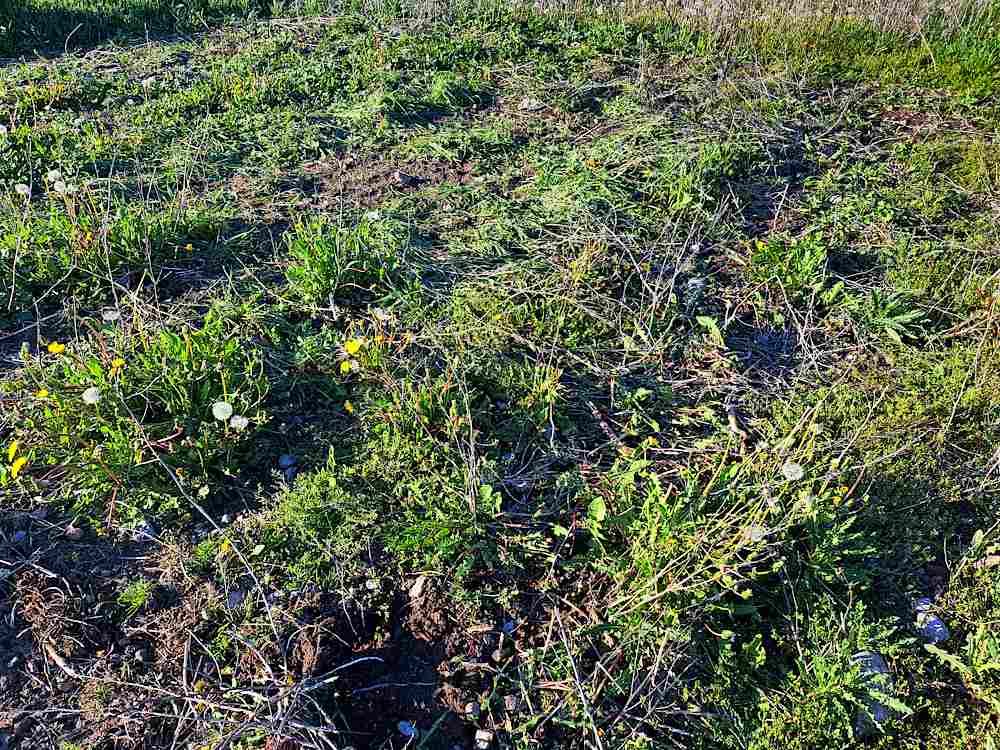
Overgrown garden bed after a first pass with the wheel hoe

Here’s a chunk of this year’s tiny veg garden, looking particularly rough in the harshly slanted evening sunlight. As unlike seeing for yourself as this photo may be, it does accurately capture the wild and not ready look of it all. Lush dandelion, prickly thistle and grass already starting to soar, mixed about with the dry dead stems of last fall’s overgrown then winter-killed weeds—that’s step 1 of hand-prepping the bed, completed. It’s not at all like what the rototiller on the tractor would’ve done.

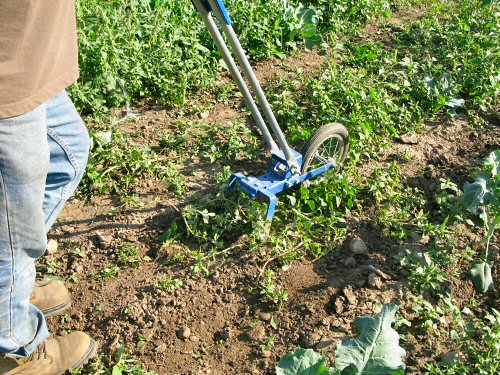
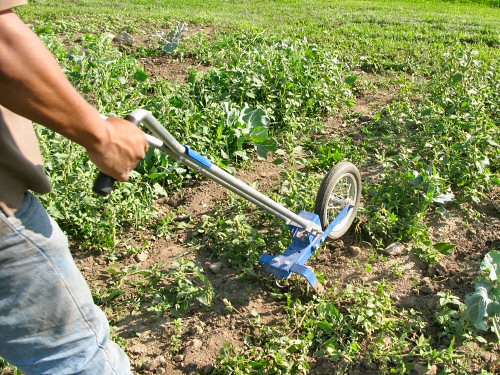
For this first pass, I used the up-for-anything Valley Oak wheel hoe. It’s probably not intended for hacking through this sort of cover, even so, it does the job amazingly well, moving forward and pulling back, using both sides of the blade to slice through tough spots. The green, intact-looking plants have actually been cut off just below the soil level—a day in the sun and they’ll all be fairly dried out, shrunken and browned. Next step, raking it clear, then, another pass with the wheel hoe. Tomorrow!

A big little fix

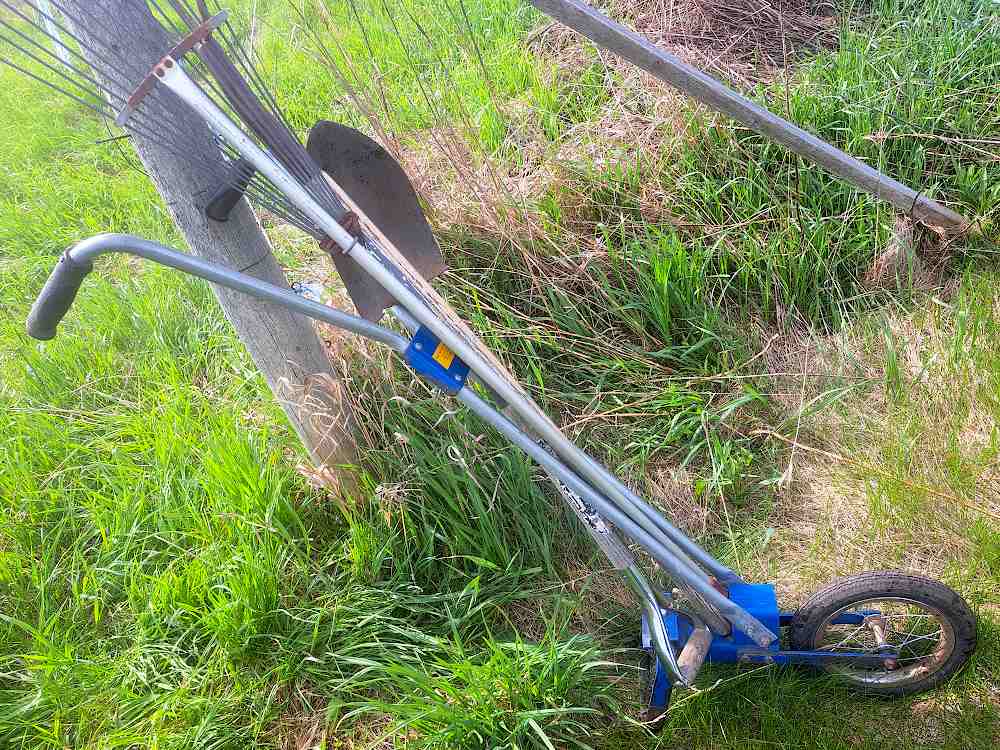
Wheel hoe as tool carrier

Today, a tiny farming breakthrough—I found I could securely balance multiple tools on the wheel hoe, and easily wheel the whole setup between the tool shed and the field! When the tiny farm was operating at a larger scale, I’d hitch the flatbed trailer to the John Deere riding mower, load up with everything we could possibly need for a job, and drive on out. That was deluxe! But for a couple of hand tools—here, a hay fork, leaf rake, shovel—plus the wheel hoe, driving is just overkill. It’s not that far a walk. Still…guiding a wheel hoe while carrying tools is a bit of a balancing act, and I usually make two trips. This new way, using the wheel hoe as a tool carrier, flips it from irksome to fun! I figured out how to quickly insert tools so they brace each other and don’t slip out the bottom, and that was it…upgrade complete. (Yes, I could just pick up the not so heavy wheel hoe, but then, that’s what wheels are for! :)

Wheel hoe underdog challenge!

Wheel hoeing the field

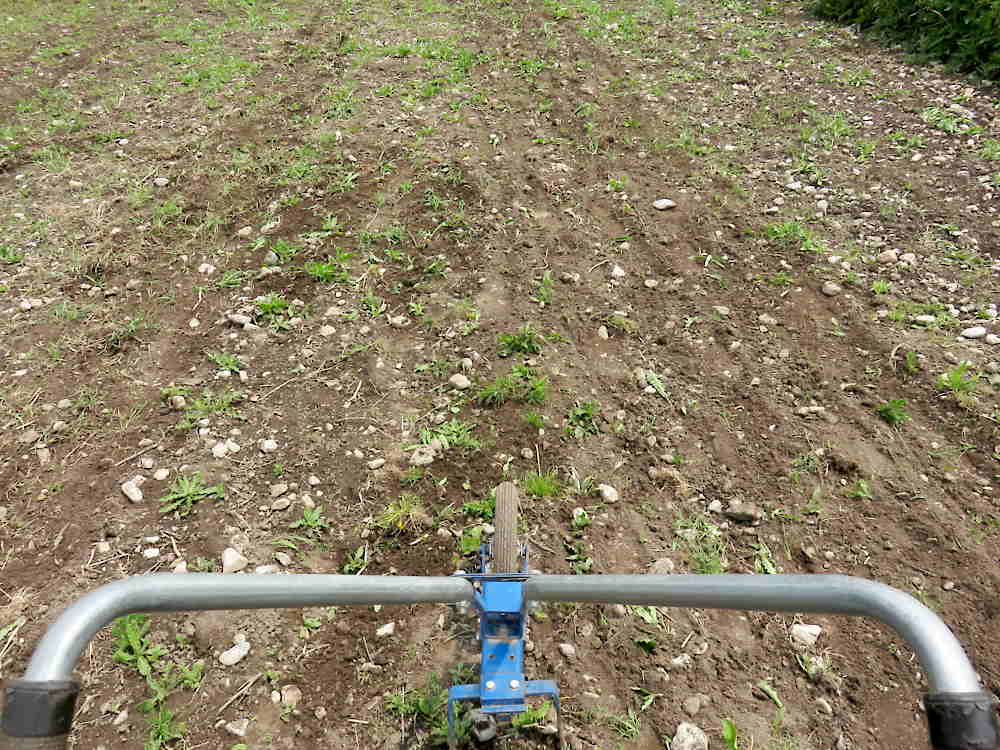
It doesn’t sound like a fair contest, the wheel hoe going up against the tiny tractor, but that’s the experiment underway this season. With all the rain recently, weeds are primed to surge. So far, it’s mostly thistle and clumps of grass itching to expand, with pigweed, lamb’s quarter and a couple of other regulars starting to emerge. This area, not yet planted out, has already been hoed, but that haze of green won’t stay down for long. A matter of days… With the 48″ rototiller on the tiny tractor turned by diesel horsepower rumbling like a tiny tank, it’s easy to put things off a bit. The tiller will churn up whatever’s in its way in no time. This fine wheel hoe has instead only an 8″ blade and a lone human…pushing. Every little bit of growth makes the going harder. The time to get in is early, when the blade can more or less glide smoothly and evenly, and you can move travel up and down with fair ease. There are other things to consider here—time, fuel, effect on the soil…more on all that as the experiment goes on—but timing is number one!

IN THE PHOTO: The wheel hoe is facing a strip that has just been walked. It’s hard to see the line between hoed and unhoed, especially compared to the cleanly erased path left by a rototiller. The weeds are sliced just beneath the soil—like cut flowers, they still look fine. Give ’em a day, especially a sunny, hot day, to dry out, and the difference becomes clear. Weeds, gone!

Wheel hoe vs weeds

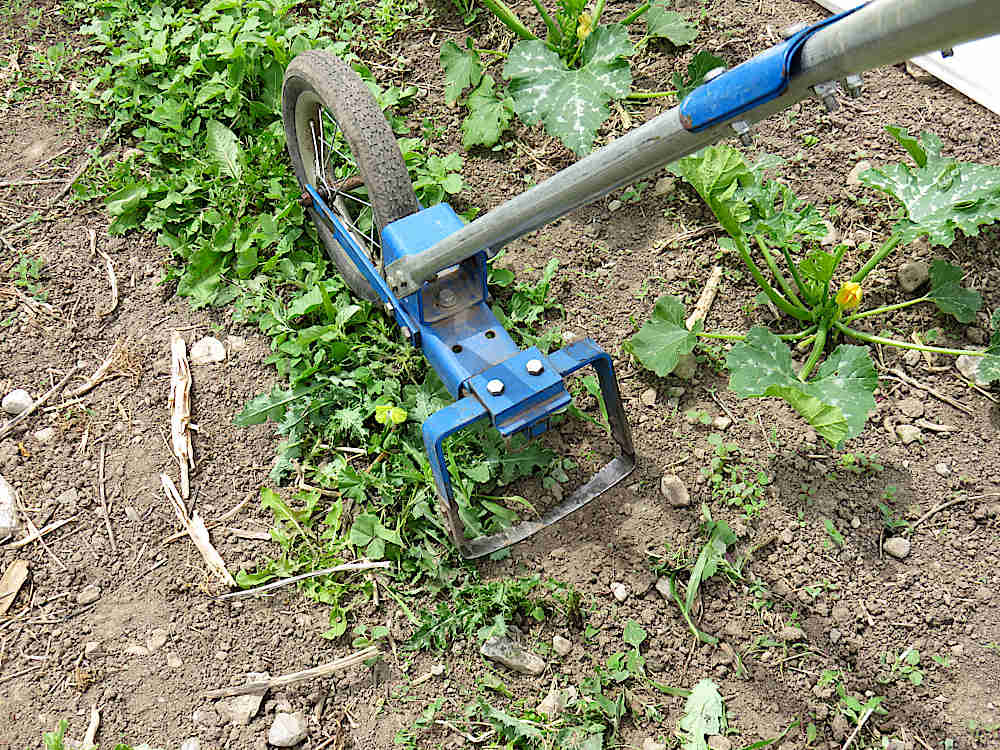
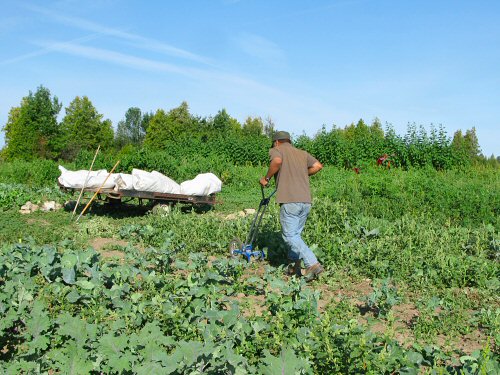
Wheel hoe in action

A tool in its element! Wheel hoes are great, and this particular one* is fantastic. Unchecked, you can see what weeds get up to given a week or two. This stretch of dirt was protected under the edge of the row cover that’s been protecting the zucchini to the right from cucumber beetles. Now there’s a dense mat of dandelion (weed or excellent salad green?: right now, weed), thistle, mallow, and lambs quarter. And there’s the steel blade that will run through them, gliding just under the soil, slicing them down. Brutal sounding, and all part of the garden balance. (The zucchini have powdery mildew, those white splotches on the leaves, which usually happens when there’s not that much sun. It can get really bad and ruin things, but usually, zucchini will outgrow it. It’s about sunny days…the weather. Another “we shall see…”)

*I got this wheel hoe well over a decade ago from Valley Oak Tool Company, one of the few companies that are a pleasure to recommend, purely out of appreciation for quality product that does its job!

After the row cover: weeding!

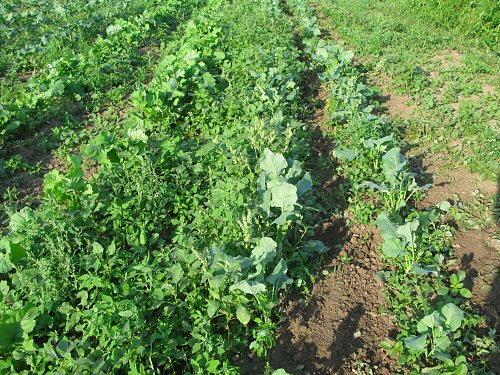
Weeding after row cover

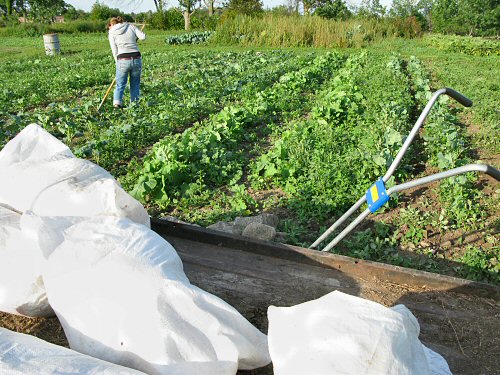
It’s been about six weeks, time to permanently remove the row cover from the last transplanting of fall brassicas! There are two sections, about 20 x 50′ beds in all, with broccoli, caulflower, cabbage, collards, kale. The cover protected against flea beetles, and at this point in the season, the FBs aren’t around much. Which leaves the post-cover weeding! I generally plan to remove the cover earlier, weed, and then replace it quickly, but this seldom seems to happen. Instead, it’s one big weed-a-thon at the end… Here, the mainly pigweed looks fairly big and dense, but it’s actually not much of a problem. The row cover has protected the ground from many days soil-packing rain, so the beds are nice and loose (it’s amazing how much rain can compact clayey soil).  Weeds come out easy! With two people, it’s a relatively quick job, 2-3 hours for a pretty thorough clean-up. We worked with a combination of hoe and wheel hoe, me doing the paths and between-row clearing, and Lynn hand hoeing in-row, between the plants spaced at 18″ (45cm)…

Each time I use the wheel hoe, I grow to love it that much more. So easy, so TIME-SAVING! It’s such a sophisticated yet simple tool, a perfect marriage of wheel, leverage and steel (you could say! :)… Today’s job is heavier work than it’s usually used for, the weeds aren’t just emerging, they’re pretty big. Rather than rolling the wheel hoe continuously down the rows, I’m cutting the weeds with a series of forward and backward strokes that either slice the plants below the surface, or pull them out, roots and all…

Clearing a path (before and after, above) in the loose soil takes maybe 3 minutes for 50′, many times faster than hoeing or hand pulling…

For this heavier weeding work, I use a fairly forceful forward stroke that travels about 1-1.5′ (30-45cm), then raise the blade to clear the felled weeds as I step forward to start the next bit…

The wheel hoe is equally good at cutting on a backstroke, which comes in handy for dense areas and tough specimens… It’s not particularly strenuous work: the blade is sharp, the wheel and angle of the handles give lots of leverage and momentum, and some part of the hoe is always in contact with the ground, so you’re never completely lifting the whole tool. Like most things I do here in the field, I’ve figured out how to use the wheel hoe on my own, by reading instructions, looking at pictures and applying my version of common sense. Techniques no doubt vary. It’ll be interesting to eventually see how others do things! Meanwhile, everything seems to work out…especially, the wheel hoe! (Wheel hoe action photos by Lynn)

Hand tools

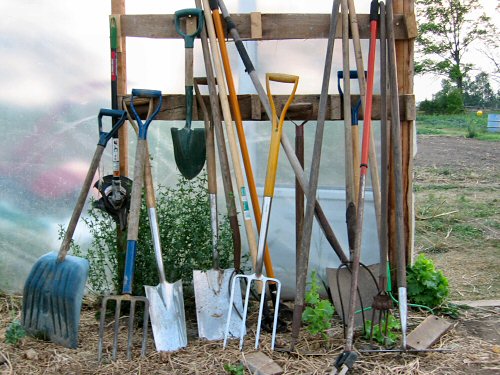
Assorted garden tools

The quick hand tool reorganization in May has worked out well, with everything staying sorted and easy to find.  Oddly this year, the hand tools themselves seem to be getting less of a workout than in the past. It only struck me today, kinda strange, so I gave it some thought. Forks are still used regularly for harvest digging, rakes for finishing off beds for seeding, but the various hoes, usually grabbed daily, have in great part been replaced by the wheel hoe! Even the Horse rototiller is getting noticeably less work. Cool. The wheel hoe has proven, as expected, to be a brilliant tool. Saves countless hours, makes tedious jobs fun. Don’t market garden without it!

Wheel Hoe Day

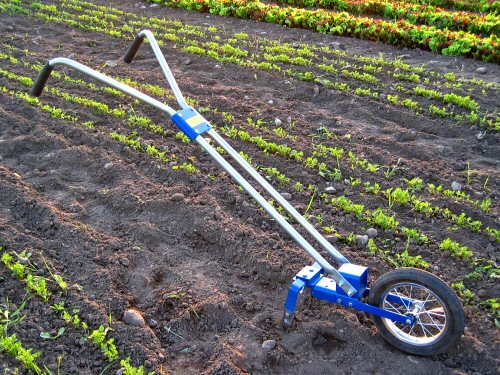
Wheel hoe

Finally, the new wheel hoe arrived today from the Valley Oak Tool Company in California! This simple and amazing garden tool is so little known in these parts, I had to order it from another country… I hadn’t used one before, but I had a very clear idea of how it should work, and it didn’t disappoint. You walk it along, pushing with minimal force, and the blade slices through the soil, beheading all weeds in its path. With ease. A slight arm adjustment translates into precise depth control, and the double-edged 8″ blade works on a back-pull as well. Even fist-sized rocks (a constant feature in this field) don’t phase it, they simply slip through the hoop. It’s at least 3-4 times faster than hand hoeing, and it matches the Horse walking rototiller for path clearing, minus the noise and gas. Amazing! (In the numerous shipping documents, I liked the note to Customs from the toolmaker, an organic veggie farmer himself: “Please let this package be delivered ASAP. There is a farmer awaiting his new tool.”)