
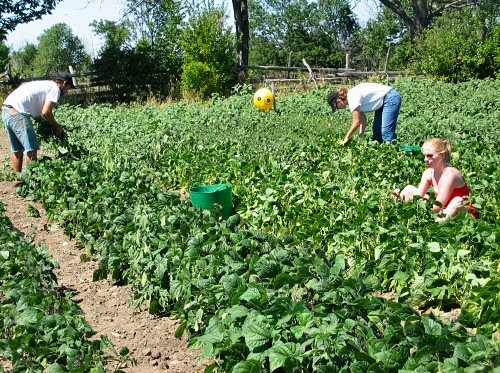
The First Shift—today, it’s Sherry and Andrea—picks Indy Gold beans in the early afternoon (Conall’s pulling weeds). On Fridays, everyone comes at different overlapping times, usually from the mid-morning on. Most Fridays so far have been sunny and hot, so I try to fit in greens in the later afternoon, anything but cutting them in high noon heat. So, it’s beans on a hot summer’s day. The Fridays have been getting smoother and more efficient every week, and so far, we haven’t been nearly shorthanded. Still, the lessons of the year of People in the Field are becoming plain, nothing startling, but made unavoidably obvious when seen first hand. The main one is, you have to maintain an equal balance of people doing general fieldwork or the weekly crop availability won’t keep up with the…harvest capacity! More on all of that later in the Fall… Today, only a bushel or so of first pick beans as we get caught been plantings, plus mesclun, carrots, beets, arugula, potatoes, chives, beet greens, a bit of kale, squash and cucumbers, and the first bushels of mixed tomatoes, along with onions and garlic from storage.
People
Farmer in field
Conall watering in mesclun in the late afternoon. Even on busy harvest Friday, plants need water if they’ve had no rain. Guest photo by Erin, with a different than usual, no less…realistic, view of the field. There’s nothing like being there to see for yourself! I cropped the photo to fit the format, but it’s the original that just catches a certain tiny farm feeling…
Pounding stakes
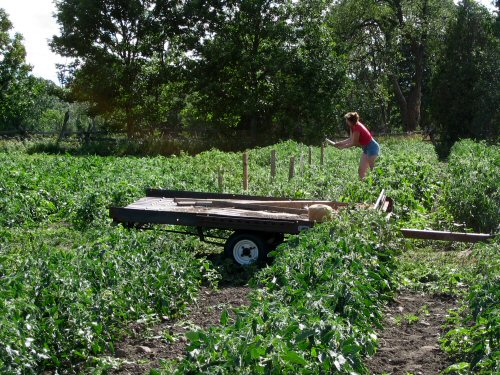
Jo pounds in wooden stakes for a somewhat catch-up version of tomato staking. I think of it as the Modified Sprawl. There are about 600 plants, with maybe 250 in home-style tomato cages. The rest are so far on their own. The cages work great, until a mighty wind comes along and blows a bunch over—they’re not really rugged field gear. It’s too late for proper basket weaving support, so it’s on to my previously tried and OK version, pulling the plants up with twine on both sides, to stakes set every three plants apart, with a bit of pruning and suckering as we go…
This is the point in the season where we start playing catch-up as a million different things need handling. It can get a little frantic, depending greatly on how it went earlier in the year. To add to the…decision-making puzzle, it’s last call, and even very iffy last call, for planting many crops (60 day maturity and under), with day length shortening and frost risk building to a significant consideration just 6-8 weeks down the road. So, thin here, or weed or seed there, or water elsewhere, you can’t do everything at once! It’s all in the timing, with much of the schedule in the hands of Ma Nature (where’s that RAIN!?!). Gambling, yes! Still and all, quite FUN.
Sort, bundle, bag
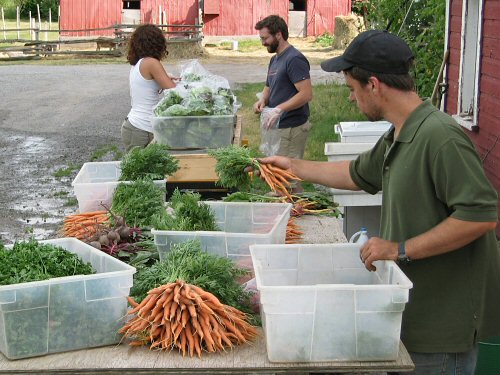
Fridays put this tiny farming system to the test, if we don’t get everything done for market and CSA shares, things would simply…CRUMBLE!!! Rain or shine, Friday is the main day for bringing in the weekly harvest, when we have to pick, sort, rinse, and bundle or bag 60-80 of everything that’s ready for the Saturday farmers’ market (about half of the CSA shareholders also pick up at the market). This week, the veggie selection is still small: beets, carrots, shell peas, green onions, mesclun, parsley. Here, at 6 pm, the picking, digging and pulling part is mostly finished and it’s mainly post-harvest action in the shade of the barn: Erin and Mike (not me, another Mike) bag and weigh just-rinsed mesclun, while Conall bundles baby carrots.
Extreme makeover
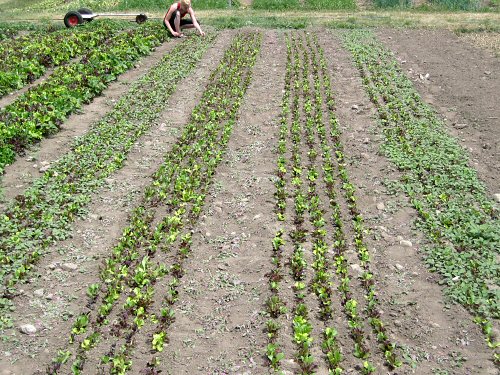
The one dark secret of this organic field, something you couldn’t really tell from selected photos, is the prevalence of pigweed (amaranth, mostly or all Amaranthus retroflexus if I’m ID-ing correctly). About two-thirds of the garden seems to be completely saturated with pigweed seed. Weeding two or three times for all-new outbreaks is common. In some spots, it’s literally as if some phantom planter is broadcasting new seed, thickly, every couple of weeks. And when it’s a closely space crop like the all-lettuce salad mix in the pic, this means painstaking fingertip weeding.
Here, Andrea and I spent about two and half hours clearing 200′ of 5-row beds, the entire latest succession planting. Luckily, conversation made the time transparent (thinking about all of the extra labor devoted just to de-pigweeding is a little painful). As best as I can figure, the pigweed came along with the two-year-old, not-fully-composted cow manure that we spread in the fall of Year 2 (three years ago). We put down I’m not sure how many, but many, tons on just over an acre—the ground was positively springy!—which was great. Except for the pigweed seed. Eventually, the vast store will be depleted (the seed is apparently viable for five years). Until then, it’s a lot of extra work… The pop quiz question: “What have those cows been eating?!”
Bicycles?!
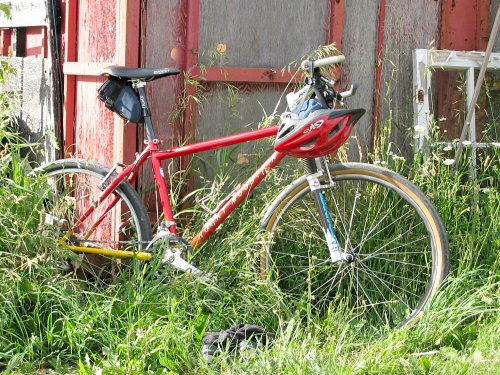
Somehow, bicycles figure quite prominently in this season of people in the field. Everyone comes in one or two days a week each, mostly from the town 12 miles (19km) away. Andrea and Jo both usually bike in and get a lift back with Conall. There are combinations of lifts, with and without bikes, lifts with bikes in and biking home… Described, it sounds even a little complicated, but people call each other to set up rides, and it all seems kinda effortless. Which is, of course…great! That’s Andrea’s bike in its usual parking space…
Farmers’ market stand described…
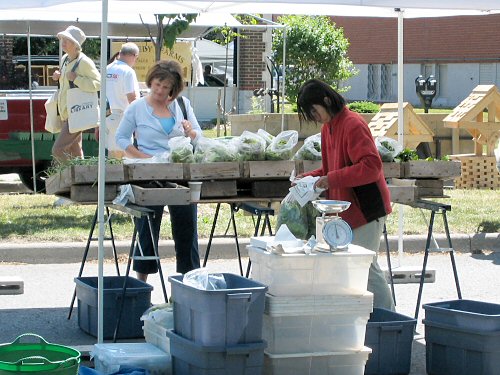
Setting up a stand at the local farmers’ market reminds me of a traveling circus, at least, the way I imagine one to be. Everything has to be compact, easily packed away in a limited space (in our case, a pick-up truck), quick to set up and tear down, and quite rugged to handle the wear and tear. There are also lots of critical bits and pieces that it simply doesn’t do to forget. Overall, the stand is a bunch of simple pieces, assembled into a functional little veggie selling spot. In this picture, taken from behind the stand, it’s near the end of a fairly busy day, with crates and big leaf bags of greens all empty, and Kikuyo the WWOOFer-for-a-week from Japan helping out.