
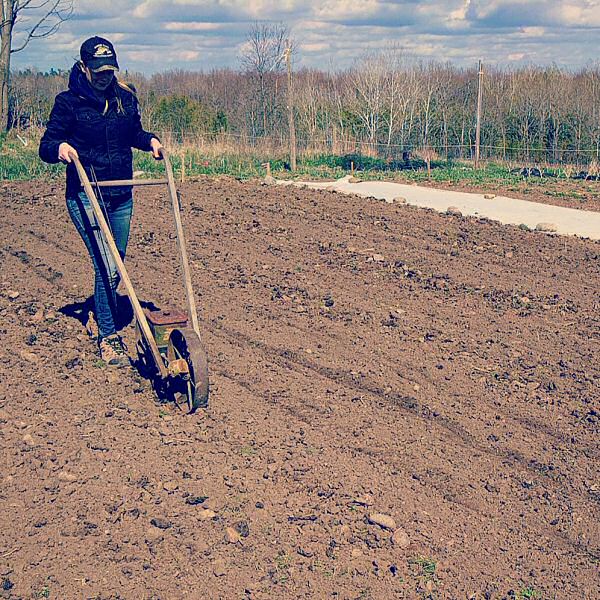
The Planet Jr. rides again. Clara learns the way of the antique seeder, having just laid down three rows of Kestrel beets. This old seeder continues to serve well!
Planet Jr.
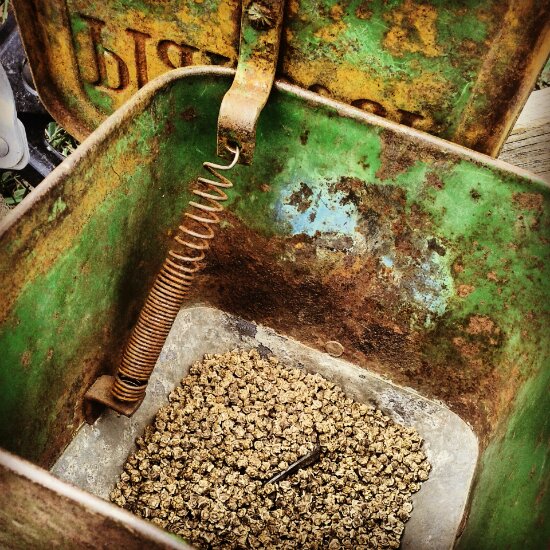
Planet Jr. rides again
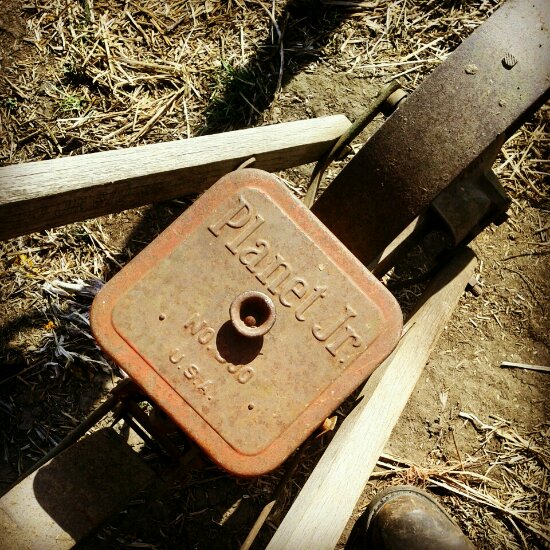
Rolled out the Planet Jr. seeder and got in a first 300′ of peas. Sugar Ann snap peas, that’s edible pod. This is just ahead of three days of colder temperatures, rain, and possibly snow. Since the weather forecast lately more often than not doesn’t even get the rest of the same day nearly right, who knows?! Still feels good to get that in. First direct seeding of the year. Yay. (Oh yeah, the new photo format is from Instagram, an app I’ve been playing with on my phone, kinda like Twitter for pics. And I started this post from my phone, but finished writing it on the laptop. Technology: enjoy it while you can! Hahaha. :)
Well-thinned carrots, growing well!
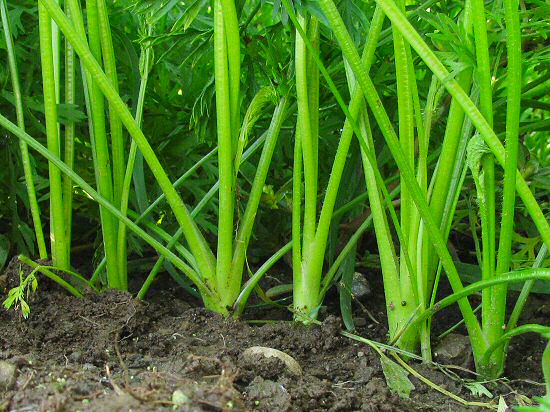
Checking in on the fairly massive time investment we made in thinning 800′ of late-planted Touchon carrots—and it’s paying off! Not that there was any doubt that thinning works, it’s just so…tedious. After laying down carrot seed thick (in other words, after using the Earthway seeder), we spent hours removing thousands of extra seedlings. Because these guys went in so late, I wanted to give ’em every shot at making the best of good weather and sizing up while they could. Now, the effect of 1″ (2.5 cm) spacing really shows. We still kept them pretty tight, thinning a few short stretches to 2″ (5 cm) for comparison, but mostly did them like this, aiming/hoping for a big yield of fairly slender full-size carrots towards the end of October. You can see, second from right, a little one that escaped. It may seem obvious, I’ve found appropriate spacing is easy to overlook or downplay. When you’ve actually seen the massive difference it usually makes, it’s hard to ignore! Think better seeder. :)
Planet Jr. rising
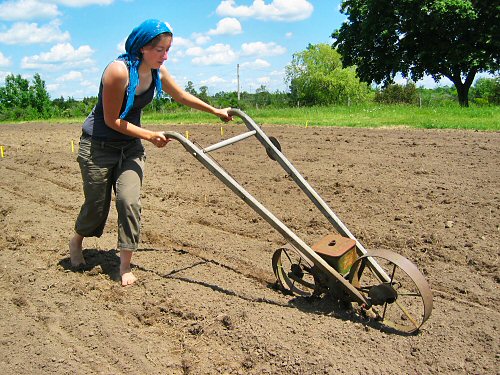
This year the antique Planet Jr. seeder finally took over from the Earthway, to handle most of the direct seeding. We’ve been using it for everything but tiny carrot and lettuce seed, where the lighter Earthway is easier to maneuver for closely spaced rows. Here, Lynn rolls out a third planting of beets, no problem. The PJ is heavy and initially hard to handle, but also more precise, uses way less seed than the Earthway, and lays down a well-packed row. And the choice of 60 or so seed holes, at first a pain, turns out to be a great way to appreciate variations in seed between varieties and fine tune seeding rates—we used three different openings to best fit three types of beet (Golden Detroit, Chioggia, Kestrel). It’s great. With this well-aged Planet Jr, old turns out to be our new and improved!
A field day
At this point in the season, EVERY day is a field day, unless it’s totally rained out. Today was no exception. Lynn brought a couple of friends, Julia and Tom, to check things out and lend a hand. They’re off to work in one of our fine parks this summer, but wanted to see what was going on on this tiny farm. No problem!
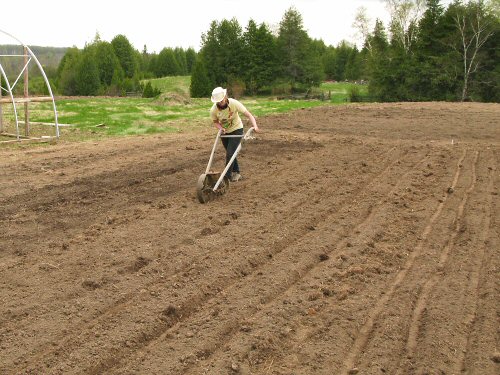
I seem to’ve gotten pretty good at tossing people into the tiny farming action, with little work-up or ceremony. A quick tour around (and here, there’s not much to see just yet), and it’s on to the hands-on. Neither Tom nor Julia had experience with market gardening, but in no time, they were seeding with the seeder of the day, the trusty and heavy Planet Jr. (above). We’re doing a second planting of spinach, and a third of peas…
The Planet Jr. can take a little getting used to, so there I am, explaining how it works as we go! Knowing exactly what a tool is doing and why really makes learning to use it so much more…satisfying. I think.
Just about EVERYTHING in tiny farming is quite simple and straightforward (there’s just a LOT of simple things to know!), still, some people have a natural talent for this or that. Like, Tom can clearly walk a very straight line as he measures off more beds for onions and peas. The current bed marking method: measure and stake the path centers at both ends of the bed, and walk ’em in! It’s pretty simple.
For getting your hands dirty, there’s nothing quite like crawling along in the dirt, pushing Stuttgarter-type yellow cooking onion sets into the ground, six inches (15cm) apart, by the hundreds. Once you get into the rhythm, you can sow and chat, and things get done in no time! All in all, relaxing and productive day in the field. Fun and useful, I hope, for all! (Photos 2, 3 by Lynn.)
Direct seeding
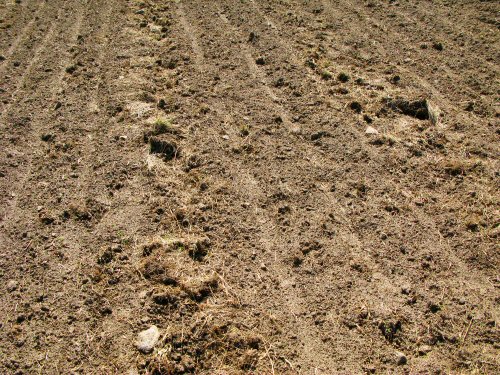
Direct seeding is going ahead at a careful pace. There’s a fair amount of broken up sod in the mix, and it would be nice for it to have more time to settle in and decompose, also for any bits of live grass to start poking up so they can be disrupted again with a light tilling… But we can’t just wait around. Spinach, beets, and radish went in a few days ago, just after the first peas. More peas went in yesterday (Connor for the first time wrestles with the kinda heavy and unwieldy Planet Jr., above, and ends up doing fine on a trial row). Now, the watching and waiting is on for the first plants to emerge in the field…