
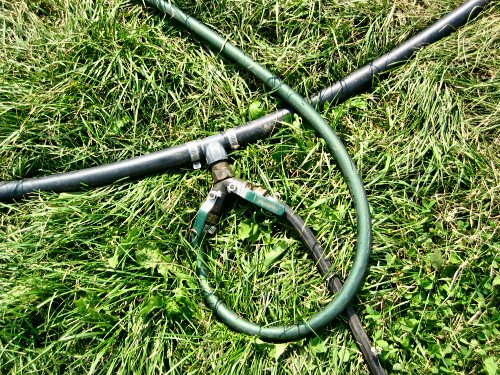
We’ve been watering heavily (well, as heavily as our gear allows) for what seems like weeks. Rain has been teasing us, 5mm a few days ago after an impressive, all-day cloud build-up; last night, 2mm following a brilliant extended lightning show and promising bit of a shower that soon faded away. It’s terrible. Conall has been honing his newly acquired hose rigging and sprinkler positioning skills. For heavier watering, the set-up begins at the pond and continues along a 1″ pipe (a little small, but it’s what I have from Year 1, intended for the much lower capacity barn well) that runs the length of the field. Water arrives through a series of shutoff Y-valves and from the valve of the moment snakes through up to 500′ of 5/8″ garden hose. (Fluid dynamics is something I should apparently be studying, to get a grip on the water-reducing effects of our often convoluted hose, valve and quick coupler combinations.) The hose leads to sprinklers (never too efficient, and quite a waste with anything above a hint of a breeze) and soaker hoses (MUCH better, but a pain to run up and down beds and then move again). The pump can deliver only so much, so it’s a multi-day rotation of gear to get around the entire field. The golden upside: WATER to the crops!! It’s amazing how much energy half an hour of heavy rain can save…!
Year: 2007
Burlap method strikes again!
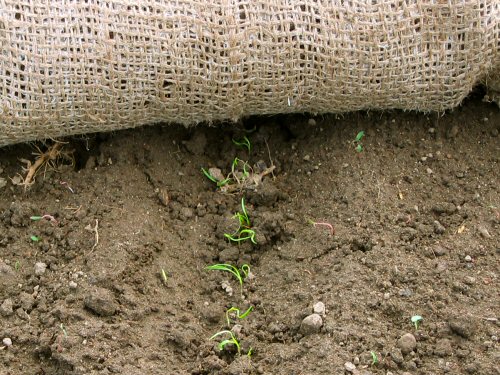
The carrots-under-burlap germination method is now 3 for 4, with this fine performance: solid rows and almost no weeds! The third attempt failed miserably with three different varieties, mainly due to underwatering (the extra drying effect of a very windy week wasn’t given proper respect) combined with using the Earthway seeder’s light carrot plate, which puts down much less seed (what a bad idea, I fall for the allure of little or no thinning every few plantings…). Anyhow, it was back to the regular seed plate and proper checking and watering, and now, a new 800′ of Nelson and Touchon is on its way (although, something’s been munching on carrot seedlings lately). Never dull! :)
Pounding stakes
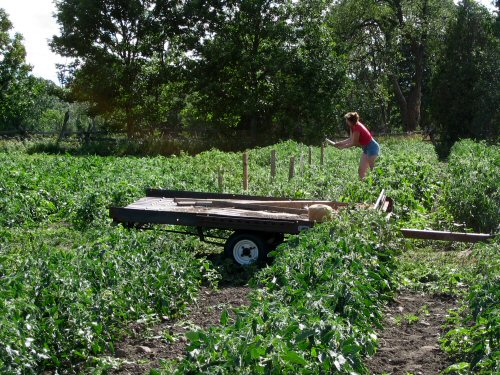
Jo pounds in wooden stakes for a somewhat catch-up version of tomato staking. I think of it as the Modified Sprawl. There are about 600 plants, with maybe 250 in home-style tomato cages. The rest are so far on their own. The cages work great, until a mighty wind comes along and blows a bunch over—they’re not really rugged field gear. It’s too late for proper basket weaving support, so it’s on to my previously tried and OK version, pulling the plants up with twine on both sides, to stakes set every three plants apart, with a bit of pruning and suckering as we go…
This is the point in the season where we start playing catch-up as a million different things need handling. It can get a little frantic, depending greatly on how it went earlier in the year. To add to the…decision-making puzzle, it’s last call, and even very iffy last call, for planting many crops (60 day maturity and under), with day length shortening and frost risk building to a significant consideration just 6-8 weeks down the road. So, thin here, or weed or seed there, or water elsewhere, you can’t do everything at once! It’s all in the timing, with much of the schedule in the hands of Ma Nature (where’s that RAIN!?!). Gambling, yes! Still and all, quite FUN.
Milkhouse looking out
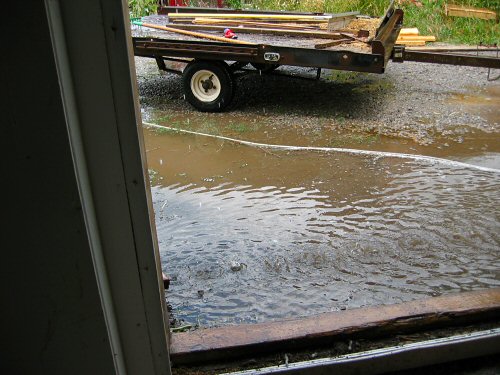
The view out of the extended Milkhouse sliding door is not yet a great one—gotta move the big storage shed that blocks the view straight out to the field—but it’s become a common one this year. Amongst other things, the Milkhouse is a place to take refuge from extreme heat and, very occasionally, from…rain. And the extreme teasing continues. The latest is rain from INDIVIDUAL CLOUDS in an otherwise largely clear blue sky, that comes down just heavily enough to make you take shelter. A gutter hasn’t yet been installed at the front of the Milkhouse, so water streams down from the roof, which picks up more from the main barn roof, creating a deceptively abundant pool in no time. Actual rainfall for this little session: 2mm. (The tiny grey hose running across the pic is the original lifeline from the barn well to the field that in the first two and a half years was all that supplied water when the weather didn’t!)
Freshly dug garlic
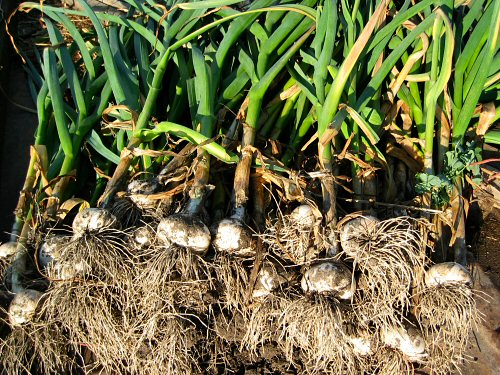
To add variety to this week’s CSA shares, I dug up 50 garlic a little ahead of the main harvest in a week or two. It’s looking great. Uncured garlic doesn’t store as well, but how long are you gonna let a single bulb of garlic hang around?! Really, there’s no such thing as too much garlic!
Red onions, golden beets
Veggie variety is great: different tastes, textures, shapes, colors… From the start, it seemed only natural to grow several varieties of each crop rather than just the most “efficient” one. This has worked out to at least a couple per crop (this year, two types of spinach so far, three potato, two corn…) to many (at the extreme end, 50+ varieties of tomato). The biggest difference is quite often in maturity date: crops fairly similar in taste and appearance can be two or three weeks or more apart in maturing for harvest. Sometimes the difference is only skin deep. The Red Baron spring onions in the pic are only red for a couple of layers, but they look great when you get ’em. The Golden Detroit beets taste a little different from red varieties, but the fun (for me, at least) is mainly in the striking and unusual golden-orange flesh. Look before you eat!
Pigweed: going in!
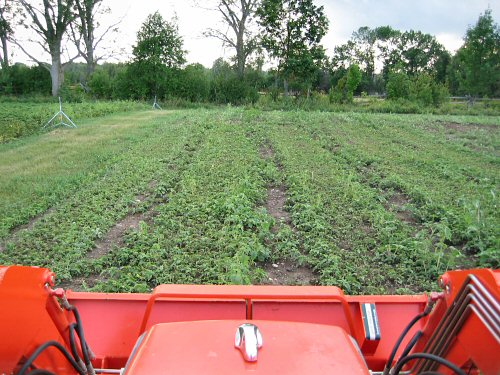
There’s no exaggerating the amount of pigweed in some sections of the field. Here, where the last seedings of spinach and peas failed—really poor germination in the heat—pigweed happily took over in no time. I mowed it down, and now I’m going in with the 48″ rototiller, prepping for fall spinach. Ideally, I’d keep the rototilling and any heavy gear off the garden beds, but this is practically an emergency. I apply the in-moderation rule here… It’s growing on me that round about next year, much of the pigweed seed, deposited three years ago in two-year-old manure, is due to expire… Right now, though, the seed seems pretty healthy to me.