
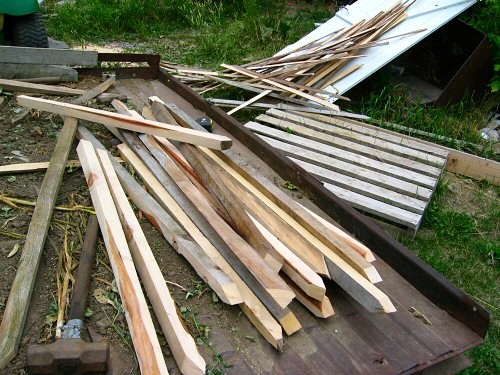
In the building and fixing department, there’s always a queue. Jobs are usually one of three degrees of urgency: Right Away (fix it or we can’t go on!), It Would Be Really Good To Have This Done Soon, and When There’s A Little Extra Time (and that’s often, all the way to Fall). Today, it’s finishing a Right Away job: making up more wooden stakes for the tomatoes. Last year, I bought for very cheap a pile of scrap wood, 10-12′ lengths, rough cut to around 2″ square, from a local sawmill. This year, we found pounding stakes made from this stuff a foot or so into the ground took an insane amount of sledgehammer effort, especially when driving into dry soil. Cutting them down just a bit made a HUGE difference. Using a table saw out in the barn yard, we shaved about 1/2″ lengthwise off each width, winding up with maybe 80 1-1/2″ square stakes. It took a couple of hours overall to save many more in the field, not to mention energy, sweat, frustration. The little things do indeed make all the difference! (Also in the pic, painted white, an old door scrapped during the Milkhouse Extension, and a nice, solid pallet (probably from the seed potato delivery), both to be reused in the composting toilet enclosure, an IWBRGTHTDS project.)
Year: 2007
Hauling garlic
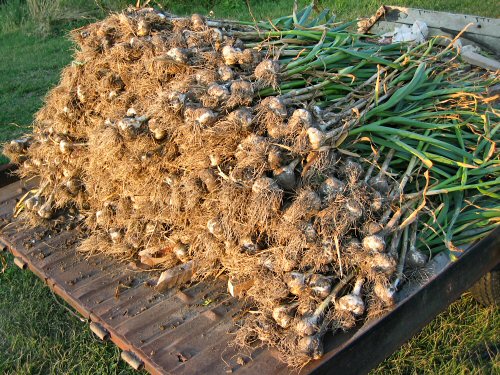
Today, we started bringing in the garlic. A gentle loosening of the soil with a digging fork—don’t spear those bulbs!—a gentle pull, and it’s done. When to harvest is a bit of a toss-up, at least, as far as I’ve made out from my three years of garlic growing. The general indicator of leaves dying off is a start, but I’m a little wary from last year’s harvest, where the garlic left only a week or so into August, with half the leaves still green, gave up a whole lot of split bulbs (the cloves began pushing back and the skin at the top split open). So now, I dig up a few, and if they look good, it’s time to harvest! This first haul is about a quarter of around 2,400. It’s off to the barn for curing in small stacks. The rest should be done in the next few days!
Supporting tomatoes
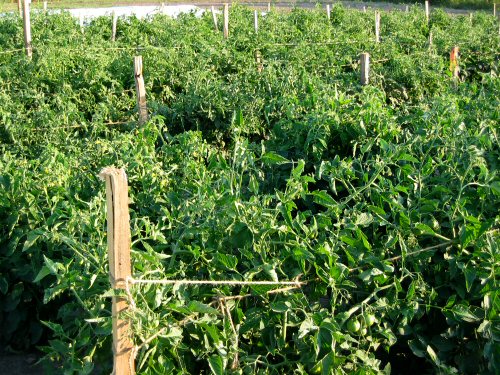
Time is tearing by, and there’s still lots more tomato-supporting work to be done, but it’s coming along. The good thing about my for-now semi-sprawl method is that it can be done reasonably effectively quite far along. The toms are indeed starting to really sprawl, but we still have a week or so when pulling them up is fairly easy and it will keep the paths clear and the fruit off the ground. Off course, stringing them together from both sides does make for a dense mass of tomato plant, but a bit of quick pruning and it’s better all around than without! We’ll see for sure over the next few weeks of tomato harvest…
The Friday harvest
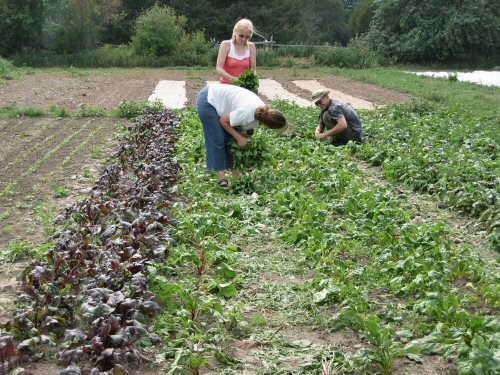
If it’s Friday… This week’s big harvest was the smoothest yet, with everything in, sorted, rinsed, bundled, bagged and COUNTED by around 8:30 pm. The crew this week: Sherry, Andrea, Molana, Lynn, Cezary, Conall and me. I’m over being slightly unnerved by the number of people—my reflex is still to wonder, “If I had to, could I do it all myself?”, but now it’s also…no worries, it’ll get done! Here, Andrea, Sherry and Cezary harvest beet greens, thinning at the same time. (And that’s last plantings of more beets to the left, carrots up top under burlap, and summer squash under row cover off to the upper right. Demolished pigweed strews the path.) In today’s harvest: beets, beet greens, eggplant, mesclun, arugula, carrots, green onions, potatoes, 60-80 units of each.
More on the carrot-burlap method
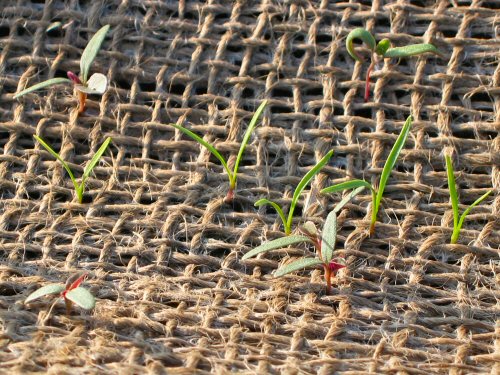
From the last carrot planting of the year, a new development in the burlap method! The variety is Nelson, and germination in less than a week was so vigorous, the seedlings came right up through the fabric, where in all previous seedings, they remained scrunched under. I’m not sure whether the burlap wearing down and loosening up helped this effect, or that there may have been less of a gap between burlap and soil due to a shallower seed furrow. In any case, it’s working better than ever! Rolling up the burlap, the seedlings slip through with ease, while most of the little pigweed emerging alongside get yanked by their aggressive leaf growth. Perfect!! (Clearly, I have carrots and pigweed on my mind…)
The end of July
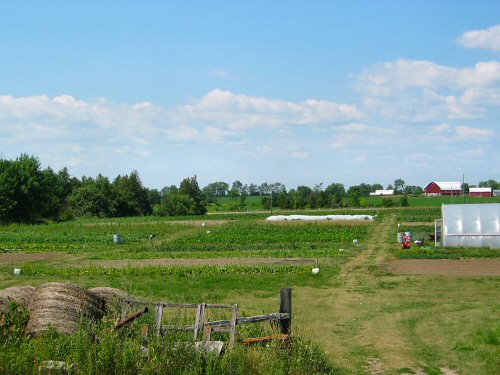
From the gangway to the upper level of the barn, the View shows the new, unusual pattern of the field as summer progresses: less veggies! Compared to barely a month ago, the difference is clear. And it’s even more striking when you walk through. What’s happening is, with this year’s more intensive planting and harvesting, larger sections are finished earlier than in previous seasons. I don’t find this pleasing: too much emptiness, where crops should abound—it’s not the main season fullness I remember (although even now, there is still more upcoming yield out there than ever before)! That’s the way of the busier market garden. And according to the plan, this year’s first organized fall cover cropping—oats, winter rye—should actually fill up the emptied sections, starting in August. I guess you’d call that positive progress, though I still take great, simple pleasure in seeing pure abundance in the field. Not logical, but there you go!
Peppers…
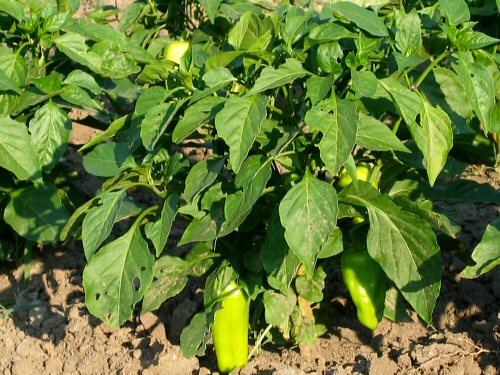
It’s all joy with the peppers (and eggplant). Here, Gypsy sweet peppers put on size and begin to peek out. In the past, these two crops barely made it in, if at all. I planted the varieties, but for eggplant, only the very early Dusky produced satisfying yields toward the end of summer, and peppers made it in decent quantity last year because of the freakishly extended warm weather that went into October. The reason is no mystery: doing the transplanting mostly alone, I’d get to peppers and eggplant last (they’re not prime farmers’ market sellers); this year, they got a good week or more head start. So we have the fruit of extra labor (and pretty good pepper-growing weather)—straightforward and…satisfying!