
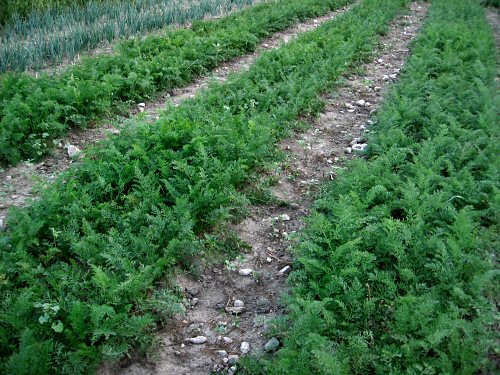
We’re just starting on the second planting of carrots, and green onions as well. It’s the standard four rows (200’/61m) to a bed, which goes a long way. Depending on thinning, and of course, the weather and amount of irrigation, anywhere from one to two feet of a single row of carrots makes up a 1-2 lb bunch, so that’s 100-200 bunches per bed. Here, it’s Nelson, Purple Haze and Touchon, with Ramrod onions up in the corner, and another bed of Nelson out of sight to the right. Once they work through germination and tiny seedlings being eaten issues, carrots around here are a carefree, low maintenance garden veg, a pleasure to host (and munch)!
Year: 2007
Pulling onions
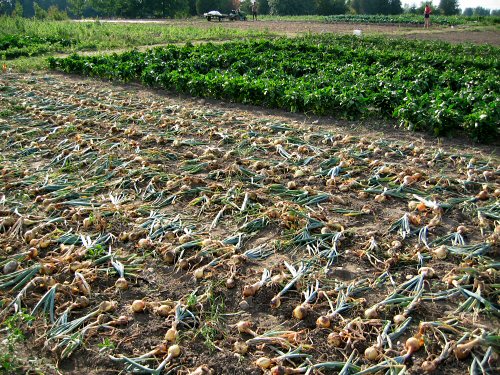
Started the full onion harvest today. This is about half the crop, pulled and layed out to dry (although, with NO RAIN, drying is hardly an issue). Above, it’s peppers and eggplant; at the top left, an almost depleted section of Yukon Gold potatoes with a scraggly weed cover that needs to be tilled in. The onions will be topped, put around half deep in the old style wooden bushel baskets (lots of air, no sweating), and set in the barn to cure. Once again, this year I took the easy way with onion sets, which limits my selection and also seems to produce flatter rather than rounder bulbs. Here it’s the usual two: Stuttgarter yellow cooking and Spanish Yellow (that’s apparently the variety name). Next year, it’s gotta finally be onions from seed! For now, nothing fancy: strong, flavorful onions that bring tears to your eyes!
Mesclun on my mind
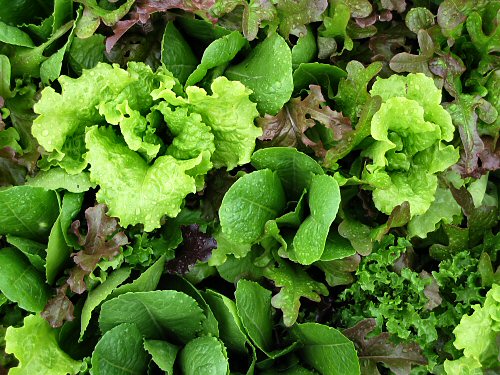
Mesclun remains the mainstay crop on this tiny farm. What I grow is perhaps not strictly “mesclun”, it’s nine varieties of lettuce with no other, more exotic greens—arugula, mizuna, and so forth—mixed in. Also, at times if it gets away a bit, the leaves can be kinda large, making it more of a basic salad mix. Still, it’s all mesclun around here, and this year particularly, we’ve grown LOTS. Salads are popular, and for no reason easily explained, the acceptable price at our farmers’ market is way higher than for any other crop (except, perhaps, blueberries?!). It’s a top seller on market day, it’s dead easy to grow, most of the time, and none of the other, larger local growers bother with it (only one other farm regularly has lettuce). So it’s an all-around winner. Then there’s the big BUT: hot, dry mid-summer weather, when the germination rate is usually terrible, the beds grow rapidly and are hard to time, and the heat can easily turn a fine, fresh-tasting crop into a messier, partially bolted bit of a nightmare. Simply seeding in many extra beds isn’t a solution, because the watering and weeding this would require would be insane. You simply have to keep planting moderately and frequently, and hope for nice weather breaks. Shortages are inevitable, and cut directly into customer satisfaction (expectations, expectations!!). For these reasons, at this time of year, mesclun is always on my mind. For the last couple of plantings, we’ve used…BURLAP for the first few days after seeding, which actually works, reducing watering in time and increasing the germination rate quite a bit. Next year, I intend to finally figure out an even better way…
More bean harvesting action
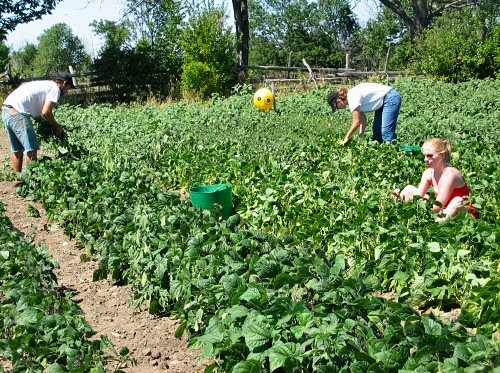
The First Shift—today, it’s Sherry and Andrea—picks Indy Gold beans in the early afternoon (Conall’s pulling weeds). On Fridays, everyone comes at different overlapping times, usually from the mid-morning on. Most Fridays so far have been sunny and hot, so I try to fit in greens in the later afternoon, anything but cutting them in high noon heat. So, it’s beans on a hot summer’s day. The Fridays have been getting smoother and more efficient every week, and so far, we haven’t been nearly shorthanded. Still, the lessons of the year of People in the Field are becoming plain, nothing startling, but made unavoidably obvious when seen first hand. The main one is, you have to maintain an equal balance of people doing general fieldwork or the weekly crop availability won’t keep up with the…harvest capacity! More on all of that later in the Fall… Today, only a bushel or so of first pick beans as we get caught been plantings, plus mesclun, carrots, beets, arugula, potatoes, chives, beet greens, a bit of kale, squash and cucumbers, and the first bushels of mixed tomatoes, along with onions and garlic from storage.
Late morning at the farmers’ market
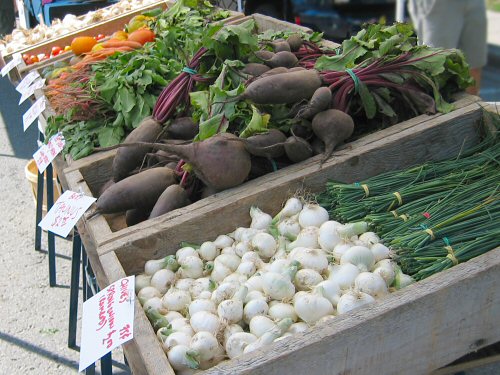
Beautiful weather and average traffic today at the market. Here, it’s late morning, with peak sales over. It’s been one of those days when what I’ve noticed most is the pressure to price low. In general, my veggies are priced a little higher than most of the other market vendors. Regular customers have no problem with this, apparently they find that succession planting, different varieties, and fresh, day-before picking are worth a premium. These are advantages of really tiny farming, but they have to be appreciated for it all to work. The biggest veggie vendor at this farmers’ market buys from other growers, comes with a big box truck and forklift, has at least half a dozen sales people, and competes on price with the supermarkets. At times, it’s hard to ignore the stacked playing field, the unnaturally low fresh produce prices we’re accustomed to, at least, here in North America. Oh well, it’s no-rain, dog days of summer thinking…quite a normal part of tiny farming. :) There’s no shortage of challenges around here. Put in perspective, they’re what keep things exciting!
Tomatoes
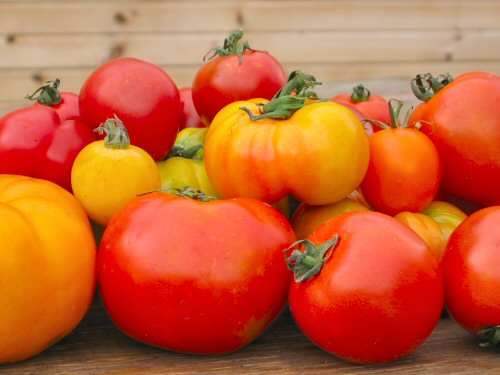
Taking a break during a drizzle (it’s not RAIN, and I doubt it’ll turn into it either), I piled up a few leftovers from Friday’s tomato harvest. The mid- and main-season toms aren’t yet ready, so we picked what we could, and didn’t keep track amongst the 50+ varieties. Still, I can recognize most of ’em. There are smaller and larger heirloom Striped Germans (yellow with a beautiful red blush), the large round one in front is Polfast, a new early hybrid that isn’t behaving that early, the smaller reds are Stupice, there are a couple of red cherries, sliding in on the left is Tangerine, and more… Notably absent are the black tomatoes (Cherokee Purple, Black Krim and the others), with their distinctive deep green to earthy red coloring—the few that were ready were sold or eaten! The little yellow cherry tom nestled in the middle on the left was actually given to me yesterday at the market; called Garden Peach, it has a fuzzy peach-like texture, and great taste (I had a couple!). If I can’t find it in the catalogs, I’ll save the seed and hope for the best.
Purple Haze
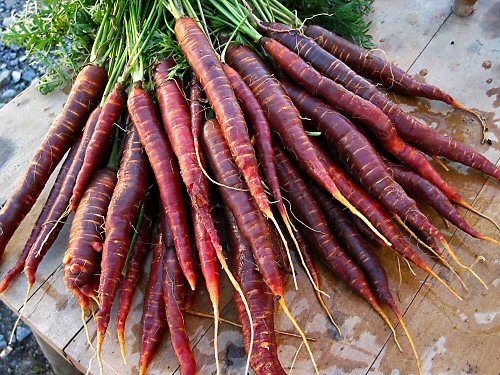
When yet another person asked for the “purple carrots” at last Saturday’s farmers’ market, I realized they had moved up from alternative variety to mainstay status, alongside Nelson (hybrid) and Touchon (open-pollinated heirloom). That’s kinda cool, considering how orange and carrot go together around here. This is the second season that I’ve harvested PH for market at least every two or three weeks.
This year, I’ve included PH in every carrot planting (five so far, one a make-up for bad germination), and despite one bad showing, germination is overall as reliable as any of the others. Once established, PH has been great in our rather heavy clay-loam soil, growing straight and performing well even when a bit crowded.
Purple Haze is an imperator-shaped carrot (thick at the top, tapering to a point, cartoon carrot-style), with an orange core, and retains its purple color even through light cooking (it gets darker and less purple with full cooking). And it consistently tastes great—raw, it has a distinctively dry, refreshing crunch, and it’s always sweet as well as…carroty.
It’s a hybrid (I intend to try Purple Dragon, which I’ve had my eye on for a while, apparently an heirloom, but the seed is crazy expensive…), grows to 10-12″ (25-30cm) in 65-70 days, was an AAS winner (best of the best new varieties) for 2006, the year it hit seed catalogs here.
The bunch in the pic, pulled for today’s last couple of CSA shares, are from the second planting and just starting to put on size. And, yeah, they’re named after the classic Jimi Hendrix track!?! “‘Scuse me while I kiss the sky…” :)