
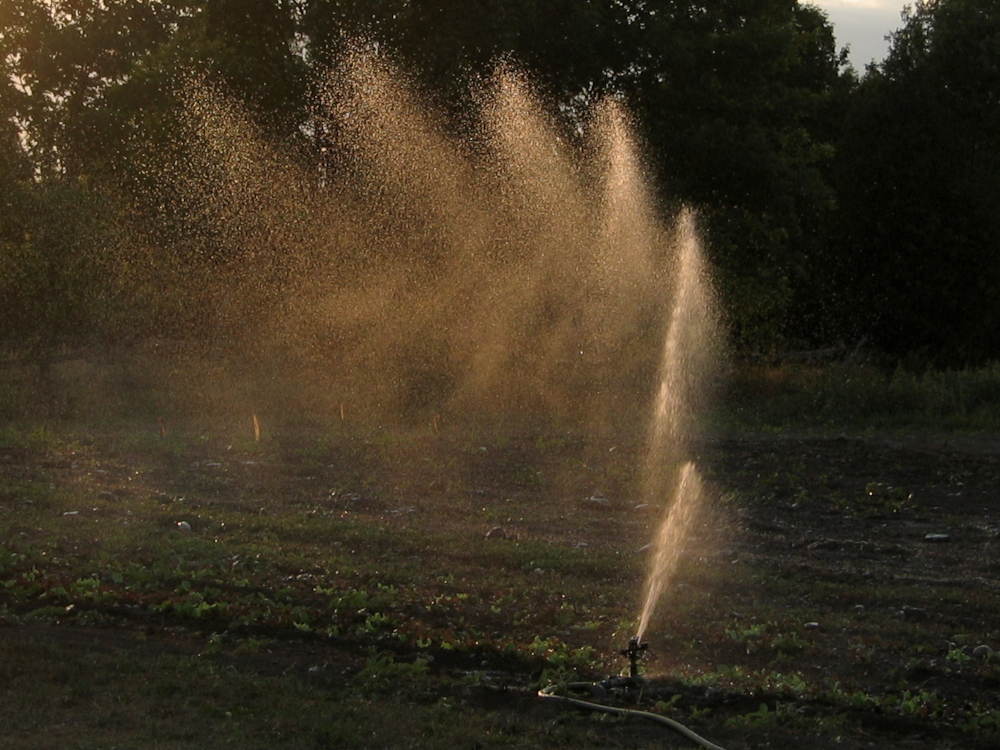
It’s supposed to rain tomorrow… I’m as skeptical as ever, still, as illogical as it is, you figure it’s gotta rain EVENTUALLY, so the longer it’s been, the more accurate the latest “60% chance of showers” forecast must be. Until then, we continue the piecemeal irrigation effort, with a combination of sprinklers and soaker hoses. The pond level is noticeably down, but bottom still isn’t in sight…and it’s gotta rain soon, right!?! :) Here, the latest beds of mesclun and spinach get their daily sprinkle. You can see by the fine mist in the air how easily much of the water can be lost to even a slight breeze, and to evaporation under a hot sun. Still, soaker hoses are only practical for larger standing crops, and pretty near useless for keeping newly seeded beds moist. From the pond pump, we get enough pressure to run four or five sprinklers and have 500′ of soaker hose set up, which means two or three of 40 sections can be covered at once. It takes a couple of hours to put down maybe 3/4-1″ of water. And the majority of days, we have to do early morning and evening sprinklers only, because of wind in the day. So, lots of moving hoses around… Next year, I’ve gotta figure out a drip irrigation solution…
Year: 2007
Pigweeding and local food

In the foreground, a pigweeding throwdown with the crew of the day: Eoghan and Alison (trying out a little tiny farming for the first time), Jo, Mami (our second WWOOFer, also from Japan), Conall. Everyone pull! (The most alarming giant pigweed specimens had already been ERADICATED by the time this photo was taken!) In the background, a house on the subdivision to the east of the garden field (it was severed from the farm years ago), home of our nearest CSA member. Their veggie farm for the season is literally a stone’s throw away—local food doesn’t get closer than that!
Cherry tomatoes
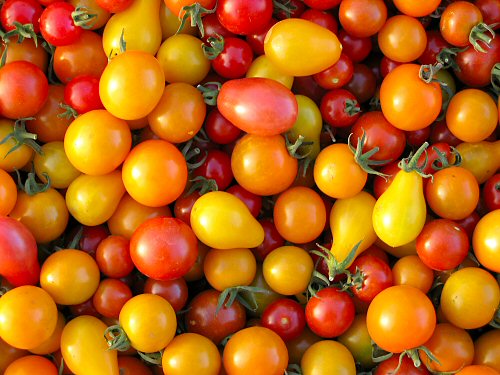
Life imitates…candy! Picking cherry tomatoes may take forever, but it’s totally worthwhile for both looks and taste. This is newer tiny farm thinking for me. In my concern for quantity, having enough every week for market and CSA shares, I tended to favor things that grew BIGGER. Kinda primitive-practical (and I’m still biased against baby veggies, like tiny scallopini squash—just give ’em a couple more days, no?! :). Only last year, I finally expanded the cherry selection from a couple of standard round, red varieties to a fair mix of heirlooms and modern hybrids. Today’s assortment includes Golden Cherry, Red and Yellow Pear, Ildi, Red Currant, Chadwick’s Cherry, Matt’s Wild Cherry, and Sweet Baby Girl. There’s supposed to be Green Grape in there, maybe they were passed over because they didn’t look ready to pick!
Harvest board
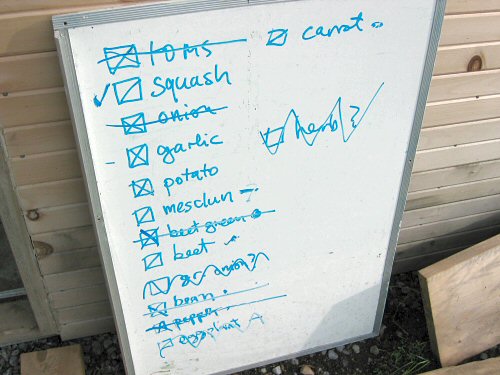
At some point on Thursday evening or Friday morning, I print out the harvest list on, of all things, a dry erase whiteboard! The last time I saw these things in action, they were lining walls floor to ceiling in trendily makeshift loft-style offices in big cities during the original dotcom frenzy. Then, they were covered with all kinds of wild brainstorming notes and diagrams for generally harebrained Web schemes. Now, it turns out they’re also perfect for listing veggies ready to be harvested. They’re fun to write on, quite impervious to a little runaway rinse water, and when it’s all over, easy to wipe clean with a damp cloth and start again! On busy harvest Fridays this year, the harvest board’s been the main way to stay on track, a step larger than the index card in an overall pocket that I used to use when harvesting on my own. Without a list of some sort, it’s amazing how you can forget an entire crop when racing against sundown. And there’s a little markup system: X in the box means harvested (half an X means maybe need more), a strikethrough line means fully sorted, rinsed, bunched or bagged, and counted. A simple and effective tiny farming tool, although a classic chalkboard would do as well!
More from the Market
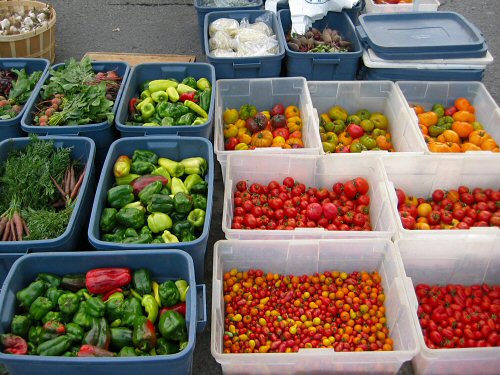
Today’s wares set up behind the stand at the farmers’ market. First thing in the morning (that’s around 7 am), we open and arrange all of the crates and use them to stock the stand and assemble CSA shares. Here, we’re partway into the morning—as the day progresses, crates get stacked. Visible in the pic, an assortment of mainly heirloom tomatoes, carrots, assorted sweet peppers (we picked a lot of ’em green before turning to red rather than let them shrivel in the near-drought conditions), various beets, garlic, and green and yellow beans pre-packed for the CSA. As for the traffic, the day was on the quiet side, despite great weather—it seems the fresh, local, organic trend so pumped in the media this year, and apparently somewhat sweeping the cities, is taking its time hitting the countryside. All in all, though, a decent Saturday!
Pigweed piled high
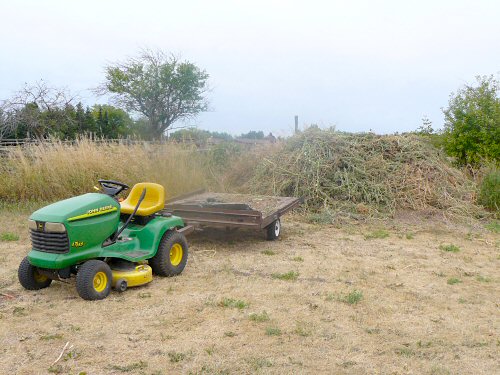
A vast repository of uprooted pigweed is collecting by the wagon load in the southwest corner of the field. It’s crazy the amount of effort that’s been put into pigweed pulling this year, that in addition to hoeing and tilling in younger specimens. The pigweed pile has already achieved almost surreal dimensions and a fascination all its own. I stop and gaze at it on the way by… What can I say? PIGWEED!!!!! Guest photo by Mami.
New view of the field
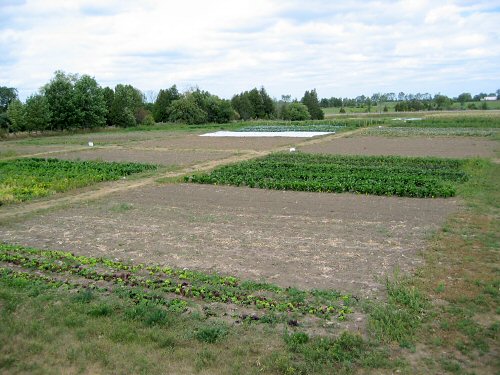
A new view of the far end of the field, taken from on top of the soon-to-be-roofed farm stand. The garden looks shockingly half-empty to me, but in fact that’s only due to being more on top of cleaning up finished sections than in years past. Also, most of the current crops happen by this year’s rotation to be way at the top: squash, corn, tomatoes, brassicas, and the last two plantings of carrots and beets are off in the distance. I’m broadcasting oats into the empty sections and hoping for WATER to fall like manna from heaven so there’ll be a decent amount of fall growth. Lots of clouds but still no rain…