
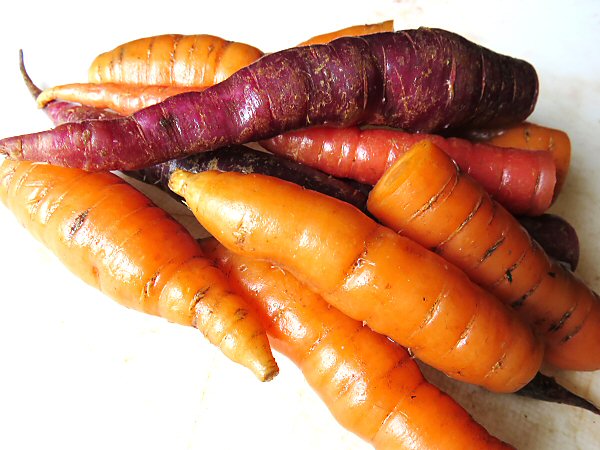
Long-term veggie storage can get fairly involved, with root cellars, sticking things in piles of sand, adjusting humidity, spotting and culling the spoiled, that sort of thing, or it can be as simple as tossing a plastic bag of small carrots, little guys that wound up at the bottom of an empty market bin, into the fridge’s crisper drawer, and forgetting about them until they’re found four months later while rooting around for ingredients for stew. These carrots represent exactly the latter, a few handfuls of Nelson (orange), Red Samurai, and Purple Sun. They’re in perfect shape, crunchy and tasty—the plastic bag maintains the humidity that keeps them hard—so a quick rinse, chop-chop, and in they go. (They’re partly cut because I’d already started slicing them when I decided to take a pic.) Another whatever-veg-is-around beef stew. What could be simpler?!
Year: 2016
Spring begins with the weather!
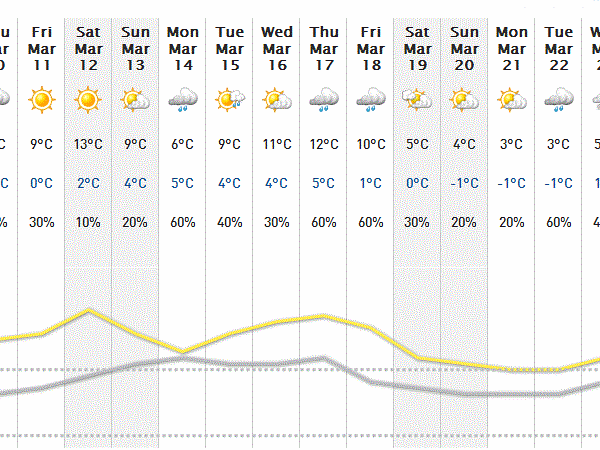
There’s official calendar Spring, and then there’s spring in the field, that ignores exact dates and goes by the weather, marking winter as over whenever the freezing temperatures end. If today’s two-week weather forecast is anything to go by—it is, in this case, when being off by ±5-10°C (14-23°F) either way isn’t a big concern—market garden spring starts now. For the moment, I’m mainly concerned about overnight lows in the unheated greenhouse, and whether row cover is necessary. If it stays above -15-20°C, my safe-with-no-cover cutoff, it should be fine to pull back the covers and let the sun shine in (prepared, of course, to put it right back if there’s a sudden severe dip, which we hope doesn’t happen). Nothing complicated, just a little of the gambling that’s called working with the seasons!
Post-winter greens
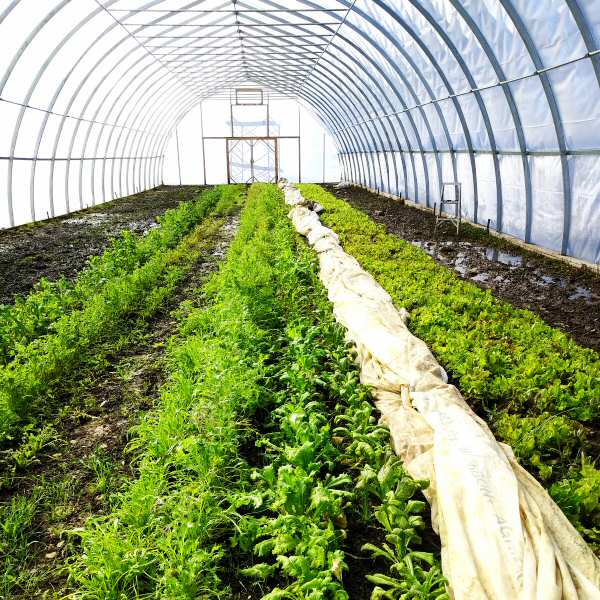
The covers are off and it’s all shades of green! That’s about three months, left to their own devices, living through freezing nights, often around -20°C (-4°F), and a low of -32°C (-25.6°F), under a couple of layers of medium-weight row cover, which means, little light (with the plastic added in, somewhere around 50% of already weak winter sun). Inside, at ground level outside the row cover, the lowest it got on the coldest night was an amazingly not-so-chilly-at-all -13°C (8.6°F). As a simple survival test…excellent!
Looking for leaves
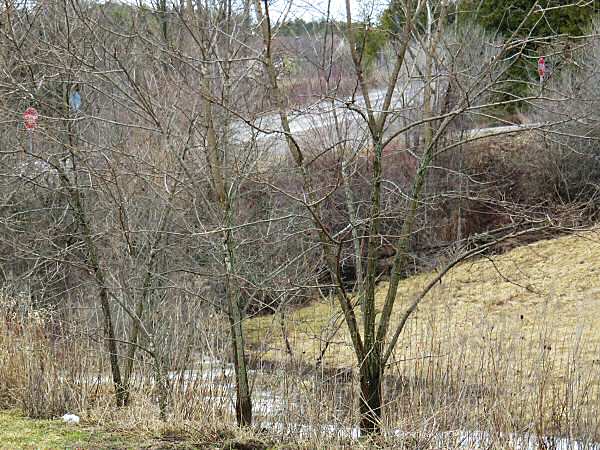
The snow’s gone, replaced by puddles and mud. You can still see the road through the trees—the only aerial green so far is evergreen. An overall browned-out scene, but what’s not in the pic is the vigorous twittering of birds, the tantalizing hint of real warmth in the still chilly air, the slightly musty dampness of winter earth waking up, as the outdoors steadily gets ready to…explode!
Seedlings start here

Staring up close at a stack of 72-cell plug sheets in webbed trays. Exactly where most of the transplant seedlings around here get started…!
Winter salad
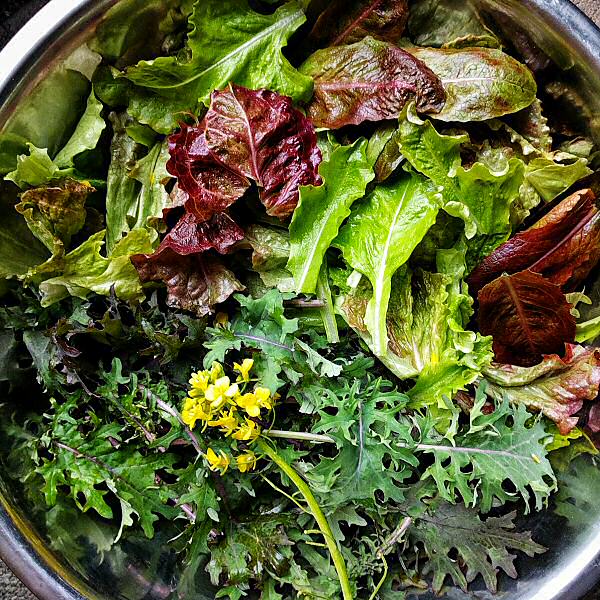
This bowl of lettuces and kale is the first cut of spring, taken from the unheated greenhouse while snow flurries whip around outside. With the help of 6 mils of plastic and some row cover, the salad easily survived three months of winter, with temperatures that went down to -30°C (-22°F). The texture and color are good, the taste, deliciously bold. Fantastic! The flowers are bok choi that managed to bolt in the alternating warmth and cold—on sunny days, the hoophouse temperature could easily reach 10-15°C (50-59°F), even when it was sub-zero outside. Interesting!
First winter harvest
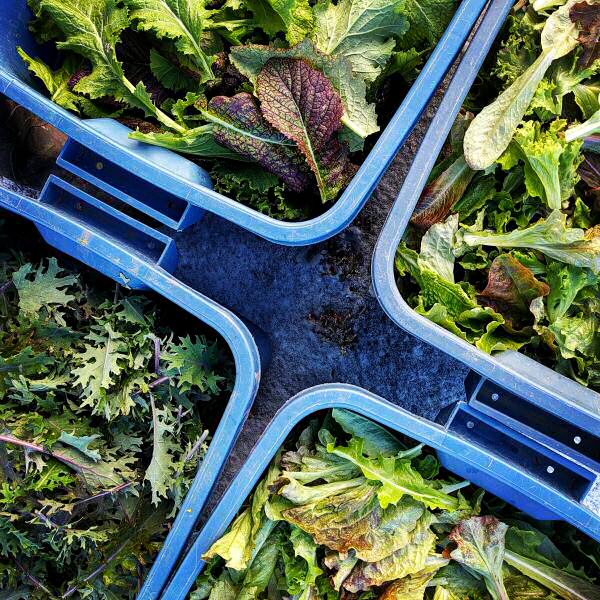
Yesterday’s harvest that went to today’s farmers’ market, my earliest market start by almost two months! From the unheated greenhouse: kale, green and red mustard, and lettuce mix times two. Harvest conditions: -2°C outside, a perfect-working-weather 10°C inside. At the end, the sun came out and it started to get sweatingly hot under a T-shirt, shirt and fleece. But, already done! No rinsing, just covered and into a cool room for a 6 a.m. pick-up this morning. It felt a little odd, starting the year’s Saturday markets so early, and indoors—this fall, if all goes as intended, weekly market will cease to end for winter and become instead a fully year-round thing…