
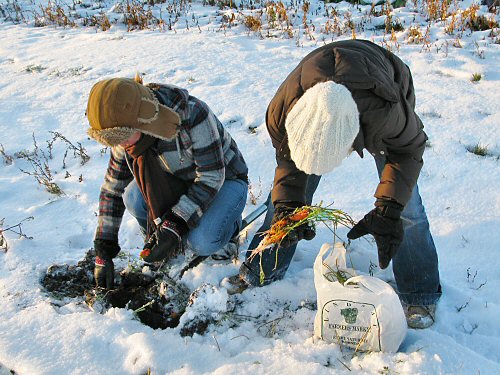
What’s a little snow when there’s crispy-sweet CARROTS buried under there? Lynn (the new Celebrity Farmer) and Raechelle headed up the field late this subzero afternoon, digging forks in hand, and scored sackfuls of Nelson and Napoli, no problem. It’s been well below zero (32°F) recent nights, and for the last couple of days as well, but the ground isn’t nearly frozen, and the layer of snow, fresh from overnight, actually acts as an insulator and helps soften it up. For now… The season’s not over until we SAY it’s over… :)
Harvest
The family that digs together…
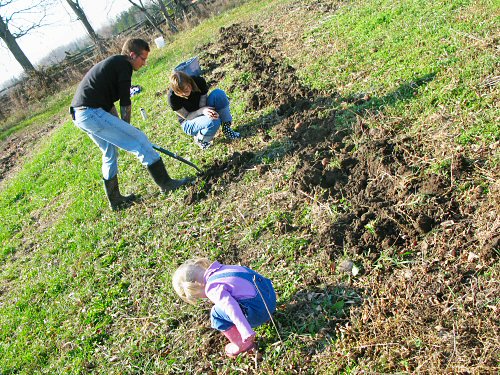
We’re still digging potatoes! Ryan, Corrie and their youngest, Hannah, came out today to salvage some potatoes. There are still a few 50′ (15m) beds of Chieftan and Kennebec. With all the rainy summer and wet ground, a lot of the potatoes were coming up with rotten spots (I heard this from other growers at the farmers’ market as well). With lots of sorting needed, and quite low yield in some rows, I decided to harvest the post-season balance only as needed. I mowed down the whole potato plot and invited anyone who wanted to dig. It looks pretty scary, in this particular spot, grass and other weeds didn’t take long to start taking over, but in the bright sunlight, it seems a lot worse than it is (a bit of tilling and left to overwinter, and it’d be right as rain). To find the treasure, locate a couple of the dried potato stems—they’re short but easy to ID once you know what you’re looking for—then dig in a line! The haul of crisp, red skin-white flesh Chieftan potatoes was pretty good! The fall harvest continues…
Big egg

Every few days, at two dozen a day, along comes one very big egg. It’s hard to see with the chipped paint on the old egg scale, but these big guys take it right off the chart. Beyond measurement by this technology. Poor girls (I think, or maybe not). They’re too big to fit into extra-large egg cartons, they won’t let the cartons close, so I put ’em aside and eat them. They’re pretty big, fat eggs!
Root love
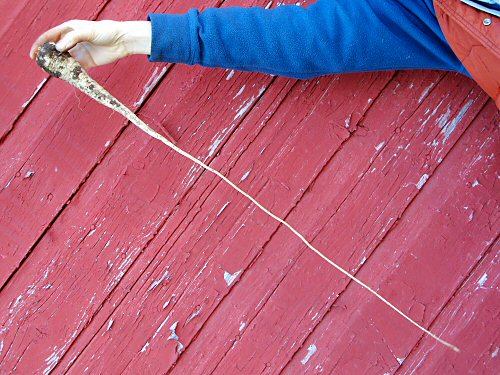
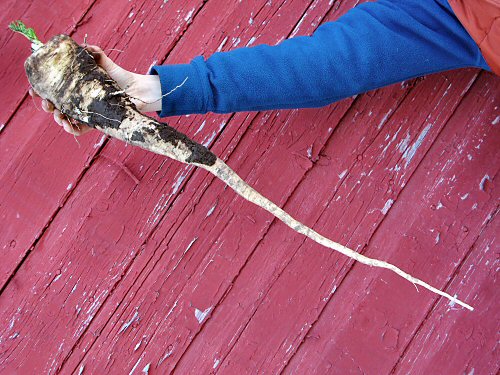
About the last thing anyone is likely ever to see first-hand is the amazing root structure of plants! I’ve been fascinated by the massive size and complexity of ROOTS since I first saw a sketch of a full root system, and way more so after browsing the wealth of technical drawings of garden veggie roots in the fantastic and fully-online Root Development of Vegetable Crops. Root systems can be VAST, but they’re incredibly difficult to actually see since the mostly fine filaments that tunnel everywhere simply break off when you dig up a plant. Today’s parsnip harvest yielded a couple of unusual, still very partial root specimens that only begin to illustrate what’s going on down there. Who knows how just a few managed to come up with so much intact… For parsnips, according to RDoVC, after a season’s growth, “at the 8-foot level roots were common and a maximum penetration of 9 feet was determined.” In the top 10″ (25cm) of the soil, lateral roots extended up to 3′ (90cm). Pretty cool, huh?! (Thanks to hand-and-arm model Lynn.)
The incredible shrinking harvest!
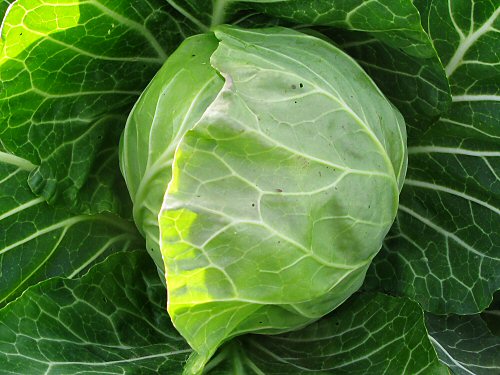
The Friday harvest is shrinking. This is the second to last of the year, and the last for CSA members, and we’re down to mainly root veggies. Some of the last cabbage planting has firmed up, and we’re picking them as “baby,” about 1-2 lbs (450-900g) each (multiplanted, the yield is good, the size really convenient for cooking, and the taste quite fantastic). And there are beets, carrots, parsnips, plus onions, garlic and other storage crops. And some lettuce… As the harvest gets shorter, so do the days, and I’m out rinsing beets and carrots after dark once again. Try not to get wet when it’s COLD…!
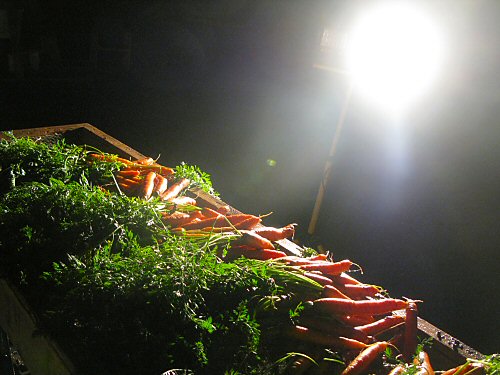
Night work
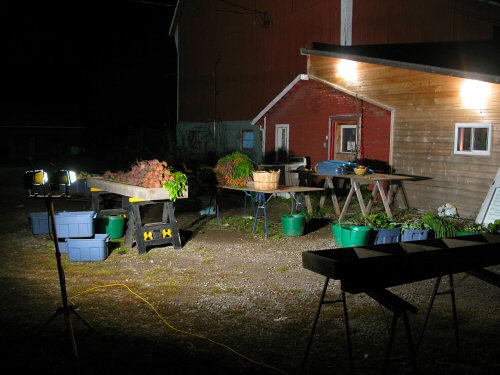
In the fall, post-harvest work doesn’t necessarily end when the sun goes down (it’s dark by about 7:30pm right now). Actually, this year the fall Friday harvest has gone great, with Lynn, Libby and usually Michelle knocking things off in the field by around 5pm, with only bundling and rinsing to go. But I’ve been wrapping up with the crew by 6, taking a break, and doing whatever’s left on my own…later at night. It’s something I’m used to from the first few seasons, when the mainly solo harvest usually went straight through until 11pm or midnight. Tonight was the first time I’ve hauled out the light stand this year. It’s around 10pm, the two lights specally installed on the side of the Milkhouse for this purpose are on (they’re both regular 100W bulbs, the full plan is to install floodlight fixtures), and there are twin 250W all-weather halogens on a stand. It’s not perfect lighting, but quite enough to get the job done without stumbling around. Tonight is a quick set-up to rinse carrots and beets. Full-on post harvest lighting includes a second light stand, with both set higher up and beaming down, and floodlights properly positioned, to give pretty good 360° coverage of the work area, and enough illumination to watch the mud wash off…
Cold-weather harvest
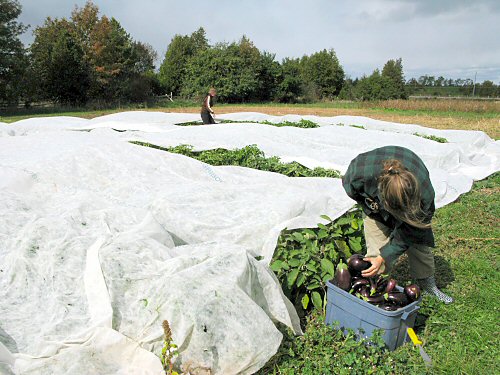
Some days now, the temperature is in the +/-20°C (50°F) range, and nights hover around the freezing point—not that cold, but comparatively so when other days shoot up to summery highs. I’m now keeping the row cover permanently on the eggplant and peppers, they’re no longer out there to grow—not enough sun—the field is now simply a convenient storage system. Picking from under cover, pulling back only as much as necessary, we take what we need for and leave the rest. There’s probably two more week’s worth of sweet and hot peppers, and at least another week of baby eggplant to go after today…
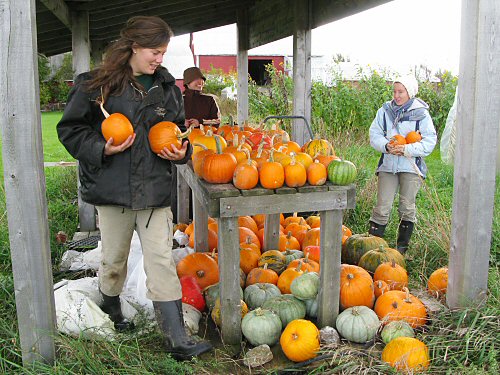
Bundling up a bit kinda seems to be the general choice. Libby and Lynn are in winter outerwear mode, down to insulated rubber boots, while Toshiko, who finds it colder here than at home in Japan, keeps warm with layers. Seasons change…