
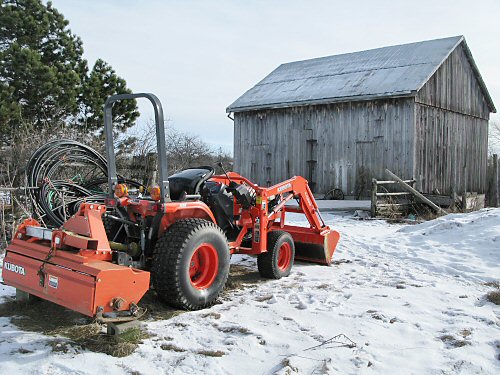
Momentum is slowly building at the new farm. The trusty Kubota compact tractor is on site, there to help out wherever it can. Today, we just about finished the demolition in the barn, which included a small room on the upper level (pounded together with a million 3″ nails), and a stall area in the lower level that looked good maybe for goats. Below, Michael uses a sawzall (reciprocating saw) to cut things up. The sawzall is my favorite power tool of the moment. With a heavy duty demo blade, it sails through wood and nails no problem (you can see the stall poles sawed just above where they’re set in concrete). Sometimes, you have to tear down in order to build—with the right tools, that can be fun. We’re moving along—the new seedling room is on its way!
People
Stacking cages

The backdrop of snow turned the puzzle of sorting tomato cages into a bit of abstract art. I don’t use these exclusively, most of the 500-600 plants each year are tied to stakes or sprawled. But the cages get used, too. After every season so far, I’ve been determined to move beyond these lightweight wire gizmos to a more robust tomato support solution, but come spring and the transplanting rush, I end up with even more of ’em. They work great for the first eight weeks after transplanting, but once the toms really get going, they’re kinda useless, too short and not strong enough to hold up the plants. At the end of the season, they have to be hacked and torn out of the tangle of dead toms. And then, they have to be bent back in shape and stacked, tossing the ones where the rings have broken from the spines. I’d left this last little task till today, and now it’s done: the before (above) and after, around 200 cages, stacked and ready to store. Next season, something new!
Battery change
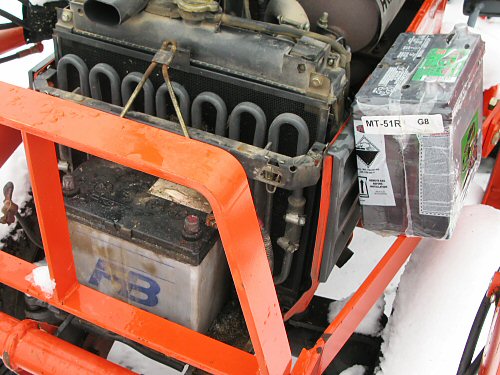
There’s nothing remarkable or even that interesting about changing a battery—routine maintenance on the tiny farm—EXCEPT… Today, I finally got around to replacing the battery, for the first time, on the Kubota compact tractor. It was a quick and simple operation that put instant new life into the trusty little tractor. It also made me realize how fond one can become of a MACHINE. I know this is nothing new: for example, car lovers. For me, though, it’s a first. Like, I love my wheel hoe, but it is such a simple tool, the attachment is more to the idea of it than to the machine itself. The complex workings of the tiny tractor, however, are largely a mystery to me. I can maintain it, and fix an increasing number of things, and I understand the general principles it runs on, but mostly, I simply trust that turning the key will bring it to life. And it hasn’t failed me over the years, faithfully and reliably performing its tiny farming tasks, asking little in return (it’s even good on diesel!). So here I find myself, strangely, with a deep affection for a machine… Cheers! This new $100 Mega-tron II battery is on me! :)
Bringing in the pipe
Bit of unusual fieldwork on the menu today, something we don’t do every year. Bob and I brought in about 1,000′ (305m) of 1″ (2.5cm) and 1-1/2″ plastic irrigation pipe, that ran all the way from the pond to the gate into the garden field. Why wasn’t this done in better weather, when, besides having no snow to deal with, warmer plastic would’ve been a lot easier to handle, especially to BEND? There’s no good answer, except maybe, “Didn’t think it’d be this cold and snowy so soon!” Anyhow, it got done, and probably in exactly the same time…
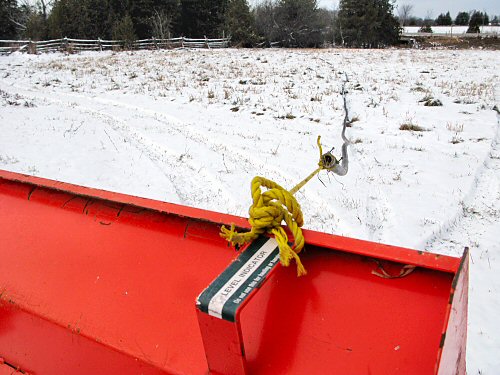
I used the Kubota compact tractor to drag the pipe in three 300′ sections, right into the barnyard (the rope is tied to the front end loader bucket; in the pic, this is at the very end of the garden, where it meets the hay, so all that stubble is mainly long grass). Backing up down the field, I worked it from the far end for the section that lay in the unmown grass right near the fence, so that it could more easily tear its way out of the overgrowth. Then, some coiling (that’s Bob), tying off the loops every few turns with baler twine (plastic twine used to bale hay, it’s all over the place)… Easy!
It’s really cold
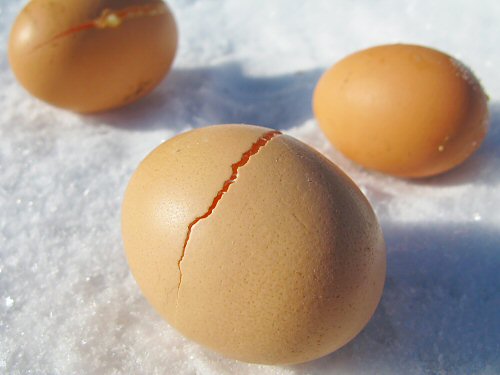
It’s taken a couple of days of this pretty intense cold snap for me to realize it’s yet another whimsical display of the crazy weather we’ve been having for the last six years or so. It’s not that overnight temperatures around -14°C (7°F) are unusual for southern Canada, just not in November. This time last year, there was a ton of snow, but without the unreasonable deep freeze. The winter before, I posted here in mid-January that “winter’s a no-show”—I was still digging carrots! Interesting… Inspired by the cold, I decided to see what it would do to chicken eggs and left a couple out overnight (there was a kinda practical purpose, it’s pretty cold in the chickenhouse). Of course, they froze as hard as hockey pucks. And cracked..
Snow carrot harvest
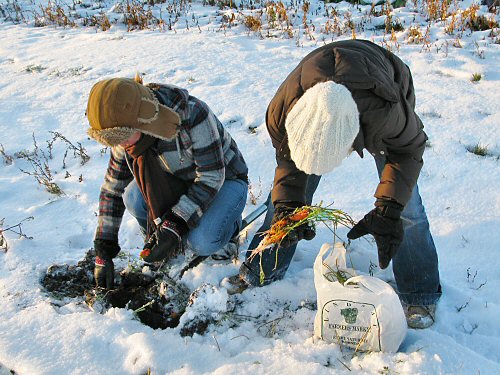
What’s a little snow when there’s crispy-sweet CARROTS buried under there? Lynn (the new Celebrity Farmer) and Raechelle headed up the field late this subzero afternoon, digging forks in hand, and scored sackfuls of Nelson and Napoli, no problem. It’s been well below zero (32°F) recent nights, and for the last couple of days as well, but the ground isn’t nearly frozen, and the layer of snow, fresh from overnight, actually acts as an insulator and helps soften it up. For now… The season’s not over until we SAY it’s over… :)
The family that digs together…
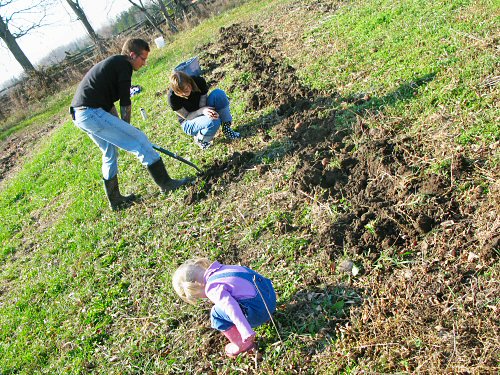
We’re still digging potatoes! Ryan, Corrie and their youngest, Hannah, came out today to salvage some potatoes. There are still a few 50′ (15m) beds of Chieftan and Kennebec. With all the rainy summer and wet ground, a lot of the potatoes were coming up with rotten spots (I heard this from other growers at the farmers’ market as well). With lots of sorting needed, and quite low yield in some rows, I decided to harvest the post-season balance only as needed. I mowed down the whole potato plot and invited anyone who wanted to dig. It looks pretty scary, in this particular spot, grass and other weeds didn’t take long to start taking over, but in the bright sunlight, it seems a lot worse than it is (a bit of tilling and left to overwinter, and it’d be right as rain). To find the treasure, locate a couple of the dried potato stems—they’re short but easy to ID once you know what you’re looking for—then dig in a line! The haul of crisp, red skin-white flesh Chieftan potatoes was pretty good! The fall harvest continues…