Tossing onions

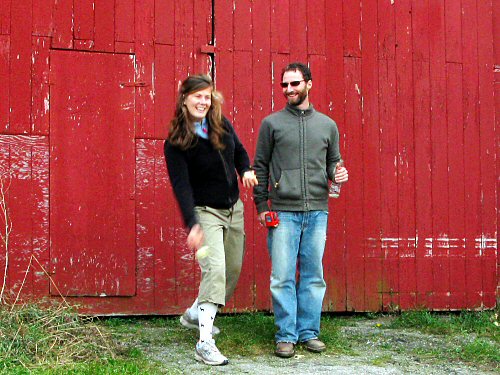
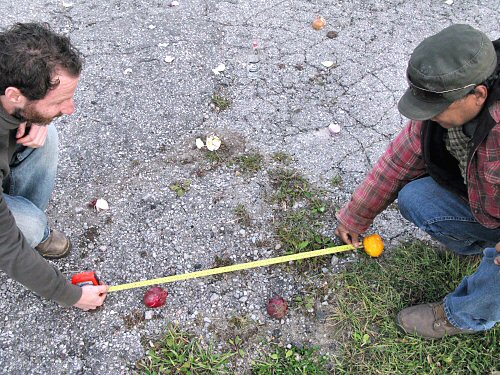
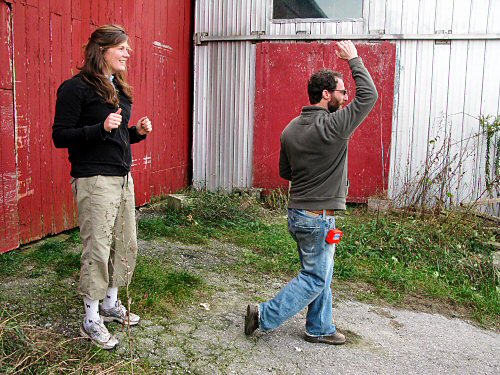
Well, Friday harvest is over…what to do? A few onions and a little winter squash you’re  set for ALL-TERRAIN ONION BOCCE. Libby used yellow cooking onions (Stuttgarter), Grant took a mild white (Superstar), I went red (Red Wing), four onions each. A stunted orange acorn squash (Table Gold) served as the target ball. Toss away!

The rules are simple: the player with the closest one or more onions to the squash scores a point apiece. The all-terrain part means the winner of a turn gets to toss the squash anywhere. We played up and down the gangway to the barn, through gravel, long grass, chicken hazards (roosters peck onions)… Good thing no-one got really competitive, ’cause onion bocce is pretty imprecise, what with eventually exploding onions (largest piece counts), and ragged edges that make down-to-the-millimeter measuring kinda futile. Still, we did get out the tape measure… Wholesome outdoor fun on the farm. With veggies. Must be a new age of innocence! :) (Guest measurement photo by Libby)

Root love

Parsnip root

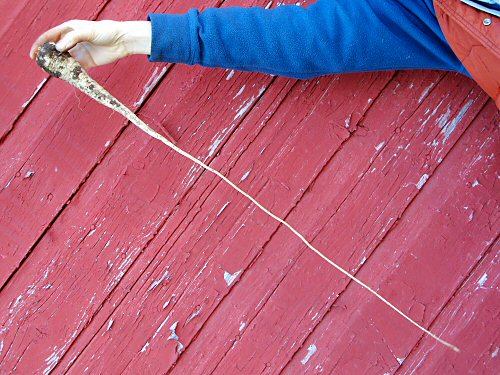
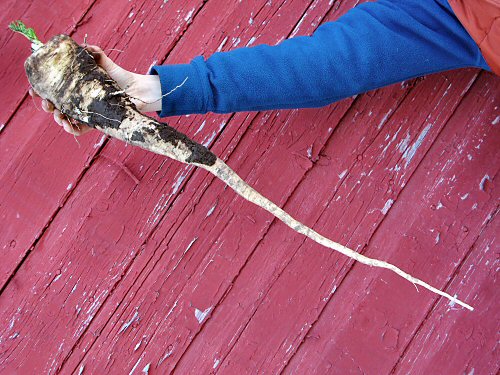
About the last thing anyone is likely ever to see first-hand is the amazing root structure of plants! I’ve been fascinated by the massive size and complexity of ROOTS since I first saw a sketch of a full root system, and way more so after browsing the wealth of technical drawings of garden veggie roots in the fantastic and fully-online Root Development of Vegetable Crops. Root systems can be VAST, but they’re incredibly difficult to actually see since the mostly fine filaments that tunnel everywhere simply break off when you dig up a plant. Today’s parsnip harvest yielded a couple of unusual, still very partial root specimens that only begin to illustrate what’s going on down there. Who knows how just a few managed to come up with so much intact… For parsnips, according to RDoVC, after a season’s growth, “at the 8-foot level roots were common and a maximum penetration of 9 feet was determined.” In the top 10″ (25cm) of the soil, lateral roots extended up to 3′ (90cm). Pretty cool, huh?! (Thanks to hand-and-arm model Lynn.)

Farm video

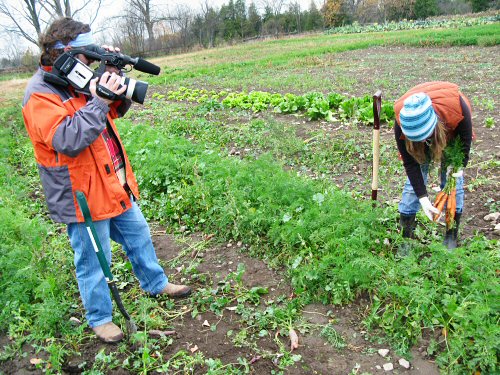
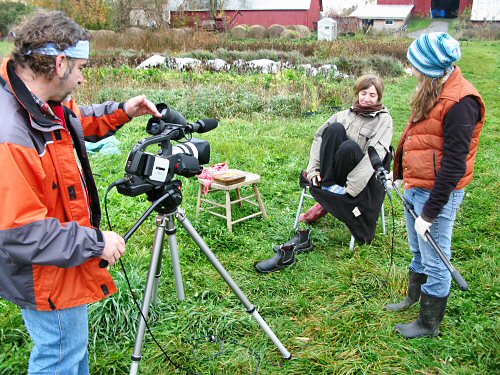
A bit of unusual activity in the field today, a mini-video interview! Raechelle and Lynn brought their friend David, who brought some video gear. The whole thing was casual, the video being mainly to record our impressions of tiny farming for a possible magazine article. Still, with the tripod and the boom mic, a certain “we’re on TV!” flavor hit the field for a couple of hours. We each did a sit-down interview (it was fun watching Lynn rustle up sound bites to describe the simple pleasures of…fieldwork), then David taped some atmosphere: digging carrots, chasing chickens,… And we had cake! Earlier this season, we had our own, self-styled, TFE version of a photo shoot for a newspaper article. Now, this! Are we becoming increasingly…media-friendly?! ;)

Allie’s photo gallery

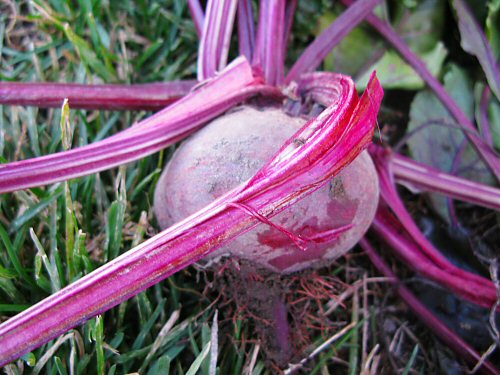
Without much thought, I handed visiting Allie my camera and let her take pictures around the farm. After she’d disappeared from sight, I did start wondering if the camera—500 bucks to replace—was safe. But if this six-year-old can, just from watching, efficiently harvest sweet potatoes with a digging fork about as tall as she is, she should be able to handle a point-and-shoot, right?! Right! First, I showed her what button to press to take a photo. A few pics later, I showed her how to use the autofocus (“point at whatever, hold the button down halfway till it beeps, wait till the rectangle turns green, then push all the way!”). That went well, so I showed her when and how to switch between normal and macro mode (“turn the dial when you want to shoot up close”), which is how she shot the Bulls Blood beet (above). Wow, that was easy!

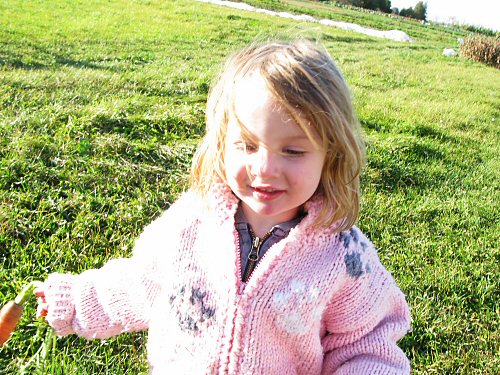
She took around 40 photos in all. Above, mom Michelle rinsing beets, below, her little sister Violet, with carrot. Kids, digital technology, and the field…all part of the TFE! (Guest photos by Allie)

Middle of the day at the market

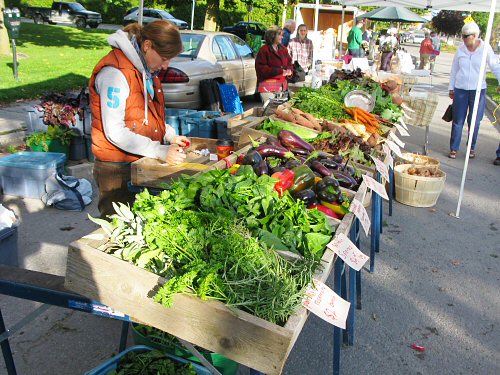
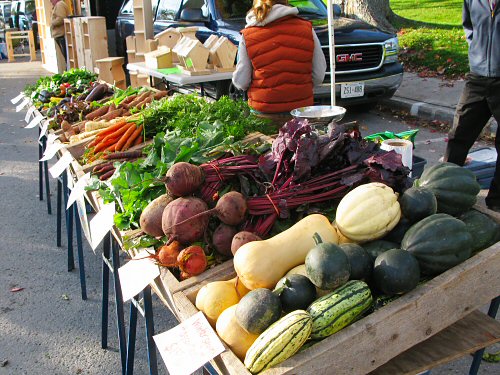
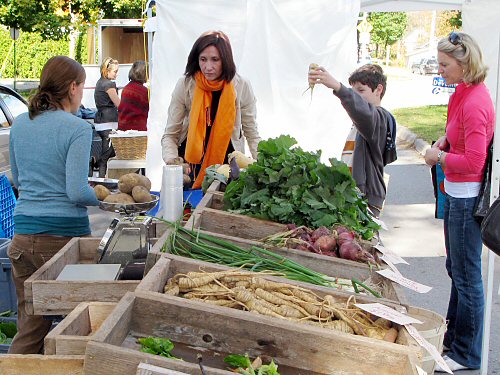
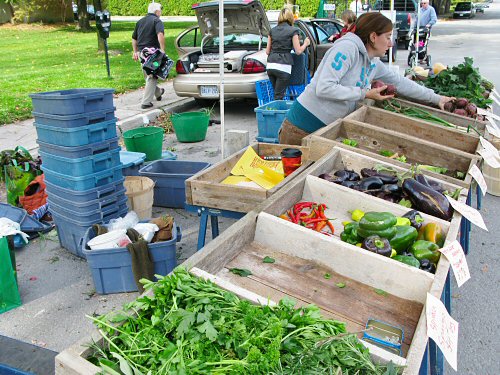
Here’s another slice of the action at the Saturday farmers’ market: recent market posts covered the beginning and the end, this is…the middle. In the first two pics, it’s about 9am—the market’s been open for two hours, but in colder weather like today, most people start showing up about now. This is the first time we’ve extended the stand by adding a new section with four more bins, quite an occasion, since I’ve been using the same 7-tray set-up for five seasons, almost since the beginning. It’s also the last day of tender crops, with a final harvest of eggplant and peppers. Lynn, vested against the chill, in the first pic looks like she’s making up more signs: red market on light brown card stock…

The shallow trays are easy to fill, it doesn’t take much to create a nice display. As things are sold, the display is refreshed from bins kept in the shade. The trays aren’t ideal for all veggies. Winter squash are harder to sort through, but there’s also a full assortment in bushel baskets that people can look through, with the trays more for display…

Jump ahead to about 11:30. It’s warmed up considerably, into a beautiful, summer-like day. This is Canadian Thanksgiving weekend, and the traffic has been pretty good. Traffic has died down in the last half hour, some crops are sold out, but people come by till the end…

It’s now about 12:40. The market ends at 1, and we have until 1:30 before the street is opened up again. Most vendors start packing up early, around 12:30, but we always wait till the official end. Today, we’re pretty well sold out: the only veggies left in a bit of quantity compared to what we started with are some mostly very tiny eggplant, curly and flat-leaf parsley, Red Russian flat-leaf kale, and some winter squash. With things like kale, not exactly a universally popular green, sales are inexplicably random: usually low, but on some days, you can’t have enough. So, you always bring as much as you can (within reason!). Anyhow, a really satisfying and fun market day is almost done…

Bus stop

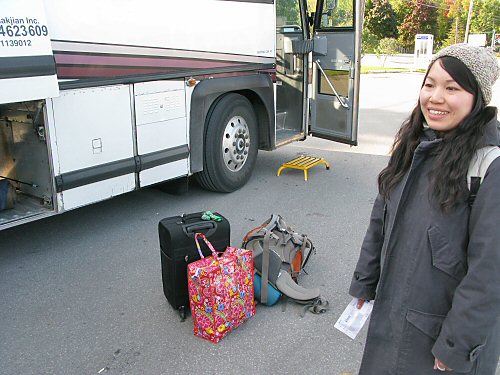
We drove Toshiko to the bus stop in town this evening. After her two weeks on the farm, trimming garlic, digging sweet potato, slinging veggies at the farmers’ market, she’s heading out again, first to Toronto and then Montreal for a few days of sightseeing, then on to the southern US and Mexico for the winter. After that, she plans to continue studying English in Vancouver for an extended period, before heading back to Japan. With the WWOOFers of the last couple of seasons—from Japan, Germany, Spain—there’s definitely been an international flavor on this very local, tiny farm. It’s fascinating to think about how far these hands have come, to do simple tasks in a field for a while, then vanish down the road. As a non-driver, growing veggies full-time for sale very nearby, I have minimal direct involvement with travel. But its effects are all around and often on my mind. I find myself calculating the distance people drive to get to the farm or the farmers’ market. I’m alert to the increasing number of Mennonites clop-clopping by with horse-and-buggy. I think about the routes traveled by the tools and supplies I pick up at the big chain stores in town. I sometimes imagine leaving the farm, on my own and without driving, catching the once daily bus that would plug me back into the world of cities (at least two-thirds of the PLANET now lives in cities!), where travel is condensed to nothing. Standing with Toshiko at the bus stop today kicked up a lifetime of memories of big city living, the oddness of flying across an entire ocean in a few hours, sometimes with hardly a day’s notice and not a second thought, and then the last few YEARS spent tending a tiny patch of FIELD, barely moving beyond a single line of sight. Hmmm… What a wiggly world. :)

Cold-weather harvest

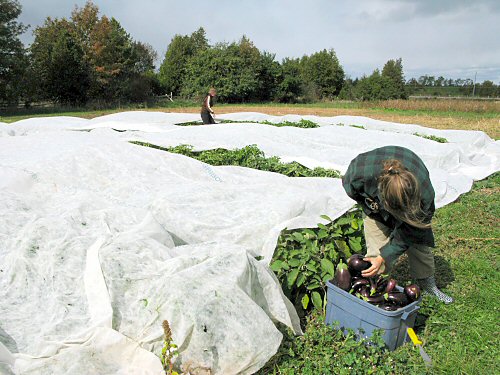
Some days now, the temperature is in the +/-20°C (50°F) range, and nights hover around the freezing point—not that cold, but comparatively so when other days shoot up to summery highs. I’m now keeping the row cover permanently on the eggplant and peppers, they’re no longer out there to grow—not enough sun—the field is now simply a convenient storage system. Picking from under cover, pulling back only as much as necessary, we take what we need for and leave the rest. There’s probably two more week’s worth of sweet and hot peppers, and at least another week of baby eggplant to go after today…

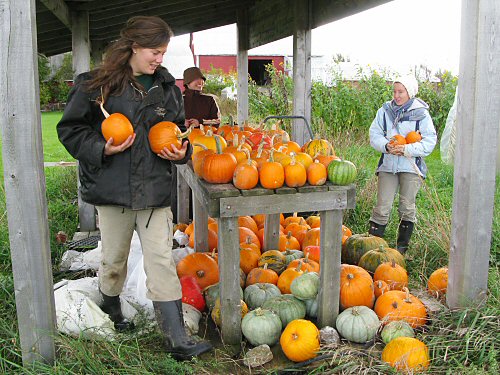
Bundling up a bit kinda seems to be the general choice. Libby and Lynn are in winter outerwear mode, down to insulated rubber boots, while Toshiko, who finds it colder here than at home in Japan, keeps warm with layers. Seasons change…