
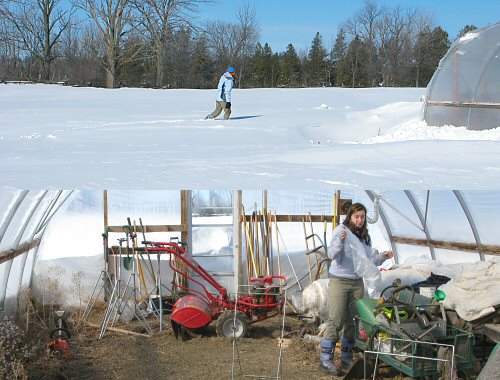
Last seen planting garlic in November as we headed into winter, Lynn is BACK IN THE FIELD, getting a head start on spring. It was great to see her again and…continue! We headed out to the greenhouse and spent three hours or so, bagging the last of the grass mulch, pulling weeds, forking beds, chatting and basking in the sunshiny, 25°C (80°F) greenhouse weather! I also brought out a tray of arugula, couldn’t resist posing it in the snow… It felt excellent to get started out there. Fun!
Seed & Seedlings
Celery!
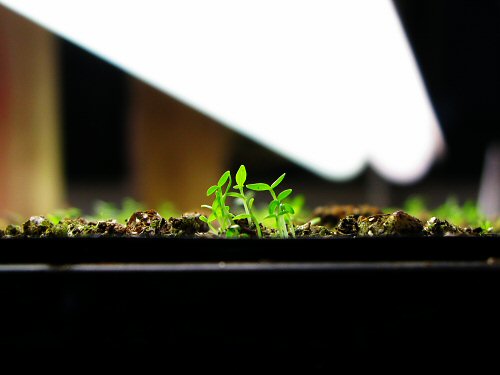
Celery has been surging up over the last day or so, 10 days after seeding. This is Utah 52-70, a pretty common variety. Celery is a member of the carrot family (Apiaceae), along with parsley, parsnip, fennel, Gotu Kola, caraway, cumin, CARROTS, cilantro/coriander, chervil, dill, anise, hemlock. Cool family! It also has a reputation for being hard to grow: maturity in up to 4-5 months, cold-sensitive seedlings, needs lots of moisture. Any two of those three can make it a challenge in this garden, especially with the crazy weather. As great as it would be to grow, celery hasn’t been high on my list! Well, it’s started now, and we’ll see what happens…
Seedlings continue to grow…
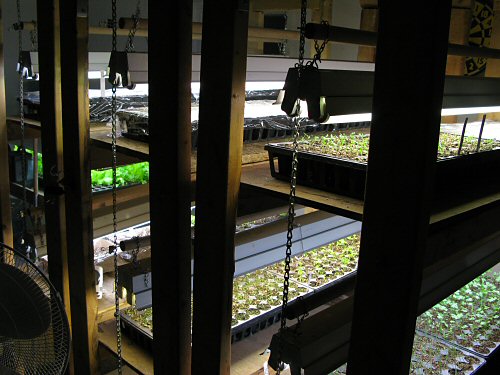
Seedling production is on about the same schedule as last year, except there are a few new things on the go: celery, onions, leek, celeriac. The three grow racks aren’t yet full (and there’s a fourth to build), but all that will change in a couple of days, when peppers and eggplant start. This is also when gambling on the weather begins, which at this point affects when I choose to start certain crops. Already, based on the 15-day forecast, it looks like a much colder March ahead than in the last couple of years, and with all the snow cover, a quick thaw towards the end of the month will still mean a few extra days of drying out time. And then there’s April to “consider”—it’s all basically pure guessing, colored by a little wishful thinking. IF there’s gonna be cold and snow for a good part of April, early transplanting will be delayed. So, starting some things in a couple of days, or in a week, or in two weeks, could make a fair bit of difference. If I have to hold things for an extra 2-3 weeks, there won’t be room under the lights as I start more, and out in the greenhouse, given real sun, growth will be quicker and the seedlings will get crowded. And so on, tons of little calculations and gambles… Nothing is THAT critical, but a little more work here, a little crop slowdown there, it all adds up. I enjoy this, juggling increments in the face of the weather, but it could drive some people into quite a state! :)
Trimming leeks
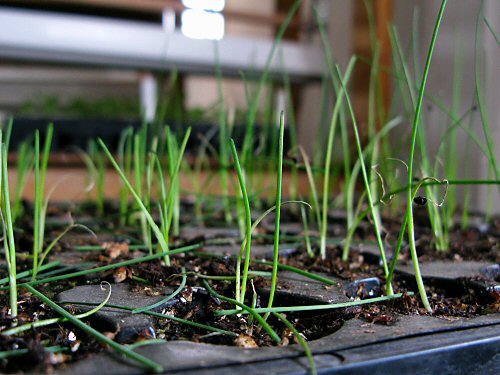
Trimming back leeks is really satisfying. Here, I’m doing the first planting. With most indoor veggie seedlings and my two-lamp fluorescent fixtures, it’s lots of tray rotating and light height adjusting to keep the stretching to a minimum.
Leek can reach all they want: at three inches (7.5cm) or so, I snip them back to about an inch (2.5cm). What could be simpler?! This goes for the onions coming up as well.
With nice low seedlings, the light can be better concentrated across the trays, and cutting back may ensure stockier growth, which is generally a good thing when it comes to seedlings (update: I read a pretty definitive-sounding study that disproved the growing-stockier part; either way, it’s worth trimming just for keeping them closer to the light).
This is the first year of starting both leek and onion indoors from seed (in the past, it’s been direct-seeded leek, and onion sets)—I’ve not actually DONE this before—so there’s the usual slight bit of reservation with trying something new. Seeing is believing. Fun (easy) so far!
Elsewhere, we got what looked like a foot of snow overnight. No problem, no extra work, except the lane, barnyard and path to the greenhouse had to be plowed again…
The wild bunch
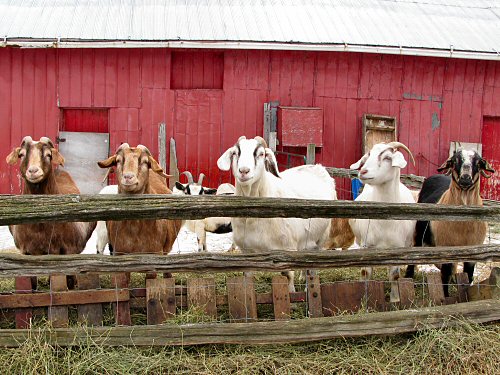
Mainly mucking about today. Visited with the goats. Around 15 of ’em. These girls upfront are the current kingpins of the goat yard. Goats have their pecking order (just like the chickens to come!), which mainly means a few get first crack at food, or crowding at the fence, or whatever else they all want to do, while the rest back away and wait or get butted. It’s mostly rank by size, but a vicious streak counts, too. The one in the middle is on top now (with her friend on the right), the brown pair on the left (the Evil Twins), used to be a vicious tag team running the yard, but they lost their edge. Not that they’re always fighting, a brief burst of deterrent action goes a long way. It’s like a soap opera if you watch ’em every day. Goats…
Every year, this little period in the first half of March is kinda like waiting for the starting gun. I’m full of energy and waiting on the weather. A little EDGY. All the early starts are now under lights: onions (first time from seed), celery (another first), more leek and parsley, plus the stuff started around the end of January (leek, parsley, rosemary, arugula, lettuce). It’s another week to the peppers and eggplant, and then the grow racks will start to get full, and I’m also holding off till then to transplant the early lettuce to the greenhouse. As soon as the snow clears and the temperature warms up a bit, there’s outdoor fix-it work, starting with an old ice fishing hut to turn into a home for the composting toilet (an outhouse for the field!) and the chickenhouse to renovate. There’s a list. Plus a lot of garden clean-up, crops left over winter, that should be pulled as soon as I can. MEANWHILE, I’m waiting…
More fun with lettuce
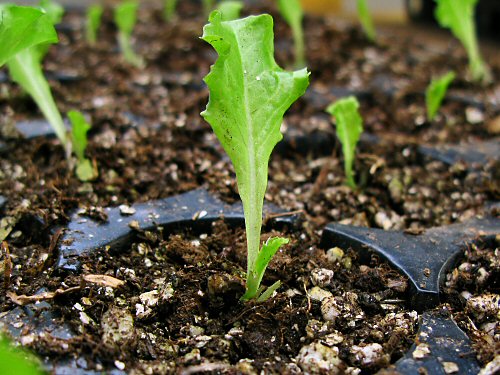
Some of the early lettuce I ended up leaving two to a cell, to see how they’d do. Now, I divided a bunch of those and potted them up singly to a much roomier 38-cell plug sheet (up from 72), and trimmed off all their leaves (and ate them). After the shock of transplanting straight from indoors to the greenhouse, the lettuce seedlings usually lose their bigger leaves anyway, so why not give them a head start?! It’s extremely time-consuming, all of this careful repotting and trimming—not practical for the market garden at all. But I know I’ll be closely watching the results of this early, cold-hoophouse planting, so I’ll see if they do better than the regular plugs. Later on in the season, I intend to keep experimenting in more practical ways, but time and many other things to do have their way with the best laid plans… (Hint: As a rule, it’s best to start seedlings in the biggest and DEEPEST container that you have room for in good light, and avoid potting up. The less you disturb roots, and the more room you give them to grow (especially, down), the better they seem to do when transplanted.)
Two arugulas
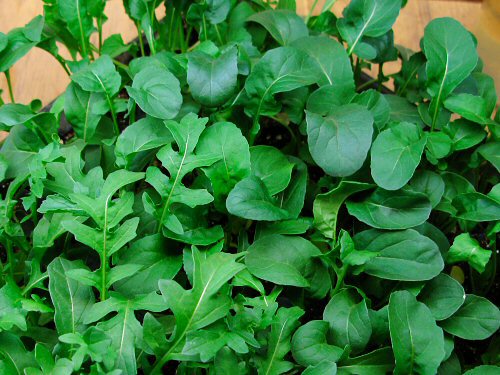
The arugula, about a month from seeding, is looking lush and…TASTY. While fiddling with macro focus and tripod (I’ve been using a borrowed one lately for indoor pics), I reached around to pluck a leaf. And another… I’ve been wandering back all morning for quick tastes. You either like arugula, or you don’t (can you be MADE to?)… It’s an easy, not subtle, veggie rush: first the familiar arugula flavor with that hint of mustard, slowly building as you begin to chew, and suddenly—wait for it—BAM, a little peppery explosion. I’m fairly new to this treat, it’s only since tiny farming that I paid attention, though I knew the taste, and only last season that I grew it out of salad mix, as a separate crop. It’s still a bit of a novelty. Here, the two varieties, somewhat generically named Rocket (smoother-edged), and Skyrocket, have quite different leaf shapes, but so far, I don’t think I could tell the tastes apart. These are two to a cell, and heading out to the greenhouse in the next week or so… (I should note, arugula grows fast, you can usually start harvesting 30-35 days from seeding, so planting this early indoors wasn’t exactly necessary, just a pre-season experiment.)