Inside and out…

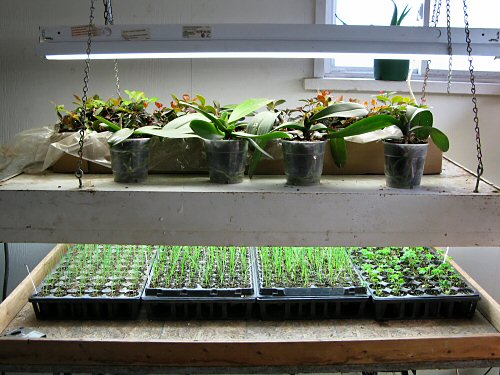
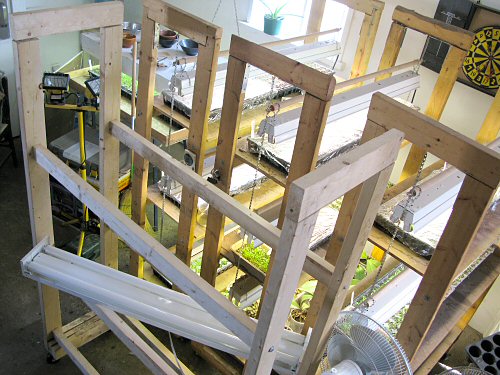
Inside, in the increasingly GREEN Milkhouse, this year’s artificial sun set-up is done. It’s about fitting in as much area-under-lights as possible, while making sure all of the trays are easily reachable, for watering, rotation, thinning. So, there are the four grow racks, and the lightbox (that’s leek, onions and parsley under there), with its second level (why waste a flat surface that comes with chains?!). For now, this extra space is the new spot for the rescued-and-passed-along decorative plants (the heather was too dried out and didn’t make it, the wintergreen are doing fine, and the orchids seem OK…), but they’ll eventually be crowded out and moved somewhere else. The shelves are filling up fast… MEANWHILE, outside, it’s snowing and snowing, again. That’s a lot of snow. Around here, we’re definitely off to a later start this year than at least the last couple, but I’m still not particularly put off, not just yet. Although, it’s not supposed to warm up for another week, maybe two…

This is today’s peaceful but uninspiring view of the garden from the north-facing Milkhouse window…
Rack built

New lumber turns into new grow rack. This adds a fourth to the set, a measure of tiny farm growth. I started with two in Year 1, built another one last year (Year 5). It’s not like the focus here is on rapid expansion…this is the speed of staying tiny! ;)

Although I don’t build these often, it seems to get quicker every time. Well under a hundred dollars of wood, wheels, screws, bolts, brackets, hooks and chains, plus a chop saw, a drill and a couple of hours, and there it is! Light fixtures are extra. In the pic, the shelves still have to go on.

Lying across the middle supports is one of the four old fluorescent fixtures, given to me instead of being tossed in the trash. Not only free, they’re BETTER: these are the overhead lighting type you see in (horribly lit) offices, the tubes are spaced farther apart than in the standard shop lights I’ve been using, the light will spread more evenly over a larger area—for the seedlings, a lot less leaning and stretching…

Peppers!

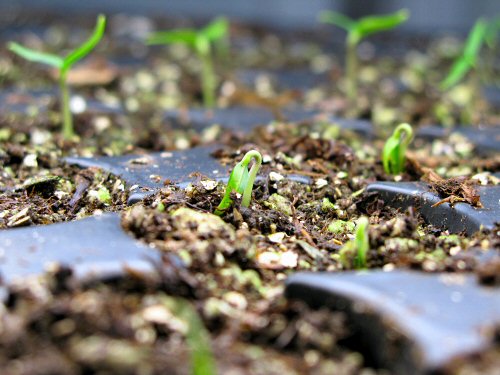
Another little new-season milestone: the first of the original veggie gang has appeared. These are Gypsy (hybrid) sweet peppers, seeded six days ago, along with other varieties of pepper and eggplant. They started to poke up in the last day or so, and by this morning, the first leaves had unfolded. Along with tomatoes (soon to be seeded), I think of these three—toms, eggplant, peppers—as my original crops. These are the veggies I started first (and way early) in Year 1: winter was storming along outside, while these brilliant little splashes of green were popping up in the warm, bright bubble of the first seedling room (a side room in the farmhouse). I was fascinated and kind of amazed. I used to come downstairs in the middle of the night to check ’em out, make sure they were still alive and growing… Actually, it’s not so different even now! :)

Seasonal salad

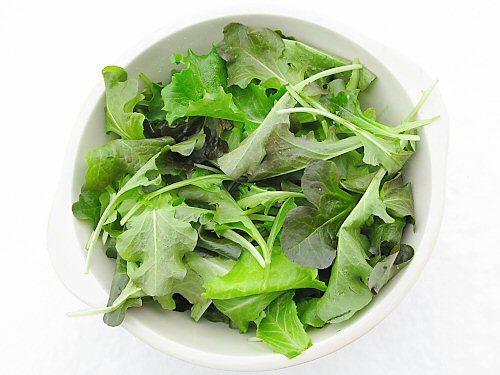
The first harvested dish of the year here usually comes from early lettuce, but not usually from lettuce still in plug sheets. With my ambitious early salad greens timing, and the way colder than hoped for weather, transplanting to the greenhouse was delayed by a couple of weeks, and the lettuce seedlings stayed in trays and went crazy. Today, I started thinning them heavily for the move, and ended up with a healthy portion of baby leaf salad! This is a mix of Simpson Elite, Granada, and Two Stars. The colors are still indoors pale, the taste and texture delicate. With a simple olive oil and lemon juice, salt and pepper dressing…delicious! And still a couple more bowls to go…

Arugula under cover

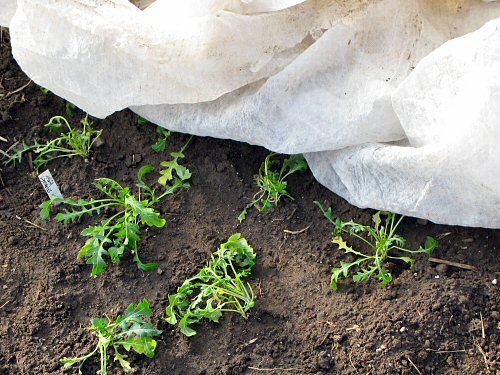
Last night, the greenhouse low was a chilly 5°F (-15°C): the arugula, spending nights under 3-4 layers of floating row cover, still seems to be doing fine. Especially with more extreme transplants like this—a long time in the plug sheet, then an abrupt jump to the harsh greenhouse conditions—there’s a critical period of a few days, waiting for the stressed little plants to settle in. Cover at night, uncover in the morning, till the weather warms up…

Back in the dirt!

Transplanted the arugula from the end of January into as small a corner of the greenhouse as seemed to make sense, two plants to a plug, about 6″ (15cm) apart. There’s no space to waste, and these guys, already a long time in trays, will likely be ready too early for market (first Saturday in May). So, another experiment in early planting, but leave room for others! The arugula has been out there in the plug sheet for a couple of nights, surviving 10°F (-12°C) nights under a few layers of row cover (an extreme rapid hardening off!; as you can see in the tray, a few much smaller seedlings, started in mid-Feb, didn’t do so well, most of ’em got toasted the first night). And now, the survivors are in the ground, free at last, in full sun during the day, and recovered at night. It felt great to put hands in the soil, first time this year. Mmmm…

The watering tray

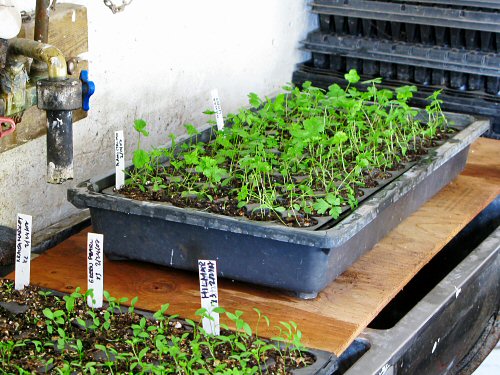
It’s funny how almost random objects can become practically indispensable tools. Like this rigid gray tray, given to me a while back, just the one, amongst a mixed bunch of plastic flower pots from bedding plants, passed along by a local gardener. For four seasons, I’ve used it to water the seedlings (all parsley in the pic): in goes a plug sheet in its webbed tray, sit for 10-15 minutes, then out to drain for a bit over the sink, and it’s back to the grow racks, good for another few days. I’ll keep this up until the seedlings are well-established, three weeks or more, depending on the crop. Perfect, except, at one point I’ll have maybe 50 plug sheets going at once, which means a lot of moving trays and tracking soak time. Not too efficient. I’ve been meaning to build a bigger watering tray, that can handle four or six plug sheets at a time. But I haven’t yet. As odd as it sounds, I’ve grown…attached to the one-at-a-time approach, and this particular, perfectly sized, always reliable gray tray! Every planting gets its own bit of focus each time it’s watered, developing its own little story on the way to the field. It’s part of the fun. Doing batches will be much quicker overall; the attention to what’s in each tray will be slightly less. Not a bad thing, there’s always lots to do with any extra time—continually improving by increments is also a main part tiny farming. With more seedlng starts this year than ever, I suppose I will build that bigger tray… Progress… ;)