
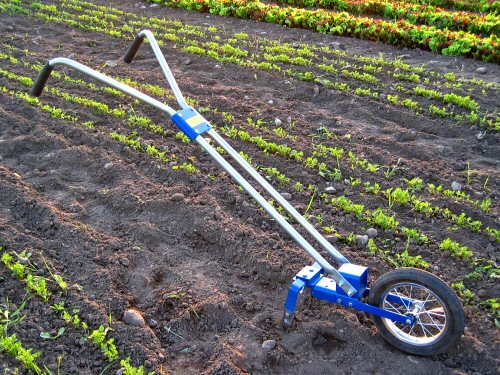
Finally, the new wheel hoe arrived today from the Valley Oak Tool Company in California! This simple and amazing garden tool is so little known in these parts, I had to order it from another country… I hadn’t used one before, but I had a very clear idea of how it should work, and it didn’t disappoint. You walk it along, pushing with minimal force, and the blade slices through the soil, beheading all weeds in its path. With ease. A slight arm adjustment translates into precise depth control, and the double-edged 8″ blade works on a back-pull as well. Even fist-sized rocks (a constant feature in this field) don’t phase it, they simply slip through the hoop. It’s at least 3-4 times faster than hand hoeing, and it matches the Horse walking rototiller for path clearing, minus the noise and gas. Amazing! (In the numerous shipping documents, I liked the note to Customs from the toolmaker, an organic veggie farmer himself: “Please let this package be delivered ASAP. There is a farmer awaiting his new tool.”)
Veggies
After the rain…
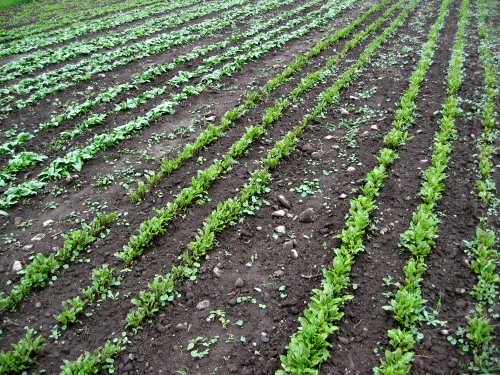
After a rain, it’s easy to see exactly how much work is ahead in the organic field! The dark wet soil and the flat light of a cloudy day make every detail stand out: weeds exploding, dense rows that’ll need thinning (thanks to the generous Earthway seeder), rocks to get in the way of hoes and tiller both. But it’s usually better than it looks. Here, the Horse tiller can be walked up each path in about a minute. Thinning the beets (first two beds on the right) is actually a harvest of excellent beet greens. The rocks, well, the bigger ones just have to be picked. The worst is in-row weeding, for stuff right in with the crops. This has to be done mostly by hand, but if you get the worst spots, the veggies soon grow to where they can more or less fend for themselves, shading out new weed growth. Or the crop is soon finished (like spinach, on the left) and the whole bed can be tilled up. With a little thoughtfully directed labor, it all works out! (We got 15mm (3/5″) of rain… Not bad.)
Found onions
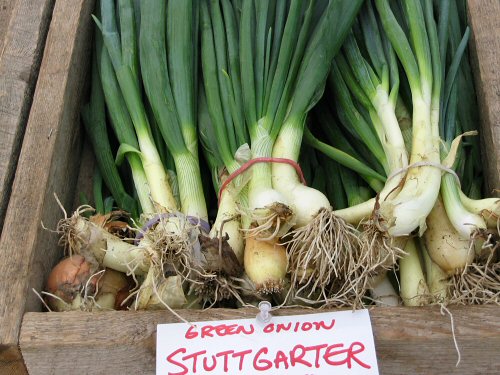
There still wasn’t much to take to the farmers’ market today, mesclun and radishes both weren’t ready, so it was baby spinach, the last harvest of early lettuce, and this surprise crop, volunteer green onions sprouted from a few dozen of last year’s cooking onions that had been overlooked in the field. I made a last minute decision to harvest them at 6:30 am, just as we were about to leave. I pulled them up—no time to dig—and filled a bushel bin in just a few minutes. At the market, I explained how they were grown and that they’re stronger tasting than regular bunching onions grown from seed. They were snapped up in no time. One of the great things about taking fresh veggies that you’ve grown yourself to market is that you’re not forced to conform to standardized tastes and sizes and appearances. So long as quality and freshness are consistent, unusual offerings provide a cool extra bit of variety and freedom all around!
Tomatoes to the field
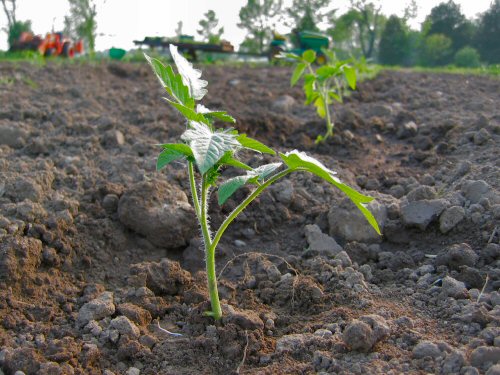
Go team… Set out another 400 tomatoes today: add a fistful of compost, bury to topmost leaves, water in. Along with the peppers and eggplant transplanted yesterday, most of the early seedlings are now in. There is still a lot to go, but it’s all coming along…!
Cucurbits germinate!
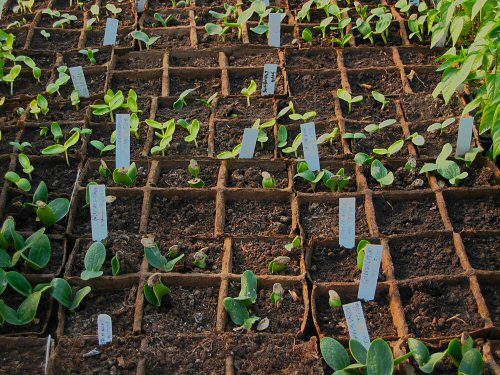
The heat-loving squash-melon-cucumber family are the last of the seedlings to be started. They’re coming up now and headed for the field as soon as they’ve fully emerged, no waiting for true leaves. Depending on the crop, each pot has 2, 3 or 4 seedlings to be transplanted together, with extra space between pots. This replaces single planting and spacing, which saves transplanting time and makes early cultivation easier.
Fieldwork!
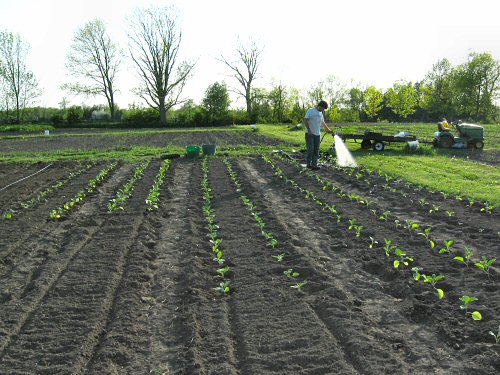
Towards the end of the day, Conall waters in newly transplanted eggplant and peppers. Over the last week, focus has moved almost entirely to the open field. The seedling room is empty, the last of the seedlings are now in the greenhouse, and the push is on to get things in the ground as quickly as we can. My juggling of HELP is on-going. Word-of-mouth recruiting has gone surprisingly well, there’s quite a list of willing workers, and it’s tempting to call in a whole crew to transplant all at once. On the practical side, having to explain and coordinate takes a lot of time, I don’t yet have a System that works for several people in the garden at once, so I’m going along more carefully, working with Conall and at most one or two others per day. And one can’t forget the budget. In any case, everything should be in over the next 10 days. Think fast, take it slow!
Spinach grows up
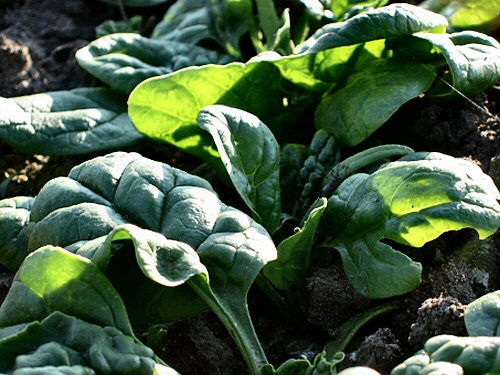
What a difference 21 days or so makes…to spinach. Spinach, mesclun and radishes all have a shot at sizing up as first field crops to harvest, for next Saturday’s market. Today was satisfyingly busy, with lots of new seeding, on-time weeding, and manual irrigation of recently seeded beds (aka watering in with a hose and fan spray nozzle)… Compared to previous years, there’s an incredible amount of stuff on the go already. Extreme gardening?!